Projection
Best Projector Screens for Churches
Quick answer
Size the screen by the six times rule: the furthest seat sits no more than six screen heights from the surface. A back row 37 feet out needs a 150 inch diagonal, which is 6 feet 2 inches high. The Elite Screens Sable Frame B2 150 inch at $575.00 is the one most churches should buy.
The screen is the cheapest large improvement available in church projection and the one churches most often undersize. Legibility at the back row is a function of character height, and character height comes from image height, which is why a bigger screen on a modest projector beats a brighter projector on a small one almost every time. The rule is simple: the furthest seat should sit within six screen heights for lyrics and sermon points. Measure the room, run it through the screen size calculator, then check the brightness that size demands with the projector lumens calculator, because a larger screen spreads the same lumens more thinly. Dimensions below come from published manufacturer specifications.
On this page
- What size screen does your room need?
- Fixed frame, pull-down or motorized, and how to decide in one question
- Small church or shared room: $292 to $380
- Dedicated sanctuary, permanent screen: $352 to $575
- Large or multi-use room, or a room full of daylight: $766 to $858
- The screens compared
- Screen height, sight lines and the mistake nobody catches until it is installed
What size screen does your room need?
Measure from the screen wall to the furthest seat anyone actually sits in, including the balcony if you have one. Divide by six for lyrics and large sermon points, or by four if you regularly put detailed text or a document on screen. That gives image height, and the diagonal follows from the 16:9 shape. This table runs the arithmetic both ways so you can start from either end.
A sanctuary whose back row is 37 feet from the screen needs a 150 inch diagonal, standing 6 feet 2 inches high, and about 2,130 lumens to hold 35 foot-lamberts on it.
| Screen diagonal | Width x height | Six times rule reach | Four times rule reach | Lumens at 35 fL |
|---|---|---|---|---|
| 100 in | 7 ft 3 in x 4 ft 1 in | 25 ft | 16 ft | 950 |
| 120 in | 8 ft 9 in x 4 ft 11 in | 29 ft | 20 ft | 1,360 |
| 150 in | 10 ft 11 in x 6 ft 2 in | 37 ft | 25 ft | 2,130 |
| 180 in | 13 ft 1 in x 7 ft 4 in | 44 ft | 29 ft | 3,060 |
| 200 in | 14 ft 6 in x 8 ft 2 in | 49 ft | 33 ft | 3,780 |
Dimensions are for 16:9 surfaces. The six times rule applies to lyrics and large sermon points; four screen heights is the stricter figure for detailed text. Lumens are screen area times 35 foot-lamberts divided by a gain of 1.1, and go up by roughly 40 percent again in a room with daylight.
Fixed frame, pull-down or motorized, and how to decide in one question
The question is whether the room does anything else. A sanctuary used only for services should have a fixed frame screen: the surface is permanently tensioned and therefore permanently flat, there is nothing to operate and nothing to fail, and the black velvet border sharpens the apparent edge of the image. It is also the cheapest of the three for a given size.
A room that hosts weddings, funerals, concerts or a weekday school needs the screen to disappear, which means pull-down or motorized. A manual pull-down at 120 inches is a one person job. At 150 inches it is heavy, awkward and slowly becomes a two person job that eventually nobody wants to do, which is exactly when a motorized screen earns its price. The other reason to go motorized is that a screen which is hard to deploy quietly stops being deployed at all. The comparison is laid out at fixed frame versus motorized, and if you are weighing the whole approach against panels, projector versus LED wall is the other half of that decision.
Small church or shared room: $292 to $380
A small church usually has one of two problems: no permanent screen wall, or no money. A manual pull-down solves both. It costs less than a fixed frame, it disappears between services so the room keeps its other uses, and at 120 inches it is light enough for one volunteer. The auto lock mechanism matters more than it sounds, because the failure mode of a cheap pull-down is a screen that will not stay down.

Elite Screens Manual Series, 120-INCH 16:9, Pull Down Projector Screen with AUTO Lock, Movie Home Theater 8K / 4K Ultra HD 3D Ready, 2-Year Warranty, M120UWH2
$292.56 Specs and sizingA 120 inch pull-down with an auto lock at $292.56, serving a back row about 29 feet out. The cheapest way to stop projecting onto a painted wall.
Best for: Fellowship halls, rented rooms and any space with another use during the week
Check price on Amazon
Elite Screens Manual Series, 150-INCH 16:9, Pull Down Manual Projector Screen with AUTO LOCK, Movie Home Theater 8K / 4K Ultra HD 3D Ready, 2-YEAR WARRANTY, M150UWH2
$379.84 Specs and sizingThe same design at 150 inches for $379.84, reaching about 37 feet. Be honest about the weight: a 150 inch manual screen is awkward, and this is the size at which a motorized screen starts to be worth the money.
Best for: A large image in a shared room, with a willing volunteer on the rota
Check price on AmazonWho should not buy this tier: A dedicated sanctuary with a permanent screen wall, where a fixed frame is both flatter and cheaper for the same size.
Dedicated sanctuary, permanent screen: $352 to $575
If the screen never has to move, a fixed frame is the correct answer and there is very little to debate. The surface stays tensioned and flat forever, so there is no ripple across the image, and the velvet border absorbs the projector overspill that would otherwise land on the wall. Size it by the room rather than by the wall: the six times rule is the constraint, not how much blank wall you happen to have.
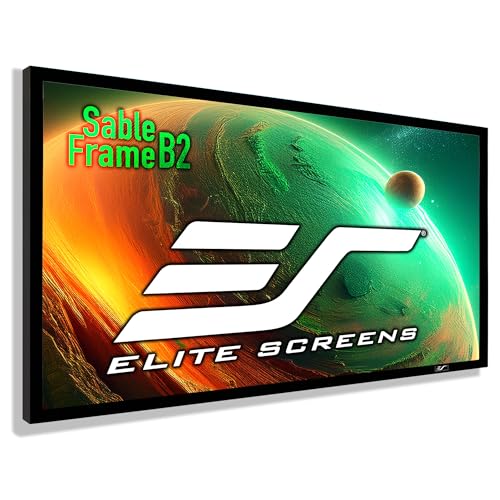
Elite Screens Sable Frame B2 150" Fixed Frame Projector Screen SB150WH2
$575.00 Specs and sizingA 150 inch fixed frame at $575.00, 6 feet 2 inches high, serving a back row about 37 feet away. This is the size and type the majority of church sanctuaries should be buying.
Best for: A 250 to 500 seat sanctuary with a permanent screen position
Check price on Amazon Elite Screens Sable Frame B2 120" Fixed Frame Projector Screen SB120WH2
$352.55 Specs and sizingThe same fixed frame construction at 120 inches for $352.55, which covers a back row about 29 feet out. A flat, bordered surface at close to pull-down money.
Best for: A small sanctuary that will never need the wall for anything else
Check price on AmazonWho should not buy this tier: Multi-use rooms where the screen has to vanish for a wedding or a concert, which is what the motorized tier exists for.
Large or multi-use room, or a room full of daylight: $766 to $858
Two different expensive problems live in this tier. The first is a large sanctuary that also hosts events, where a 150 inch screen has to retract and nobody should be wrestling it. The second is a room with clerestory windows or lighting that never comes down, where ambient light landing on the screen raises the black level and flattens the whole picture. Throwing projector lumens at that second problem is the expensive way to solve it.

Projector Screen Elite Screens Spectrum, 150-INCH Diag 16:9, Motorized Projection Screen Movie Home Theater 4K/8K Ultra HD Ready, Black Case, ELECTRIC150H2
$766.95 Specs and sizingA motorized 150 inch screen in a black case at $766.95. The screen goes up for the wedding and comes back down for the service without two people and a stepladder, which is what makes a retractable screen in a big room actually workable.
Best for: A large shared sanctuary that regularly hosts weddings, funerals and concerts
Check price on Amazon
Elite Screens 150-Inch ALR Projector Screen 16:9 – Ceiling & Ambient Light Rejecting, Fixed Frame Wall Mounted, ISF-Certified CineGrey 3D for Home Theater, Standard Throw Projectors, ER150DHD3
$858.53An ambient light rejecting fixed frame surface at $858.53. It reflects light coming from the projector direction and absorbs light arriving from above, which does more for contrast in a bright room than another 2,000 lumens of projector would.
Best for: Sanctuaries with clerestory windows or house lighting that cannot come down
Check price on AmazonWho should not buy this tier: A church with a dedicated screen wall and lighting it can control. An ambient light rejecting surface costs $283 more than the fixed frame and has a narrower viewing cone, so wide seating at the sides sees a dimmer image. In a darkened room a plain white fixed frame is both cheaper and better.
The screens compared
Screen height, sight lines and the mistake nobody catches until it is installed
Screen size is only half the problem. The other half is height off the floor, and it is the one that gets discovered after the holes are drilled. The bottom of the image needs to clear the heads of standing people in the rows in front, which in a flat floored room with people standing to sing means the bottom edge should be at least 4 feet above the floor and often more. In a room with a raised platform the screen usually ends up higher still, and then the front rows are craning upward all service.
The other trap is putting the screen where the projector is convenient rather than where the congregation can see it. Two smaller screens at the sides frequently beat one large one behind a platform, because the platform is where the people are and a screen behind them fights for attention with the person speaking. Work the sight lines from the corner seats of the front row and from the centre of the back row before committing, and if there is a balcony, check it separately. The placement question in full is at projector placement in a sanctuary, and the whole projection chain at projection software and hardware. If the room also feeds an overflow room, plan that display at the same time.
How we chose
We did not test these products in person and we never claim to. Picks are researched from manufacturer specification sheets and operator manuals, FCC rules where spectrum is involved, published standards, warranty terms, and the recurring themes in verified owner reviews. Every pick is matched to a real room size, seat count or input list rather than to a price bracket, and it is placed in the tier where its capability actually belongs. Where a product is wrong for most churches we say so on the page.
Sources
- Elite Screens published dimensions, gain and material specifications for the Sable Frame B2, Manual, Spectrum and ALR series
- Six times and four times viewing distance rules as used in standard presentation design practice
- Foot-lambert brightness targets applied to 16:9 screen areas at a gain of 1.1
Frequently asked questions
What size projection screen does a church need?
Measure from the screen to the furthest seat and divide by six. That is the minimum image height for lyrics and large sermon points. A back row 29 feet out needs a 120 inch diagonal, 37 feet needs 150 inches, and 44 feet needs 180 inches. If you regularly show detailed text, divide by four instead, which roughly halves the room a given screen can serve.
How high should a church projection screen be mounted?
High enough that the bottom of the image clears the heads of standing people in front of it, which in a flat floored room usually means the bottom edge sits at least 4 feet above the floor. Go higher and the front rows crane upward all service, so check sight lines from the front corner seats and the back centre seat before drilling anything.
Is a fixed frame screen better than a pull-down screen?
For a dedicated sanctuary, yes. A fixed frame stays permanently tensioned so the surface is flat, has no mechanism to fail, includes a black border that sharpens the apparent image edge, and costs less than a motorized screen of the same size. A pull-down or motorized screen wins only when the room has another use and the screen genuinely has to disappear.
Do we need an ambient light rejecting screen?
Only if light falls on the screen itself and cannot be moved or blocked. An ambient light rejecting surface reflects the projector and absorbs light arriving from above, which lifts contrast far more efficiently than extra projector lumens. The trade is cost, roughly $283 more at 150 inches, and a narrower viewing cone, so seating spread wide at the sides sees a dimmer image.
What screen gain should a church use?
Around 1.0 to 1.1 for almost every sanctuary. A gain of 1.1 reflects slightly more light back toward the centre of the room at the cost of a narrower viewing angle, which suits typical church seating. High gain surfaces above about 1.5 concentrate light down the centre line and visibly dim the image for anyone sitting off axis, which is most of a wide congregation.
Should a church use one large screen or two smaller ones?
Two side screens often work better than one central screen, because a screen directly behind the platform competes with the person speaking and forces a choice between watching them and reading the words. Two screens also shorten the viewing distance to the side seats. The cost is a second projector and a longer cable run, so decide it before wiring rather than after.
Researched, not professional advice. This page is compiled from published manufacturer specifications, operator manuals, FCC rules, published standards and owner-review consensus, not hands-on testing. Sound system design, rigging loudspeakers overhead, and any electrical work are jobs for a qualified professional: have flown loudspeakers and their attachment points signed off by a structural engineer or a certified rigger, and have all wiring done by a licensed electrician to your local code. Wireless microphone rules change, so confirm the current FCC position before buying. As an Amazon Associate we earn from qualifying purchases.