Acoustics
Best Acoustic Treatment for Churches
Quick answer
Two inch acoustic foam is effective above roughly 500 Hz and does almost nothing below it, which is why a sanctuary covered in foam still sounds muddy. Corner bass traps do the work flat panels cannot, and most rooms need 15 to 25 percent of their surface area treated.
This is the page where a church saves the most money by not buying something. Foam panels are cheap, they arrive quickly and they look like action, and a wall of two inch foam in a reverberant sanctuary changes the problem far less than anybody expects. The reason is physical and it is not a matter of brand.
An absorber works on sound whose wavelength is comparable to its thickness. Two inch foam is effective from roughly 500 Hz upward, where wavelengths are short. Below that, where the muddiness and the boom actually live, it is close to transparent. Work out how much absorption your room needs with the acoustic treatment calculator, check the target in the RT60 target chart, and read acoustic treatment for a sanctuary before ordering anything.
On this page
What each treatment actually absorbs
Absorber type against the frequency range it genuinely works in, and what that means for a church complaint.
Two inch foam works above about 500 Hz, while the muddiness and boom churches complain about lives below 250 Hz, where only corner traps and thick absorbers do anything.
| Treatment | Effective above roughly | Fixes | Does not fix |
|---|---|---|---|
| 2 inch foam panel | 500 Hz | Slapback, harsh cymbals, sibilance | Muddiness, boom, long reverberation |
| 4 inch panel or thick absorber | 250 Hz | General reverberation, vocal clarity | Low frequency build-up in corners |
| Corner bass trap | Below 250 Hz | Boom, muddy band sound, uneven bass | High frequency slapback |
| Heavy drapes, lined | 500 Hz | Rear wall reflections, flutter | Anything below the vocal range |
| Carpet | 1 kHz | Footfall noise, a little brightness | Almost everything people complain about |
| Upholstered pew cushions | Broadband | Reverberation that changes when the room is empty | Nothing, this is the cheapest real absorption a church owns |
| A full congregation | Broadband | Most of the reverberation | The empty room at rehearsal |
Absorption coefficients vary with mounting: the same panel spaced an inch or two off the wall absorbs more low frequency than one glued flat to it. Published coefficients assume a specific mounting, so treat manufacturer figures as comparative rather than absolute.
Treat the room the congregation sits in, not the platform
The instinct is to treat the platform, because that is where the sound comes from. The reflections that damage intelligibility come from the rear wall, the side walls and the ceiling above the congregation, and they arrive at the listener after the direct sound has already passed. A hard, flat rear wall facing a loudspeaker is the single worst surface in most sanctuaries.
The order that works is: corners first, rear wall second, first reflection points on the side walls third, and the ceiling last unless it is low. Corners because low frequency energy collects there and nothing else touches it. Rear wall because that reflection is the longest path and the most damaging to speech. Side walls because those reflections arrive early enough to smear consonants.
How much is enough? Between 15 and 25 percent of the total surface area is a working figure for a room that needs help, and the honest answer depends on the reverberation time you are starting from and the target for your service style. A room used for spoken word wants a shorter reverberation time than one built around an organ and a choir, which is exactly the tension in a traditional church building. Reverberation time for churches works through the targets.
Small church: one specific problem
A small church with one identifiable problem, usually a slapback off a hard rear wall, can fix that problem for under a hundred dollars. Clap your hands at the front of the room and listen: a distinct repeat means a specific reflective surface, and a couple of panels in the right place will remove it. What this will not do is change a room that booms, which is a different frequency and a different purchase.

Auralex Studiofoam Wedge Panels, 2-Inch by 24-Inch by 24-Inch, Pack of 2
$58.99Two inch foam, which is genuinely effective above roughly 500 Hz and close to useless below it. Useful against a specific rear wall slapback, useless against a boomy room, and worth saying so plainly before a church buys forty panels.
Best for: A specific slapback off a rear or side wall
Check price on AmazonWho should not buy this tier: Rooms whose complaint is muddiness or boom, which is low frequency and needs corner traps instead.
Mid-size: treat both halves of the spectrum
A mid-size sanctuary that has never been treated needs both broadband panels for the reflections and corner traps for the low end, and buying only the first is the most common mistake. A package that includes both is the practical purchase, and the corners should go in first, because the change they make to a muddy band mix is the one people notice.

Auralex 2 inch Studiofoam Wedgies 1x1 foot Acoustic Panel 24-pack with Bass Trap 4-pack
$356.98Enough panels to treat a small room properly, with four bass traps for the corners where the low frequency energy actually collects. The only package here that addresses both problems rather than one.
Best for: A recording room, a green room or a small chapel with a slap problem
Check price on Amazon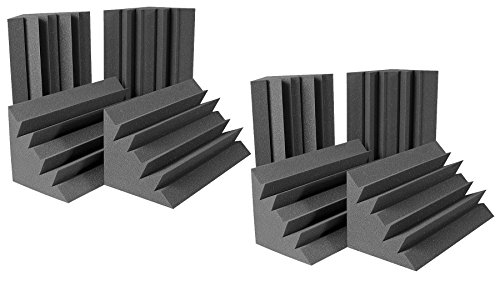
Auralex Acoustics LENCHA LENRD Acoustic Absorption Bass Traps, 24" x 12" x 12", 8 Pack
$374.99Corner bass traps, which do the job flat panels cannot. In a sanctuary the low frequency build-up in the corners is usually what makes the band sound muddy at the back of the room.
Best for: Room corners, before spending anything on more flat panels
Check price on AmazonWho should not buy this tier: Large sanctuaries with a serious reverberation problem, which need an engineered solution rather than a package.
Large room: corners first, then get a measurement
A large sanctuary with a three second reverberation time is not a package purchase. It needs a measurement of the current reverberation time by octave band, a target for the service style, and a calculation of how much absorption of what type is needed to get from one to the other. That is a consultant's job, and the money spent on the measurement usually saves more than it costs by preventing a wall of the wrong material. Corner traps are the part that is safe to buy first, because every room needs them.
Auralex Acoustics LENCHA LENRD Acoustic Absorption Bass Traps, 24" x 12" x 12", 8 Pack
$374.99Corner bass traps address the one problem that is essentially universal in a hard-surfaced room, and they are unlikely to be wrong whatever a measurement later says. Everything else should wait for numbers.
Best for: The corners of any sanctuary, before any other treatment
Check price on Amazon Auralex 2 inch Studiofoam Wedgies 1x1 foot Acoustic Panel 24-pack with Bass Trap 4-pack
$356.98Green rooms, recording rooms, overflow spaces and youth rooms are small enough that a package genuinely treats them, and they are where a large church gets the most benefit per panel.
Best for: Small rooms attached to a large building
Check price on AmazonWho should not buy this tier: Do not buy a large quantity of any treatment for a big sanctuary before somebody has measured it. Absorption in the wrong place or the wrong thickness makes a room dead at high frequency while leaving the boom untouched, which is a worse result than doing nothing and is far more expensive to undo once panels are glued to a historic wall.
The treatment options compared
| Model | Price | Panels | Panel size |
|---|---|---|---|
| Auralex Studiofoam Wedge Panels, 2-Inch by 24-Inch by 24-Inch, Pack of 2 | $58.99 | 2 | 24 x 24 x 2 |
| Auralex 2 inch Studiofoam Wedgies 1x1 foot Acoustic Panel 24-pack with Bass Trap 4-pack | $356.98 | 24 | 12 x 12 x 2 |
| Auralex Acoustics LENCHA LENRD Acoustic Absorption Bass Traps, 24" x 12" x 12", 8 Pack | $374.99 | 8 | 24 x 12 x 12 |
Finding out what your room actually needs
- Clap once at the front of the empty room and listen. A distinct repeat means a specific hard surface is reflecting straight back, usually the rear wall. A long ring that fades slowly means reverberation, which is a different and much larger problem.
- Do it again with the room full. A congregation is broadband absorption. If the full room sounds fine and the empty one rings, the problem is limited to rehearsal and the treatment budget may be better spent elsewhere.
- Ask whether the complaint is clarity or boom. Clarity complaints point to reflections and mid to high frequency treatment. Boom and muddiness point below 250 Hz, which means corners and thickness rather than panels.
- Treat the corners first, then listen again. Corner traps are the treatment least likely to be wrong, and they change the character of a muddy room more than any other single purchase.
- Get a measurement before committing serious money. For a large sanctuary, a measured reverberation time by octave band turns a guess into a calculation. It is cheaper than a wall of the wrong material.
How we chose
We did not test these products in person and we never claim to. Picks are researched from manufacturer specification sheets and operator manuals, FCC rules where spectrum is involved, published standards, warranty terms, and the recurring themes in verified owner reviews. Every pick is matched to a real room size, seat count or input list rather than to a price bracket, and it is placed in the tier where its capability actually belongs. Where a product is wrong for most churches we say so on the page.
Sources
- Manufacturer published absorption coefficients and panel dimensions
- Standard acoustic practice for absorber thickness against wavelength
Frequently asked questions
Does acoustic foam work in a church?
It works above roughly 500 Hz and does almost nothing below it, so two inch foam fixes a slapback and leaves a boomy room boomy. That is why a sanctuary covered in foam panels can still sound muddy. For the low frequency problems churches actually complain about, corner bass traps and thicker absorbers are what change the room.
How much of a sanctuary needs acoustic treatment?
Between 15 and 25 percent of the total surface area is a working figure for a room that needs help, and the exact number depends on the reverberation time you are starting from and the target for your service style. A spoken word service wants a shorter reverberation time than a traditional organ and choir service, which is why the same room can suit one and not the other.
Where should acoustic panels go first?
Corners first, because low frequency energy collects there and nothing else absorbs it. Then the rear wall, which produces the longest and most damaging reflection back toward the congregation. Then the first reflection points on the side walls. The platform is usually last, despite being where most churches instinctively start.
Will carpet fix our church acoustics?
Barely. Carpet absorbs above about 1 kHz, so it reduces footfall noise and takes a little brightness off the room, and it does nothing to the reverberation that makes speech hard to follow. Upholstered pew cushions are far more effective, because they are thicker and because they keep the room sounding similar whether it is full or empty.
Do we need bass traps in a church?
If the complaint is that the band sounds muddy or the room booms, yes, and they are the treatment most likely to be missing. Low frequency energy accumulates in room corners, where flat wall panels cannot reach it. Corner traps are also the treatment least likely to be wrong, which makes them safe to buy before a full measurement.
Is acoustic treatment safe to put on sanctuary walls?
Only if it meets the flame spread requirements for an assembly occupancy in your jurisdiction, and not all foam sold online does. A large area of untested material on a sanctuary wall is a genuine fire risk and may be ordered removed. Check the published fire rating, confirm with your local authority, and never cover sprinklers, detectors or exit signage.
Researched, not professional advice. This page is compiled from published manufacturer specifications, operator manuals, FCC rules, published standards and owner-review consensus, not hands-on testing. Sound system design, rigging loudspeakers overhead, and any electrical work are jobs for a qualified professional: have flown loudspeakers and their attachment points signed off by a structural engineer or a certified rigger, and have all wiring done by a licensed electrician to your local code. Wireless microphone rules change, so confirm the current FCC position before buying. As an Amazon Associate we earn from qualifying purchases.