Wireless and monitors
Wireless Microphone Channel Calculator
Quick answer
How many wireless channels you can run is decided by how many 6 MHz TV channels are empty at your address, not by your seat count. A digital system fits about 8 compatible channels per empty TV channel and an analog one about 4, so four open TV channels carries roughly 32 digital channels or 16 analog.
Almost every church asks this question the wrong way round. The number of wireless microphones you can run has nothing to do with how many people you seat and everything to do with how much empty television spectrum exists at your street address. A church in rural Montana can run twenty channels where a church in Chicago struggles with eight.
Two things set the answer: how many 6 MHz TV channels are locally unused, and whether your systems are analog or digital. Enter both below. The grid underneath filters to systems that suit the density you need.
Wireless microphone channel calculator
Capacity in your spectrum
Wireless systems that suit your channel count
Top matches update when you change your numbers.
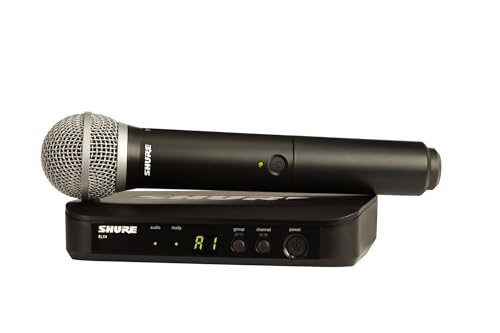
Shure BLX24/PG58 Wireless Vocal Microphone System - H10 Band
$329.00 Specs and sizingThe cheapest Shure wireless we would put in a church. The PG58 capsule is a step below the SM58 and the receiver is the same BLX4, so the upgrade path later is just a capsule.
Best for: A first wireless handheld for announcements and a roaming speaker
Check price on Amazon
Shure BLX24/SM58 Wireless Microphone System - 14-Hour Battery Life, 300 ft Range, UHF
$389.00 Specs and sizingThe SM58 capsule on a BLX transmitter, which is the wireless most churches settle on. Up to twelve compatible channels per band, and the capsule is the one every singer already knows how to use.
Best for: Worship vocals and a roaming handheld in a 100 to 500 seat room
Check price on Amazon
Shure BLX24R/B58 Rack-Mount Wireless Audio System J11 Band (596–620 MHz) – BLX4R Receiver, BLX2 Transmitter with Beta 58A Mic, Up to 14 Hr Battery, 300 ft Range
$539.00 Specs and sizingA rack-mounting BLX receiver with the Beta 58A capsule, whose tighter supercardioid pattern buys real gain before feedback on a loud platform.
Check before buying: This J11 unit tunes 596 to 620 MHz, and only the part below 608 MHz is legal to operate in the United States: 608 to 614 MHz is TV channel 37 and 617 MHz upward was sold off in the repack. The system is legal to own and use, but set every frequency below 608 MHz and ignore the top of its range.
Best for: A permanent rack install where the lead vocal fights the wedges
Check price on Amazon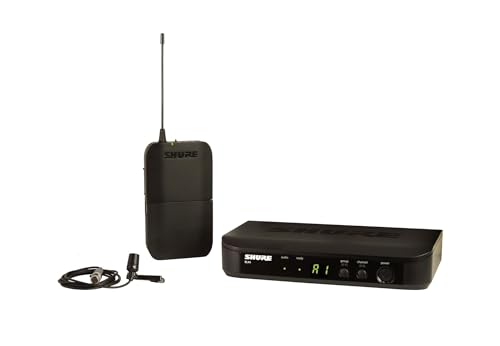
Shure BLX14/CVL Lavalier Audio System H9 Band (512–542 MHz) – BLX4 Receiver, BLX1 Bodypack & CVL Clip-On Lavalier Mic, Up to 14 Hr Battery, 300 ft Range
$359.00 Specs and sizingThe standard church lapel system. An omnidirectional lavalier is forgiving of head movement and unforgiving of feedback, which is why placement and gain structure matter more here than anywhere else.
Best for: A preacher who wants nothing visible on the face
Check price on Amazon
Shure BLX14/P31 Wireless Headset Microphone System - H10 Band
$379.00 Specs and sizingA headworn system, and the honest recommendation over a lapel for most preaching: the capsule stays a fixed distance from the mouth, which is worth roughly 6 to 10 dB of usable gain.
Best for: Preaching, especially in a live room or where the lapel keeps feeding back
Check price on Amazon
Shure BLX188/CVL Dual Wireless Lavalier System - H9 Band
$689.00 Specs and sizingTwo lavalier channels in one dual receiver, which halves the rack space and the power outlets for a church that needs a pastor and a worship leader on lapels.
Best for: Two speaking positions, or a pastor plus a guaranteed spare
Check price on Amazon
Shure SLXD24/SM58 Digital Wireless Microphone System - Includes SLXD2 Handheld Transmitter with SM58 Vocal Mic Capsule and SLXD4 Single Channel Rack Mount Receiver
$769.00 Specs and sizingDigital transmission with 24 bit audio and far tighter channel spacing than analog, so many more systems fit in the shrinking legal spectrum. That density is the reason to pay the difference.
Best for: Churches running more than about six wireless channels at once
Check price on Amazon
Shure SLXD24D/SM58 Dual Wireless Vocal System - H55 Band
$1,649.00 Specs and sizingTwo SLXD channels in one rack unit, with the receivers coordinating their own frequencies. Two channels per rack unit is what makes a ten channel system physically possible.
Best for: Dense wireless systems where rack space and coordination time both matter
Check price on Amazon
Shure GLXD24+/SM58 Digital Wireless Vocal System - Z3 Band
$659.00 Specs and sizingDual band 2.4 and 5.8 GHz with automatic frequency management and a rechargeable battery, so there is no UHF coordination to do at all. The trade is range and the fact that it shares the band with the church Wi-Fi.
Best for: Small rooms with no volunteer willing to coordinate UHF frequencies
Check price on Amazon
Sennheiser Pro Audio Sennheiser EW 100-835S Wireless Dynamic Cardioid Microphone System-A Band (516-558Mhz), 100 G4-835-S-A
$749.00 Specs and sizingA 42 MHz tuning range with a true diversity receiver and a scan function that finds clear frequencies for you, plus a mute switch the platform can actually reach.
Best for: Churches in crowded RF environments, or near a broadcast tower
Check price on Amazon
Sennheiser Pro Audio EW-D 835-S Wireless Handheld Microphone System, R1-R6
$699.00 Specs and sizingDigital, with a 56 MHz tuning range, 134 dB of input dynamic range and no compander at all, so there is no gain knob to set wrong. That last point matters with volunteers.
Best for: A system nobody has time to teach: it is very hard to set up badly
Check price on Amazon
Sennheiser EW-D ME2 Lavalier SET (R4-9)
$737.40 Specs and sizingThe EW-D bodypack with the ME2 omnidirectional lavalier, and the same no-gain-setting advantage as the handheld.
Best for: A lapel channel that has to work every week without anyone checking it
Check price on Amazon
Sennheiser EW-D ME3 Dynamic Headset SET (R1-6)
$669.86 Specs and sizingA cardioid headworn capsule on the EW-D platform. The directional pattern plus the fixed mouth distance is the most feedback-resistant combination a preacher can wear.
Best for: The hardest rooms: high ceilings, hard surfaces and a wireless preaching microphone
Check price on Amazon
Sennheiser Pro Audio XSW 1-825-A Vocal Wireless Microphone, A Range 548-572 MHz, Black, medium
$329.00 Specs and sizingSennheiser build and an automatic frequency setup at the entry price, with a 24 MHz range and ten compatible channels.
Best for: A small church that wants Sennheiser reliability without the G4 price
Check price on Amazon
Sennheiser Pro Audio XSW 1-825 DUAL-A Channel Wireless Microphone System
$649.00 Specs and sizingTwo channels in one receiver at close to the price of one and a half, which is usually the cheapest honest way to get a second wireless channel.
Best for: A second handheld for worship vocals or the announcements slot
Check price on Amazon
Audio-Technica ATW-1102 Wireless Handheld Microphone System
$349.95 Specs and sizingA 2.4 GHz digital system with automatic frequency selection and three levels of diversity. No UHF licence question at all, because it is not in the TV band.
Best for: Churches that want nothing to do with the 600 MHz repack
Check price on Amazon
Audio-Technica ATW-1101/H Wireless Headworn Microphone System
$399.95 Specs and sizingA headworn 2.4 GHz system at roughly half the price of the UHF equivalents, with the same caveat: it shares the band with every access point in the building.
Best for: A small building where the Wi-Fi plan is under your control
Check price on Amazon
Audio-Technica ATW-1101/L Wireless Lavalier System
$399.95 Specs and sizingThe lavalier version of the same system, and the cheapest route to a digital lapel channel with no frequency coordination.
Best for: A first lapel microphone in a small sanctuary
Check price on Amazon
Audio-Technica 3000 Series Wireless System Wireless Handheld Microphone System (ATW-3212/C710DE2)
$699.00 Specs and sizingThe 3000 series receiver with a C710 condenser capsule, which is a far more detailed vocal capsule than any dynamic and correspondingly less forgiving of a loud platform.
Best for: A skilled lead vocalist in a room with in-ear monitoring rather than wedges
Check price on AmazonOn this page
- Why does the TV band decide how many microphones I can use?
- How many wireless channels fit per open TV channel?
- Which frequencies are legal for church wireless microphones?
- How do I find out how many TV channels are open at my building?
- What if UHF is crowded where we are?
- How many channels does a church actually need?
Why does the TV band decide how many microphones I can use?
Wireless microphones in the United States operate as secondary users in the UHF television band, 470 to 608 MHz. That means they may use spectrum a television station is not using in your area, and they must not interfere with one that is. Each television channel is 6 MHz wide, and a handful of microphone frequencies fit inside one of those unused channels.
The limit inside a TV channel is not bandwidth, it is intermodulation. When two transmitters operate close together, their signals mix in the receiver front end and produce spurious products at predictable frequencies, notably 2f1 minus f2 and 2f2 minus f1. Put a third microphone on one of those products and it will not work, no matter how clean the band looks on a scanner. Coordination software exists to find sets of frequencies where no product lands on another channel.
Analog systems need wide guard bands to stay clear of those products, which is why they fit only about four channels per TV channel. Digital systems transmit in a way that produces far fewer usable products and need much tighter spacing, which is the single best reason to pay for digital once you pass about six channels.
How many wireless channels fit per open TV channel?
Realistic compatible channel counts. These are working figures rather than theoretical maxima, and a coordination tool will sometimes beat them and sometimes not reach them depending on what else is transmitting nearby.
A digital UHF system fits about 8 compatible channels per empty 6 MHz TV channel, so four open TV channels carries roughly 32 microphones where an analog system would carry 16.
| System type | Per TV channel | Minimum spacing | 2 TV channels | 4 TV channels | 6 TV channels |
|---|---|---|---|---|---|
| Analog UHF | 4 per TV channel | 400 kHz | 8 | 16 | 24 |
| Digital UHF | 8 per TV channel | 250 kHz | 16 | 32 | 48 |
| High-density digital mode | 15 per TV channel | 125 kHz | 30 | 60 | 90 |
High density mode trades range and audio bandwidth for channel count and is intended for large productions rather than a Sunday service. Do not plan a church system at its limit.
Which frequencies are legal for church wireless microphones?
The United States position after the 600 MHz repack. This matters more than the channel count: operating in a prohibited band is illegal, and a great deal of secondhand gear tuned to those bands is still being resold.
In the United States, 470 to 608 MHz is the working band for church wireless microphones, and 617 to 652 MHz, 663 to 698 MHz, 698 to 806 MHz and TV channel 37 are all prohibited.
| Band | Status | Licence | What it means for a church |
|---|---|---|---|
| VHF 169 to 216 MHz | Legal | Unlicensed, Part 15 | Legal but crowded and antenna-hungry. Cheap systems live here; ranges suffer indoors. |
| UHF 470 to 608 MHz (TV 14 to 36) | Legal | Part 74 licence or unlicensed under Part 15 | The main working band. You must operate in locally unused TV channels, which is what coordination means. |
| 608 to 614 MHz (TV channel 37) | PROHIBITED | Prohibited | Reserved for radio astronomy and wireless medical telemetry. Never legal for microphones. |
| 614 to 616 MHz guard band | Legal | Part 15, 20 mW limit | A narrow sliver of the guard band, not the duplex gap. Usable but tiny: perhaps two or three channels at low power. A further narrow allocation exists in the 652 to 663 MHz duplex gap that this site does not model, so check the current FCC rules before planning around it. |
| 617 to 652 and 663 to 698 MHz | PROHIBITED | Prohibited since the repack | Sold to mobile carriers. Operating a microphone here is illegal, and secondhand gear tuned to it is worthless. |
| 698 to 806 MHz | PROHIBITED | Prohibited since 2010 | Public safety and mobile broadband. Gear from before 2010 often sits here. |
| 902 to 928 MHz ISM | Legal | Unlicensed, Part 15 | Shares space with cordless phones and telemetry. Fine for a handful of channels. |
| 1920 to 1930 MHz DECT | Legal | Unlicensed | Self-coordinating digital systems. Very easy to deploy, limited range and channel count. |
| 2.4 GHz ISM | Legal | Unlicensed, Part 15 | Shares the band with every Wi-Fi access point in the building. Workable if you control the Wi-Fi plan. |
| 5.8 GHz ISM | Legal | Unlicensed, Part 15 | Cleaner than 2.4 GHz in most buildings, shorter range, needs line of sight. |
Rules change. Confirm the current FCC position before buying, and be especially careful with used equipment, which frequently sits in the bands sold off during the repack.
How do I find out how many TV channels are open at my building?
- Look it up before you scan. The FCC publishes which television stations broadcast in each area. That gives you the list of channels you must avoid, which is the starting point rather than the answer.
- Scan in the actual room, with everything on. Most receivers have a scan function. Run it in the room where the microphones will be used, with the building lighting, LED walls, dimmers and Wi-Fi running, because all of those raise the noise floor and some of them radiate directly in band.
- Scan at the time of day the service happens. Spectrum is not constant. A Tuesday afternoon scan can miss a nearby production, a school event or a weekend broadcast that will be there on Sunday.
- Use the manufacturer coordination tool for more than six channels. Every major manufacturer publishes free software that finds intermodulation-free frequency sets. Below about six channels the receiver scan is usually enough; above it, guessing will cost you a service.
- Write the frequency plan down and tape it inside the rack. A plan that lives in one volunteer’s memory is a plan that fails the week they are away. Record the frequency, the band and the transmitter for every channel.
- Rescan after any change nearby. A new broadcast tower, a neighbouring venue installing systems, or a repack of the band itself all change the picture. Rescan at least annually.
What if UHF is crowded where we are?
If the scan comes back with very little open spectrum, the honest options are to move out of the TV band entirely rather than to fight for it. The 900 MHz ISM band, 1.9 GHz DECT, 2.4 GHz and 5.8 GHz are all unlicensed and none of them care what the local television stations are doing.
The trade is real and worth stating. A 2.4 GHz system such as the Audio-Technica ATW-1102 Wireless Handheld Microphone System or the Shure GLXD24+/SM58 Digital Wireless Vocal System - Z3 Band shares its band with every Wi-Fi access point in the building, so it works well where you control the wireless network and badly where you do not. DECT and 5.8 GHz are cleaner in most buildings but have shorter range and lower channel counts. None of these will carry twelve channels.
For a church that genuinely needs many channels in a crowded market, the answer is digital UHF with a proper coordination pass: the Shure SLXD24D/SM58 Dual Wireless Vocal System - H55 Band puts two coordinated channels in one rack unit, and the Sennheiser Pro Audio EW-D 835-S Wireless Handheld Microphone System, R1-R6 offers a 56 MHz tuning range to work around whatever is occupied.
How many channels does a church actually need?
Fewer than most churches buy. Count the positions that genuinely cannot be wired: the preacher, the worship leader, a roaming handheld for testimony or announcements, and a spare. That is four for most churches, and a church running more than eight should be able to name each one.
Every additional wireless channel is a battery to charge, a frequency to coordinate, a capsule that can fail and a receiver in the rack. A wired Shure SM58 Pro XLR Dynamic Vocal Microphone at $109.00 does not do any of those things. The convention that keeps a service running is one spare transmitter per four channels in service, and a spare capsule such as the Shure Centraverse CVL Lavalier Condenser Microphone in the drawer, because a dead capsule is the most common wireless failure by a wide margin.
Plan the battery side too, with the wireless battery calculator: switching to rechargeable packs is the change that pays back fastest and removes the most Sunday morning stress.
Sources
- FCC rules on wireless microphone operation and the 600 MHz transition
- Manufacturer published tuning ranges and compatible channel counts for the systems listed
Frequently asked questions
How many wireless microphones can a church run at once?
It depends on how many 6 MHz TV channels are empty at your address, not on the size of your church. A digital system fits roughly eight compatible channels per empty TV channel and an analog one about four, so four open TV channels supports about 32 digital or 16 analog. Four to six channels is achievable almost anywhere in the United States; twelve needs a scan and a real coordination pass.
What wireless microphone frequencies are legal in the US?
The main working band is UHF 470 to 608 MHz, used in television channels that are locally unoccupied. Also legal are 614 to 616 MHz at 20 mW, 902 to 928 MHz, 1920 to 1930 MHz DECT, 2.4 GHz and 5.8 GHz. Prohibited are TV channel 37 at 608 to 614 MHz, the 617 to 652 and 663 to 698 MHz service bands sold in the repack, and the 700 MHz band since 2010.
Why do my wireless microphones interfere with each other?
Almost always intermodulation rather than the frequencies being too close in a simple sense. When two transmitters operate near each other their signals mix and produce spurious products at predictable frequencies, particularly twice the first frequency minus the second. A third microphone sitting on one of those products will drop out even though its own frequency looks clear on a scan. Coordination software finds sets where no product lands on a used channel.
Is digital wireless worth the extra money for a church?
Below about six channels, usually not: a good analog system sounds fine and costs less. Above six channels it becomes the deciding factor, because digital fits roughly twice as many compatible channels into the same shrinking spectrum. Digital systems also tend to have no gain control to set wrongly, which matters more than it sounds on a volunteer team.
Do we need an FCC licence for church wireless microphones?
Most churches operate unlicensed under Part 15 and accept that they must not cause interference and must tolerate receiving it. A Part 74 licence gives interference protection and access to higher power, but eligibility is limited and most churches do not qualify. Do not let anyone sell you equipment on the basis that a licence is required when it is not.
Can we use 2.4 GHz wireless microphones instead?
Yes, and it removes the TV band question entirely, which is genuinely attractive in a crowded market. The trade is that 2.4 GHz shares its band with every Wi-Fi access point in the building, so it works well where you control the wireless network and poorly where you do not. Range is shorter and channel counts are lower, so it suits a small room with a few channels rather than a large system.
Researched, not professional advice. This page is compiled from published manufacturer specifications, operator manuals, FCC rules, published standards and owner-review consensus, not hands-on testing. Sound system design, rigging loudspeakers overhead, and any electrical work are jobs for a qualified professional: have flown loudspeakers and their attachment points signed off by a structural engineer or a certified rigger, and have all wiring done by a licensed electrician to your local code. Wireless microphone rules change, so confirm the current FCC position before buying. As an Amazon Associate we earn from qualifying purchases.