Projection
Best Projectors for Churches
Quick answer
A 150 inch screen under normal service lighting needs about 2,130 ANSI lumens, worked from screen area times target foot-lamberts divided by screen gain. Lumens alone means nothing without a screen size. Most churches should buy a 1080p laser projector such as the Epson Pro EX11000 at $1,399.99.
Brightness is the specification churches get wrong most often, and it costs them either money they did not need to spend or an image nobody can read. The number on the box is lumens. What the congregation actually sees is foot-lamberts, which is those lumens spread across your screen area and multiplied by the gain of the screen surface. The same 3,000 lumen projector is comfortably bright on a 100 inch screen and visibly weak on a 200 inch one. Size the screen first with the screen size calculator, then work the brightness with the projector lumens calculator, because screen size is an input to the brightness question rather than something you decide afterwards. Every figure below is researched from published manufacturer specifications and from that arithmetic.
On this page
- How many lumens does a church projector actually need?
- White brightness and color brightness are not the same number
- Small church: one screen, a room you can darken, $999 to $1,099
- Mid-size church: 150 inch screen, lights partly up, $1,399 to $1,999
- Large room or multi-campus: 180 inch and up, $2,494 to $4,790
- The projectors compared
- What usually goes wrong with church projection
How many lumens does a church projector actually need?
This is the table that settles the argument in the committee meeting. Find your screen diagonal down the left, then read across to the column that matches how bright the room is during a service. The right hand column is the honest one for most sanctuaries with windows, and the left hand column only applies if somebody genuinely turns the house lights down for the whole service. Buying to the wrong column is how churches end up with a projector that looked fine in the shop and grey on Sunday.
A 150 inch 16:9 screen needs about 2,130 ANSI lumens to hold 35 foot-lamberts under normal service lighting, and about 3,040 lumens in a room with real daylight.
| Screen diagonal | Image height | Area, sq ft | 16 fL, lights down | 35 fL, normal service | 50 fL, bright room |
|---|---|---|---|---|---|
| 100 in | 4 ft 1 in | 30 | 430 | 950 | 1,350 |
| 120 in | 4 ft 11 in | 43 | 620 | 1,360 | 1,940 |
| 150 in | 6 ft 2 in | 67 | 970 | 2,130 | 3,040 |
| 180 in | 7 ft 4 in | 96 | 1,400 | 3,060 | 4,370 |
| 200 in | 8 ft 2 in | 119 | 1,730 | 3,780 | 5,400 |
Worked from screen area in square feet multiplied by the target foot-lamberts and divided by a screen gain of 1.1. Manufacturer lumen ratings are white brightness measured on a new light source in the brightest picture mode, which is not the mode anyone runs in a sanctuary, so treat the headline figure as a ceiling rather than as what you will get.
White brightness and color brightness are not the same number
This is the single most useful thing on this page, and almost nobody selling projectors volunteers it. A single-chip DLP projector makes color by spinning a filter wheel in front of one imaging chip, and part of that wheel is usually clear, which raises the white output without adding any color. The headline lumens figure is white brightness. The color brightness can be a great deal lower, and on a church screen that shows up as white text that looks bright and a color background or a video clip that looks washed out and dull.
A 3-chip 3LCD projector splits the light into red, green and blue and images all three at once, so it produces the same figure for white and for color. That is why a 3LCD projector rated at 4,000 lumens frequently looks better on a worship background than a single-chip projector rated at 5,000. When you compare two projectors, ask for the color brightness figure, and if it is not published, assume it is lower. The full argument is at three-chip versus single-chip.
Small church: one screen, a room you can darken, $999 to $1,099
Under about 150 seats with a screen of 120 inches or less and lighting you can control, you need somewhere between 600 and 1,400 lumens by the table above. Every projector in this tier clears that comfortably, which means the money is better spent on the light source type and on mounting it properly than on chasing another thousand lumens you will never use.

Epson Pro EX9270 Wireless 1080p 3-Chip 3LCD Business Projector
$999.99A 3-chip 3LCD projector at full HD, so white and color brightness match and slide backgrounds hold up. Lamp rather than laser, which is the compromise that keeps it under a thousand dollars.
Best for: A fellowship hall or a small sanctuary with a 100 to 120 inch screen
Check price on Amazon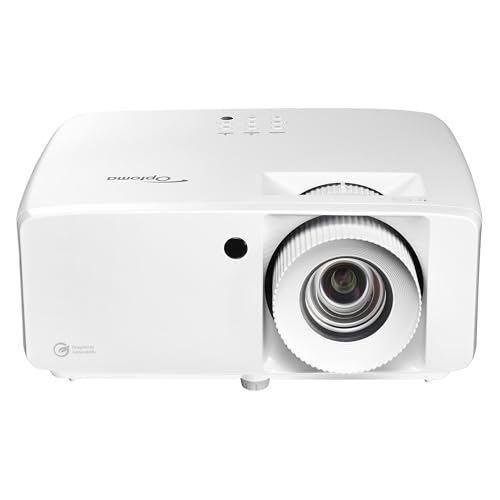
Optoma ZH451 - Full HD 1080p, 4,600 Lumens, Miracast Wireless Display, Laser, Compact, Business and Classroom Projector, Regular Throw 1080p Miracast
$1,099.00A 4,600 lumen laser rated for 30,000 hours at $1,099, which is a great deal of brightness per dollar. Single-chip DLP, so compare the color brightness figure before you assume it beats a 3LCD projector on a color background.
Best for: A small room with windows that cannot be covered
Check price on Amazon
WALI Universal Projector Ceiling Wall Mount with Hidden Cable Management
$37.99A universal ceiling mount with real adjustment in all three axes for $37.99. Squaring the projector to the screen physically is what keeps the image sharp, because keystone correction fixes the shape by throwing away pixels.
Best for: Any ceiling mounted projector up to about 30 pounds
Check price on AmazonWho should not buy this tier: Rooms where the house lights stay up and the screen is 150 inches or larger, which needs roughly three times this much light.
Mid-size church: 150 inch screen, lights partly up, $1,399 to $1,999
This is where most churches land. A 150 inch screen with normal service lighting wants around 2,100 lumens, and a laser light source starts to pay for itself because a mid-size church runs the projector for six to ten hours a week across services, rehearsals and mid-week groups. At that rate a 20,000 hour laser is a twenty year light source and a lamp is a recurring line item plus a ladder.
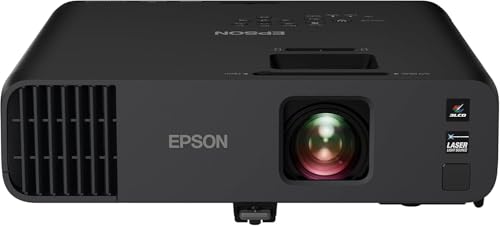
Epson Pro EX11000 3-Chip 3LCD Full HD 1080p Wireless Laser Projector
$1,399.99 Specs and sizingThe 3-chip 3LCD laser combination. Equal white and color brightness, no lamp to replace, and full HD so sermon points in a smaller font stay readable from the back.
Best for: A 150 inch screen in a 250 to 500 seat sanctuary
Check price on Amazon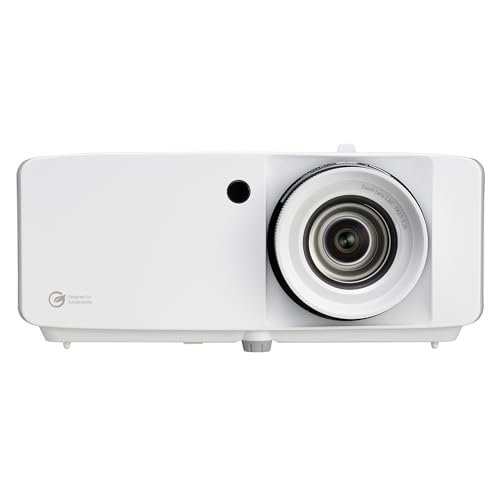
Optoma ZH551 - 1080p Full HD, 5600 Lumens, Laser, IP6X Dust Resistant, DuraCore 30,000 Hour Maintenance-Free, Miracast Wireless Screen Sharing Projector, 1080p
$1,499.00A 5,600 lumen laser with a dust-resistant sealed optical engine, which matters when the projector is fifteen feet up and the air handling in the building is older than the projector.
Best for: A bright room, or a ceiling mount nobody wants to get a lift out to clean
Check price on Amazon
Epson PowerLite L500W Laser Projector - HDTV
$1,999.00A laser install projector at a lower price, with one honest caveat: it is WXGA rather than full HD, so fine text on slides will look soft. Lyrics and images are fine, a detailed sermon outline is not.
Best for: Lyrics and images on an installation budget that will not stretch to 1080p laser
Check price on AmazonWho should not buy this tier: Churches projecting onto a 180 inch or larger screen in daylight, where the arithmetic calls for 4,000 lumens and up.
Large room or multi-campus: 180 inch and up, $2,494 to $4,790
Past about 180 inches of screen with the lights up you need 3,000 to 5,400 lumens, and the room usually adds a second problem: either there is no depth to mount a long-throw projector, or people keep walking through the beam. Both of those are geometry problems rather than brightness problems, and they are what this tier is actually solving. A brighter projector does not fix a shadow.

Epson PowerLite L530U Long Throw 3LCD Projector
$2,749.00A WUXGA 3LCD laser install projector that holds an image with the house lights up, which is the condition most churches project in whatever they told the committee.
Best for: A sanctuary with clerestory windows or lighting that never comes down
Check price on Amazon
Epson PowerLite 805F Ultra Short Throw 3LCD Projector - 16:9 - Wall Mountable, Tabletop
$2,494.31 Specs and sizingAn ultra short throw laser that sits a couple of feet from the wall. No long ceiling mount, no lift to service it, and nobody casts a shadow across the lyrics walking to the platform.
Best for: Low ceilings, and platforms where people keep walking through the projection
Check price on Amazon
BenQ LK936ST 4K Ultra HD Short-Throw Laser DLP Projector
$4,790.00A 4K short throw laser for a large screen from a mount much closer than a standard lens would need. The most capable projector here and priced accordingly at $4,790.
Best for: A large screen in a room with no depth behind the seating
Check price on AmazonWho should not buy this tier: A church with a 120 inch screen and lights it can control. The arithmetic says you need about 1,360 lumens and these projectors deliver several times that, which buys nothing visible and costs three times as much. Spend the difference on a proper screen instead, which will change the picture far more.
The projectors compared
What usually goes wrong with church projection
Four things, in order of how often they happen. The screen is too small for the room, so the back rows squint at lyrics that are technically visible and practically unreadable. The fix is the six times rule, covered on the screen roundup and computed for your building at screen size. The projector is aimed crooked and corrected with keystone, which resamples the image and softens every letter on the slide. Square it mechanically and leave keystone at zero.
Then there is ambient light landing on the screen itself, which no amount of projector brightness fixes efficiently: light falling on the screen raises the black level, and contrast is what makes text readable. Move the fixture, or use an ambient light rejecting surface. And finally the wrong light source for the usage pattern, which is the laser versus lamp question. If the projector runs more than about six hours a week, laser wins on total cost before the fifth year. For placement, see projector placement in a sanctuary, and for the whole decision how to choose a church projector.
How we chose
We did not test these products in person and we never claim to. Picks are researched from manufacturer specification sheets and operator manuals, FCC rules where spectrum is involved, published standards, warranty terms, and the recurring themes in verified owner reviews. Every pick is matched to a real room size, seat count or input list rather than to a price bracket, and it is placed in the tier where its capability actually belongs. Where a product is wrong for most churches we say so on the page.
Sources
- Epson published specifications for the Pro EX9270, Pro EX11000, PowerLite L500W, L530U and 805F
- Optoma published specifications for the ZH451, ZH450 and ZH551 laser projectors
- BenQ published specifications for the LK936ST 4K short throw laser projector
- Foot-lambert targets and the lumens formula as used in standard projection design practice
Frequently asked questions
How many lumens does a church projector need?
It depends entirely on screen size, so the honest answer is a formula: screen area in square feet multiplied by your target foot-lamberts, divided by screen gain. Use 16 foot-lamberts with the lights down, 35 under normal service lighting and 50 in a bright room. A 150 inch screen under normal lighting works out at about 2,130 lumens, and a 200 inch screen at about 3,780.
What are foot-lamberts and why do they matter more than lumens?
Foot-lamberts measure the light actually reflecting off your screen toward the congregation, which is what people see. Lumens measure what leaves the projector. The same projector produces high foot-lamberts on a small screen and low foot-lamberts on a large one, so a lumen figure quoted without a screen size tells you nothing. Every projector comparison should be made at your own screen size.
Is a 3LCD projector better than a DLP projector for a church?
Usually, for one specific reason. A 3-chip 3LCD projector produces the same color brightness as white brightness, while a single-chip DLP projector uses a filter wheel with a clear segment that lifts white output without lifting color. A DLP rated at 5,000 lumens can look duller on a colored worship background than a 3LCD rated at 4,000. Always ask for the color brightness figure.
Should a church buy a laser or a lamp projector?
Laser, if the projector runs more than about six hours a week. A laser light source rated at 20,000 to 30,000 hours has no lamp to replace, no gradual dimming curve and no ladder work. A lamp projector is cheaper to buy and costs a few hundred dollars plus labour every eighteen months or so in typical church use, which closes the gap well before year five.
Do we need a 4K projector for a church?
Almost never. Lyrics, sermon points and livestream playback are all fine at 1080p, and at normal viewing distances in a sanctuary most of the congregation cannot resolve the difference. Spend the money on brightness, on a 3-chip light engine or on a larger screen instead. A 4K projector makes sense mainly as a side effect of buying a short throw lens that only exists on higher models.
Why does our projector look washed out even though it is bright enough?
Almost always ambient light falling on the screen surface rather than insufficient projector output. Light landing on the screen raises the black level, and contrast rather than raw brightness is what makes text readable. Move or shield the offending fixture, angle the screen away from windows, or fit an ambient light rejecting surface, which does more for the picture than another 2,000 lumens would.
Researched, not professional advice. This page is compiled from published manufacturer specifications, operator manuals, FCC rules, published standards and owner-review consensus, not hands-on testing. Sound system design, rigging loudspeakers overhead, and any electrical work are jobs for a qualified professional: have flown loudspeakers and their attachment points signed off by a structural engineer or a certified rigger, and have all wiring done by a licensed electrician to your local code. Wireless microphone rules change, so confirm the current FCC position before buying. As an Amazon Associate we earn from qualifying purchases.