Amplification
Best 70 Volt Amplifiers for Churches
Quick answer
A 70 volt amplifier needs a genuine 70 volt output, and the total of every speaker tap on the line should come to no more than 80 percent of the amplifier rating. A 500 watt amplifier therefore carries 400 watts of taps, which is fifty ceiling speakers tapped at 8 watts.
A 70 volt system, also called a constant voltage or distributed system, exists to solve one problem: running many small loudspeakers from one amplifier over long cable runs. Each speaker carries a transformer with selectable taps, you set the tap to the wattage that speaker should draw, and you add the taps up. Impedance matching disappears as a problem, and 16 or 18 gauge cable will run hundreds of feet without meaningful loss.
Work your tap total first in the 70 volt system calculator, and check the spacing your ceiling height demands with the ceiling speaker spacing calculator. The architectural choice between this and ordinary 8 ohm wiring is laid out in 70 volt against 8 ohm, and the wiring itself in how to wire a 70 volt system.
On this page
- The 80 percent rule, and the number that actually sizes the amplifier
- Tap totals and the amplifier each one needs
- Small church: you probably do not need 70 volts at all
- Mid-size: one real 70 volt amplifier, two zones
- Multi-campus or whole-building: several zones from one rack
- The 70 volt amplifiers compared
- When a distributed system is the wrong answer
The 80 percent rule, and the number that actually sizes the amplifier
Sizing a distributed system is arithmetic, not judgement. Count the speakers, decide the tap setting each one needs, add the taps, then divide by 0.8 to get the amplifier rating you must buy.
The 80 percent margin is there for two reasons. Transformers are lossy, so the amplifier delivers a little more than the taps ask for, and a line loaded to exactly its rating leaves the amplifier no room for programme peaks. Twenty percent headroom is the figure installers have used for decades and it is the one to design to. A line carrying 400 watts of taps therefore wants a 500 watt amplifier, which is exactly why the CDi 1000 is the workhorse of church distributed audio.
The tap setting itself is a level decision. A higher tap draws more power from the line and makes that speaker louder. Speech in a quiet nursery may need 2 or 4 watts. A foyer with a coffee queue in it may need 8 or 16. Setting every speaker to its maximum tap because it is available is how a church runs out of amplifier halfway through the ceiling.
Tap totals and the amplifier each one needs
Common distributed layouts, the tap total each produces, and the minimum amplifier rating once the 80 percent rule is applied.
Twenty four ceiling speakers tapped at 8 watts total 192 watts, which needs an amplifier of at least 240 watts and comfortably fits one channel of a 500 watt install amplifier.
| Layout | Speakers | Tap each | Tap total | Minimum amplifier | Amplifier to buy |
|---|---|---|---|---|---|
| Nursery and two classrooms | 6 | 4 W | 24 W | 30 W | One channel of a CDi 1000 |
| Foyer and corridors | 10 | 8 W | 80 W | 100 W | One channel of a CDi 1000 |
| Fellowship hall | 16 | 8 W | 128 W | 160 W | One channel of a CDi 1000 |
| Flat-ceilinged sanctuary, speech | 24 | 8 W | 192 W | 240 W | One channel of a CDi 1000 |
| Sanctuary carrying music | 24 | 16 W | 384 W | 480 W | One channel of a CDi 1000 |
| Whole building, all zones | 48 | 16 W | 768 W | 960 W | Both channels of a CDi 2000 |
Tap totals assume every speaker is on the same line. Splitting the building into zones on separate amplifier channels is almost always worth it, because it lets the nursery run quietly while the foyer runs loud, and it means one failure does not silence the whole building.
Small church: you probably do not need 70 volts at all
This is the honest part of the page. Below roughly six speakers on runs under about 100 feet, a distributed system costs more and sounds worse than ordinary 8 ohm wiring. Every transformer in the chain rolls off low frequency and adds insertion loss, and you are paying for that on every speaker. Four 8 ohm ceiling speakers wired in series and parallel back to 8 ohms will run happily from a standard amplifier. Buy the 70 volt system when the speaker count or the cable distance actually demands it, not because the ceiling speakers list a 70 volt tap on the box.

Crown XLS1002 2-Channel Class D DriveCore Professional Power Amplifier with DSP, Band Pass Filters & Peakx Limiters. XLR/RCA Inputs, 350W at 4 Ohm, PureBand Crossover System. Black
$439.88 Specs and sizingA published 215 watts per channel at 8 ohms with onboard crossover and limiting. Four 8 ohm ceiling speakers wired in series and parallel present 8 ohms, which this drives without a transformer anywhere in the signal path.
Best for: Four to six speakers in a foyer or a cry room on short cable runs
Check price on Amazon
Behringer NX1000 Ultra-Lightweight 1000 Watt Class-D Power Amplifier with SmartSense Loudspeaker Impedance Compensation
$259.00 Specs and sizingThree hundred watts per channel at 8 ohms with impedance compensation, at a price that leaves budget for the speakers themselves. For a handful of speakers in one small zone, this plus 8 ohm wiring is the cheaper and cleaner answer.
Best for: A single small zone with no long cable runs
Check price on AmazonWho should not buy this tier: Buildings with more than about six speakers, or any run over roughly 100 feet, where voltage drop and impedance make low impedance wiring impractical.
Mid-size: one real 70 volt amplifier, two zones
Once the count passes six speakers or the runs pass 100 feet, the distributed system earns its place. What you are buying is an amplifier with a genuine constant voltage output stage, not a low impedance amplifier feeding an external transformer. External step-up transformers exist, they add cost and loss, and an amplifier with the output built in is both cheaper and more reliable over a fifteen year install life.

Crown CDi 1000 Two-Channel, 500-Watt @ 4Ω, 70V/140V Power Amplifier
$1,487.52 Specs and sizingDirect 70 volt and 140 volt outputs at a published 500 watts per channel, in one rack unit. Two channels covers the classic church split of sanctuary ceiling on one and ancillary rooms on the other, each with its own level.
Best for: Any 70 volt ceiling or distributed system up to about 400 watts of taps per zone
Check price on Amazon
dbx DriveRack PA2 2x6 PA Complete Professional Loudspeaker Management System, Rack Mountable with Android and iOS Control. Black
$426.00 Specs and sizingA distributed line carrying speech wants a high pass filter, some equalisation and a limiter ahead of the amplifier, because small ceiling drivers fed full-range low frequency waste power and distort. This handles all three and adds automatic feedback suppression for a live microphone in the same room.
Best for: Any distributed system that has never been equalised
Check price on AmazonWho should not buy this tier: A worship band. A ceiling system is a speech and background music system and it will not carry a contemporary service.
Multi-campus or whole-building: several zones from one rack
Large buildings run the sanctuary, the overflow room, the foyer, the corridors, the nursery and sometimes an outdoor speaker on separate zones with separate levels and sometimes separate sources. That is a channel count problem and a processing problem more than a power problem. Plan the rack space with the rack space calculator, and see multi-campus church AV for keeping several buildings on one standard.

Crown CDi 2000 Two-Channel, 800-Watt @ 4Ω, 70V/140V Power Amplifier
$1,125.00 Specs and sizingEight hundred watts per channel on 70 volt and 140 volt outputs, which is 640 watts of taps per zone after the 80 percent rule. That is enough for a dense ceiling layout in a large flat-ceilinged room with a second zone to spare.
Best for: Large distributed systems, or a 70 volt line shared across several ancillary rooms
Check price on Amazon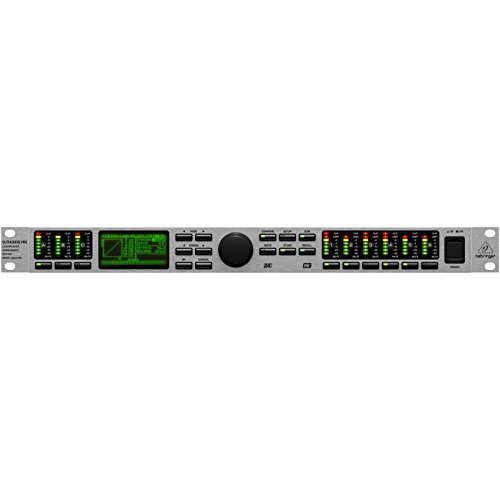
Behringer Ultradrive Pro Dcx2496 Ultra High-Precision Digital 24-Bit/96 Khz Loudspeaker Management System
$339.00 Specs and sizingThree inputs and six outputs with crossovers, delay and limiting on every output, so each zone gets its own equalisation and its own delay. Delay is what stops the foyer speakers arriving audibly after the sanctuary ones when a door is open.
Best for: Buildings where several zones are audible from the same place
Check price on AmazonWho should not buy this tier: Do not buy this tier for a single-room church or for anything under about 20 speakers. The cost per zone only makes sense when there genuinely are zones, and a small building served by one amplifier channel gains nothing from a second one except a second thing to configure wrongly.
The 70 volt amplifiers compared
| Model | Price | Amplifier channels | Power at 4 ohms | Class D | Rack space | Power at 70V |
|---|---|---|---|---|---|---|
| Crown CDi 1000 Two-Channel, 500-Watt @ 4Ω, 70V/140V Power Amplifier | $1,487.52 | 2 | 500 W per channel | Yes | 1U | 500 W |
| Crown CDi 2000 Two-Channel, 800-Watt @ 4Ω, 70V/140V Power Amplifier | $1,125.00 | 2 | 800 W per channel | Yes | 1U | 800 W |
| Crown XLS1002 2-Channel Class D DriveCore Professional Power Amplifier with DSP, Band Pass Filters & Peakx Limiters. XLR/RCA Inputs, 350W at 4 Ohm, PureBand Crossover System. Black | $439.88 | 2 | 350 W per channel | Yes | 1U | - |
When a distributed system is the wrong answer
A ceiling system is wrong for a worship band, and saying otherwise sells hardware that will disappoint. Small ceiling drivers with transformers on them cannot carry low frequency, cannot reach the level a band needs, and put sound directly above open microphones on the platform. Churches that install ceiling speakers for a contemporary service almost always end up adding front of house loudspeakers within two years and paying twice.
It is also wrong in a room with a high ceiling. Above roughly sixteen feet the coverage circle from a standard ceiling speaker becomes large and thin, and speech arrives from a long way overhead with plenty of room reflection mixed in. The narrow pattern models exist for this, and are covered in ceiling speakers for churches, but a point source system aimed at the congregation is usually the better answer.
Where distributed audio genuinely wins is speech coverage in low, wide, flat rooms, and in every ancillary space in the building. Foyers, corridors, nurseries, cry rooms and fellowship halls are what this system is for, and it does that job better than anything else at the price.
How we chose
We did not test these products in person and we never claim to. Picks are researched from manufacturer specification sheets and operator manuals, FCC rules where spectrum is involved, published standards, warranty terms, and the recurring themes in verified owner reviews. Every pick is matched to a real room size, seat count or input list rather than to a price bracket, and it is placed in the tier where its capability actually belongs. Where a product is wrong for most churches we say so on the page.
Sources
- Manufacturer published specifications for each amplifier and ceiling loudspeaker listed
- Constant voltage distribution practice as published in manufacturer install guides
Frequently asked questions
How do you calculate 70 volt amplifier size?
Add up the tap setting of every speaker on the line, then divide by 0.8 to leave twenty percent headroom. Twenty four speakers tapped at 8 watts is 192 watts of taps, which needs an amplifier of at least 240 watts. Never load a line to the full amplifier rating, because transformer losses and programme peaks both need somewhere to go.
Can a normal amplifier drive 70 volt speakers?
Not directly. A constant voltage speaker has a step-down transformer expecting a 70 volt line, and a low impedance amplifier cannot produce that swing at useful power. You either buy an amplifier with a real 70 volt output stage or add an external step-up transformer, and the transformer adds cost, weight and insertion loss for no benefit.
What tap setting should church ceiling speakers use?
Tap for the level the space needs, not for the maximum the speaker offers. Two to four watts suits a quiet nursery or corridor, eight watts suits a foyer or a fellowship hall, and sixteen watts suits a room that must carry music over conversation. Higher taps consume more of your line budget, so tapping everything at maximum is how a design runs out of amplifier.
How far can 70 volt speaker cable run?
Far enough that distance stops being the design constraint. Because the line runs at high voltage and low current, a 16 or 18 gauge run of several hundred feet loses very little, which is the entire reason distributed systems exist. Low impedance wiring over the same distance would need much heavier cable and would still lose power to resistance.
Do we need one amplifier channel per zone?
One channel per zone is the practical rule, because a zone is defined by having its own level. The nursery wants to be quiet while the foyer is loud, and that is impossible on a shared channel unless every speaker carries a volume control, which adds failure points and confuses volunteers. Two channels covers most small buildings and four covers most large ones.
Is 100 volt different from 70 volt?
It is the same idea at a higher line voltage, used outside North America. Many amplifiers and speakers support both, and the install amplifiers listed here publish 70 volt and 140 volt outputs. The arithmetic is identical: add the taps, divide by 0.8, buy the amplifier. Do not mix speakers tapped for one line voltage onto a line running at another.
Researched, not professional advice. This page is compiled from published manufacturer specifications, operator manuals, FCC rules, published standards and owner-review consensus, not hands-on testing. Sound system design, rigging loudspeakers overhead, and any electrical work are jobs for a qualified professional: have flown loudspeakers and their attachment points signed off by a structural engineer or a certified rigger, and have all wiring done by a licensed electrician to your local code. Wireless microphone rules change, so confirm the current FCC position before buying. As an Amazon Associate we earn from qualifying purchases.