Mixing consoles
Best Budget Digital Mixers for Churches
Quick answer
The Behringer XR18 is the best budget digital mixer for churches at $509.00, which works out at about 32 dollars per microphone preamp. That is the lowest figure in this catalog, and it is the number that matters more than the sticker price on a mixer.
Budget mixer comparisons usually go wrong by ranking on sticker price. The figure that predicts whether a church will be happy in three years is cost per microphone preamp, because preamps are what run out. A cheaper mixer with four preamps costs more per input than a dearer one with sixteen, and the church with four ends up buying twice.
Everything on this page recalls its settings, which is the whole reason to go digital on a small budget. Size the requirement first with the mixer channel calculator, then read the cost per preamp table below. If the budget has to cover the whole system, the AV budget allocator shows what proportion should reach the console at all.
On this page
Cost per preamp is the number that matters
A microphone preamp is the thing you cannot add later. Line inputs, USB channels and effects are all plentiful at every price. Preamps are the scarce resource, and every microphone on the platform needs one. So the honest way to rank budget digital mixers is to divide the price by the number of preamps on the box.
Do that and the ordering changes completely. A four preamp unit at 369 dollars is more expensive per input than a sixteen preamp unit at 509 dollars, by a factor of nearly three. The cheap mixer is only cheaper if the church genuinely never exceeds four microphones, which is rare once a band exists.
The second number to check is aux sends, because monitor mixes come out of a different pool. A mixer with four buses supports two wedges and a stream feed and then stops. Anyone planning in-ear monitors should count buses before channels.
Budget digital mixers ranked by cost per preamp
Price divided by onboard microphone preamps, which is the figure that predicts whether the mixer still fits in three years.
The XR18 works out at about 32 dollars per microphone preamp, the lowest figure in the catalog, while a four preamp mixer costs roughly 92 to 147 dollars per input.
| Mixer | Price | Mic preamps | Cost per preamp | Aux sends |
|---|---|---|---|---|
| XR18 | $509.00 | 16 | about $32 | 6 |
| Ui12 | $399.00 | 8 | about $50 | 4 |
| XR16 | $429.00 | 8 | about $54 | 8 |
| X32 Rack | $979.99 | 16 | about $61 | 16 |
| CQ-20B | $999.99 | 16 | about $63 | 6 |
| XR12 | $369.00 | 4 | about $92 | 4 |
| CQ-12T | $899.99 | 8 | about $113 | 4 |
| MR12 | $589.00 | 4 | about $147 | 4 |
Cost per preamp is a buying heuristic, not a quality measure. The MR12 sits at the expensive end because its four preamps are Midas PRO designs, which is a legitimate reason to pay more when the channel count is genuinely low.
Under 400 dollars: four to eight inputs
This tier only makes sense for a church that is certain its input list stays tiny: a chapel, an overflow room, a youth space. Both units recall their settings, which is the point of buying digital at all at this price.
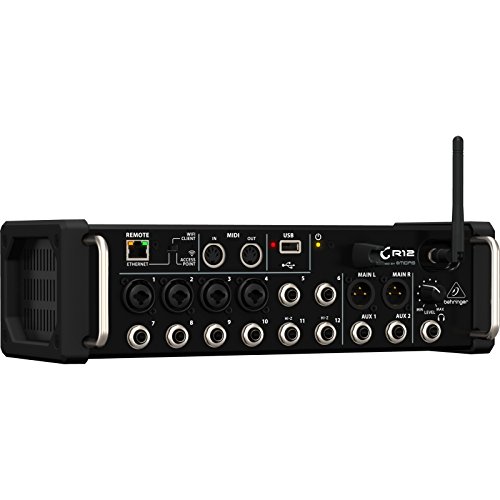
Behringer X Air XR12 Tablet-Controlled Digital Mixer
$369.00 Specs and sizingFour preamps in one rack unit with full processing and scene recall. It is the cheapest way into a console that remembers last Sunday, and the cheapest to outgrow.
Best for: A chapel, a portable setup or an overflow room with four or fewer microphones
Check price on Amazon
Soundcraft Ui12 Remote-Controlled 12-Input Digital Mixer
$399.00 Specs and sizingEight preamps for {{price:soundcraft-ui12}}, controlled from any web browser with no app to install. Double the inputs of the XR12 for a similar outlay.
Best for: Volunteer teams where everyone uses a different phone or tablet
Check price on AmazonWho should not buy this tier: Any church with a drum kit or more than two monitor mixes. Four preamps will be gone before the vocals are plugged in.
400 to 600 dollars: the band fits
This is the tier that suits most budget-constrained churches with a worship band, and the XR18 is the reason. Sixteen preamps is the difference between fitting a drum kit and running a submixer, and a submixer costs money while removing recall from the channels it handles. The head to head against the step-up option is in XR18 against X32 Rack.
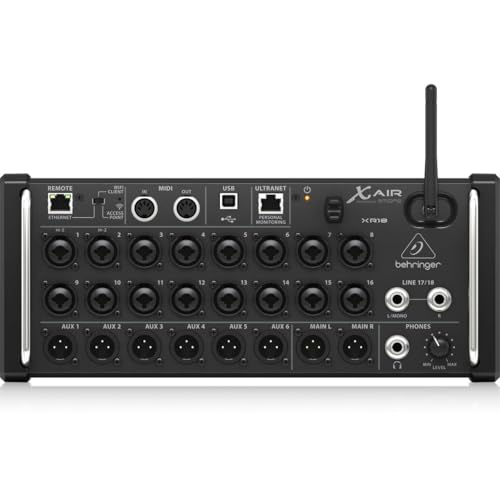
Behringer X AIR XR18 18-Channel, 12-Bus Digital Mixer for iPad/Android Tablets with 16 Programmable Midas Preamps, Integrated Wifi Module and Multi-Channel USB Audio Interface
$509.00 Specs and sizingSixteen preamps, six aux sends and 18 track recording. It holds a full band with drums, feeds monitors, and records the service for the podcast without any additional hardware.
Best for: A 100 to 250 seat room with a band and a tight capital budget
Check price on Amazon
Behringer X AIR XR16 16-Input Digital Mixer for iPad/Android Tablets with 8 Programmable Midas Preamps, 8 Line Inputs, Integrated Wifi Module and USB Stereo Recorder
$429.00 Specs and sizingEight preamps and eight line inputs in two rack units with eight buses, which is more monitor sends than the XR18 offers if wedge mixes are the priority.
Best for: Speech-led services with a piano and a few microphones but several monitor mixes
Check price on Amazon
Midas MR12 12-Input Digital Mixer for iPad/Android Tablets with 4 Midas PRO Preamps, 8 Line Inputs, Integrated Wifi Module and USB Stereo Recorder
$589.00 Specs and sizingFour Midas PRO preamps in one rack unit. The preamps are the entire reason to choose it over cheaper four-input units, and on a lectern and a soloist that is a defensible trade.
Best for: A small room where the handful of channels that exist need to sound right
Check price on AmazonWho should not buy this tier: Churches needing more than six monitor mixes, or more than 18 inputs on an ordinary Sunday.
Stretching to a thousand: a large room on a small budget
A church with 400 or more seats and a genuinely tight budget is the case for this tier. All three add either channel capacity, bus count or a path to a stage box, and all three are still rack boxes with no console surface. If the input list will pass 16, the X32 Rack is the only one here that doubles without being replaced, which is covered in the rack mixer roundup.

Behringer X32 Rack Digital Mixer
$979.99 Specs and sizingThe full 32 channel X32 engine with 16 preamps on the box, 16 buses, and an AES50 port that adds 16 more preamps from a stage box when the platform grows.
Best for: Churches that expect to outgrow 16 inputs within five years
Check price on Amazon
Allen & Heath CQ-20B Digital Mixer with WiFi and Bluetooth Connectivity
$999.99 Specs and sizingSixteen preamps and no surface at all, driven over Wi-Fi or a wired network. It disappears into a rack where nobody can reach the knobs, which solves a real problem in shared buildings.
Best for: Installed systems where the mixer should be physically inaccessible
Check price on Amazon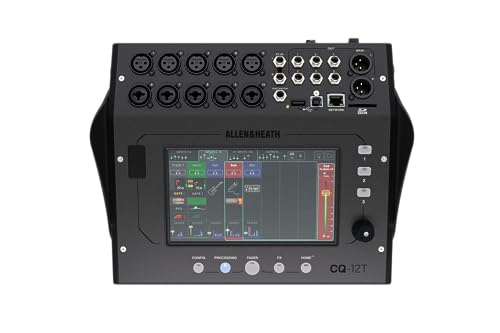
Allen & Heath CQ-12T Digital Mixer with 7-inch Touchscreen and Bluetooth
$899.99 Specs and sizingEight preamps with a seven inch touchscreen on the unit, so a network failure does not end the service. The most expensive per preamp here, and the most resilient on a Sunday.
Best for: Churches with unreliable wireless coverage at the mix position
Check price on AmazonWho should not buy this tier: Do not buy this tier for a room under 200 seats with a fixed eight input list. The extra preamps and buses are money that would do more good in loudspeakers or microphones, both of which change what the congregation hears while a spare input does not.
What you give up at this price, honestly
Budget digital mixers give up three things. Preamp quality is the first, and it is audible mostly on quiet sources such as a hanging choir microphone or a soft speaker, where a cheaper preamp needs more gain and brings up more noise. Second is build: plastic encoders and lighter chassis do not survive a weekly teardown as well as metal ones. Third is processing depth, particularly the number of effects that can run at once and the quality of the dynamics on each channel.
None of those stops a budget mixer from running a good service. What matters far more is whether the input count fits, whether the volunteers can operate it, and whether the loudspeakers downstream are adequate. A church choosing between a better console and better speakers should choose speakers nearly every time, then check the result against the amplifier power calculator.
For the specific long-term view on the top pick, including where owners report it falling short, see the XR18 review.
How we chose
We did not test these products in person and we never claim to. Picks are researched from manufacturer specification sheets and operator manuals, FCC rules where spectrum is involved, published standards, warranty terms, and the recurring themes in verified owner reviews. Every pick is matched to a real room size, seat count or input list rather than to a price bracket, and it is placed in the tier where its capability actually belongs. Where a product is wrong for most churches we say so on the page.
Sources
- Manufacturer published specifications and catalog pricing for each mixer listed
- Consensus of verified owner reviews across major retailers
Frequently asked questions
What is the cheapest digital mixer a church should buy?
The cheapest defensible choice is a four preamp rack mixer for a chapel with a lectern, a lapel and a piano. For any church with a band, the cheapest sensible choice is a sixteen preamp mixer, because eight preamps disappear the first time a drum kit is added. On cost per input a sixteen preamp unit is often cheaper than a four preamp one.
Is a budget digital mixer reliable enough for weekly services?
Broadly yes, according to the consensus of verified owner reviews, with two caveats. Tablet-controlled units depend entirely on the wireless network, so a dedicated access point is not optional. And lighter plastic chassis do not tolerate weekly transport well, so a portable church should budget for a proper rack case rather than carrying the unit loose.
Do cheap preamps actually sound worse?
On loud close sources such as a vocal microphone or a snare, the difference is small and rarely the limiting factor in a church. On quiet distant sources such as a hanging choir microphone, cheaper preamps need much more gain and the noise floor becomes audible. If choir or ambient microphones are central to the service, preamp quality is worth paying for.
Can a budget mixer handle in-ear monitors?
Only within its bus count. Each stereo in-ear mix uses two buses, so a mixer with six aux sends supports three stereo mixes and nothing else. A church planning four or more in-ear mixes plus a stream feed needs sixteen buses, which moves the purchase up a tier regardless of how few microphones are in use.
Is it better to buy a used higher-end mixer than a new budget one?
Often yes, if the model is still supported. A used console from another church or a rental company usually lives indoors and is rarely abused. Check that firmware and control apps are still published, test every preamp with a microphone, and move every fader through its travel. Avoid any tablet-controlled unit whose app has been withdrawn, since it cannot be operated at all.
How much of a church AV budget should the mixer take?
Around a fifth is a common and defensible share, with roughly double that going to loudspeakers and amplification. Churches that invert those proportions tend to be disappointed, because the congregation hears the loudspeakers and the room, not the console. Where the budget is very tight, buy adequate speakers and a simple mixer rather than the reverse.
Researched, not professional advice. This page is compiled from published manufacturer specifications, operator manuals, FCC rules, published standards and owner-review consensus, not hands-on testing. Sound system design, rigging loudspeakers overhead, and any electrical work are jobs for a qualified professional: have flown loudspeakers and their attachment points signed off by a structural engineer or a certified rigger, and have all wiring done by a licensed electrician to your local code. Wireless microphone rules change, so confirm the current FCC position before buying. As an Amazon Associate we earn from qualifying purchases.