Mixing consoles
Behringer XR18 vs X32 Rack
Quick answer
Buy the XR18 at $509.00 if your input list stops at 16 microphones and will stay there, and the X32 Rack at $979.99 if it will not. The Rack costs about $470 more and buys 32 mix channels, 25 buses and an AES50 port that a stage box plugs into.
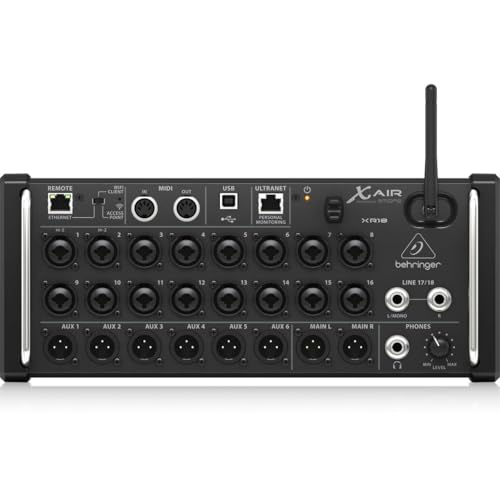
Behringer X AIR XR18 18-Channel, 12-Bus Digital Mixer for iPad/Android Tablets with 16 Programmable Midas Preamps, Integrated Wifi Module and Multi-Channel USB Audio Interface
$509.00 Specs and sizingSixteen programmable Midas preamps, six aux sends and 18 track USB recording in three rack units, for the price of a pair of decent loudspeakers.
Best for: A church plant or a 100 to 250 seat room where the mixer can stand in the congregation
Check price on Amazon
Behringer X32 Rack Digital Mixer
$979.99 Specs and sizingThe full X32 engine: 32 mix channels, 25 buses and an AES50 stage box port, with 16 preamps on the box itself.
Best for: Churches with no booth space, or a mixer who wants to walk the room while setting the mix
Check price on AmazonIf your church will never mix more than 16 microphones, buy the XR18 and spend the difference on loudspeakers. If there is any chance of a drum kit, a full band and a stream mix in the same service, buy the X32 Rack, because the XR18 has no expansion path and the Rack has one.
That is the entire decision, and it is a ceiling question rather than a quality question. Both units have Midas-designed preamps, both recall scenes, both run from a tablet, and neither has faders. What differs is what happens in year three. Build your input list on the mixer channel calculator and the answer usually falls out on its own.
Side by side
| Model | Price | Input channels | Mic preamps | Mix buses | Digital | Scene recall | Rack space |
|---|---|---|---|---|---|---|---|
| Behringer X AIR XR18 18-Channel, 12-Bus Digital Mixer for iPad/Android Tablets with 16 Programmable Midas Preamps, Integrated Wifi Module and Multi-Channel USB Audio Interface | $509.00 | 18 | 16 | 12 | Yes | Yes | 3U |
| Behringer X32 Rack Digital Mixer | $979.99 | 32 | 16 | 25 | Yes | Yes | 3U |
The ceiling, stated plainly
An 18 channel mixer is not 18 microphones. Two of those channels are a stereo line input, and the aux sends you use for monitors come out of the same pool as the ones you use for effects.
The XR18 stops at 16 microphone inputs and six aux sends, which a full band with three monitor mixes consumes entirely.
| Resource | XR18 | X32 Rack | What uses it up |
|---|---|---|---|
| Microphone preamps | 16 | 16 onboard, 32 with a stage box | A drum kit takes four to seven |
| Mix channels | 18 | 32 | Playback, ambience and stream returns |
| Buses | 12 | 25 | Monitors, effects, stream mix, overflow feed |
| Aux sends for monitors | 6 | 16 | One per musician on in-ears |
| Stage box port | None | AES50 | Getting inputs off the platform on one cable |
| USB multitrack | 18 in and out | 32 in and out | Recording the service |
Both figures are Behringer published. The XR18 limit is hard: there is no card slot, no expansion port and no way to add a stage box.
Choose the XR18 if the input list is small and honest
A church plant, a chapel or a 100 to 250 seat room running two vocals, an acoustic guitar, a keyboard, a preaching microphone and a playback feed uses seven of sixteen preamps. That church does not need an X32 Rack, and the $509.00 price difference is roughly a QSC CP12, which will do far more for the congregation than nine unused preamps.
The XR18 also has a genuine advantage the Rack does not: built-in Wi-Fi. It is one box, one power cable and no access point to configure, which for a portable setup that goes into a case every week is a real saving in setup time. Our portable church AV guide leans on exactly that.
The limit to be clear-eyed about is monitors. Six aux sends sounds like plenty until a five piece band each wants their own mix and the stream wants its own bus. At that point you are out, and there is nothing to buy that fixes it.
Choose the X32 Rack if a drum kit is coming
The moment a church mics a drum kit, the input list roughly doubles. A seven piece drum kit is seven channels before the bass, the guitars, the keys and three vocals. On an XR18 that is the whole mixer; on an X32 Rack it is half of it, with an AES50 port ready for an S16 when the platform grows again.
Twenty-five buses is the second reason. It means a dedicated livestream mix that is not just a copy of the house mix, which is the single biggest improvement most churches can make to their broadcast. Our livestream mixing guide assumes you have a spare bus, and on the XR18 you often do not.
The third reason is the one nobody plans for: resale and rental. X32 platform gear is everywhere, so a visiting engineer can drive it and a rental house can supplement it. The XR18 is a smaller pool.
Sources
- Behringer published XR18 and X32 Rack specifications
- Behringer X AIR series expansion documentation
Frequently asked questions
Can the XR18 be expanded with a stage box?
No. There is no AES50 port, no expansion card slot and no digital snake option. The sixteen preamps on the back panel are the whole system for its entire life. This is the single most important fact in the comparison and the reason a growing church should think hard before choosing it as a permanent console.
Do they use the same preamps?
Both use Midas-designed programmable preamps and both are recallable from a scene. Published noise and headroom figures are close enough that no congregation would identify one in a blind listen. The difference between these mixers is capacity and expansion, not sound quality, and any page that claims otherwise is inventing a distinction.
Which is easier for a volunteer team?
The XR18, slightly, because there is less to get lost in. Fewer buses and fewer layers means fewer ways to route something to nowhere. The X32 Rack rewards a scene file built properly once by someone who knows what they are doing, after which a volunteer only touches faders. Both need a written Sunday checklist.
Do I need a separate Wi-Fi access point for the X32 Rack?
Yes, and that is a feature rather than a nuisance. The XR18 onboard radio is convenient but weak, and in a full sanctuary it can struggle. The Rack expects a proper access point, which lets you put a decent antenna where it is actually needed and keep the mixer off the guest network entirely.
Is 18 track recording enough for a church archive?
For a small church, yes. Eighteen tracks captures every input on the XR18, so nothing is lost. The question is what you do with it. If you are producing a podcast or remixing the stream audio later, the extra channels and the interface capacity of the X32 Rack give you more to work with.
Researched, not professional advice. This page is compiled from published manufacturer specifications, operator manuals, FCC rules, published standards and owner-review consensus, not hands-on testing. Sound system design, rigging loudspeakers overhead, and any electrical work are jobs for a qualified professional: have flown loudspeakers and their attachment points signed off by a structural engineer or a certified rigger, and have all wiring done by a licensed electrician to your local code. Wireless microphone rules change, so confirm the current FCC position before buying. As an Amazon Associate we earn from qualifying purchases.