Mixing consoles
Digital vs Analog Mixer for a Church
Quick answer
Choose digital if volunteers rotate, because scene recall resets every setting to a known good state before each service. Choose analog if one experienced person always runs sound and the input list never changes, because an analog board boots instantly and has nothing to go wrong.
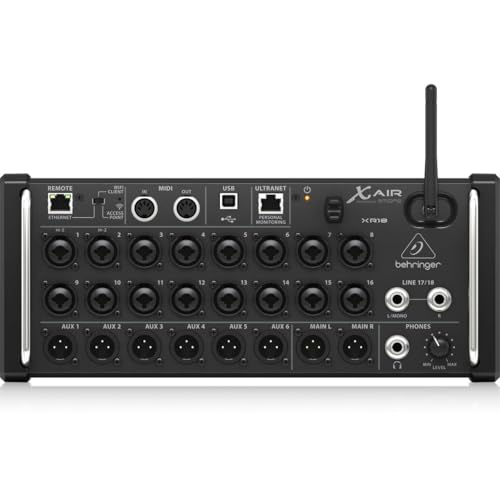
Behringer X AIR XR18 18-Channel, 12-Bus Digital Mixer for iPad/Android Tablets with 16 Programmable Midas Preamps, Integrated Wifi Module and Multi-Channel USB Audio Interface
$509.00 Specs and sizingSixteen preamps with full recall, so last week settings come back exactly and a bad Sunday cannot become a permanent one.
Best for: A church plant or a 100 to 250 seat room where the mixer can stand in the congregation
Check price on Amazon
Yamaha MG12XU 12-Input 4-Bus Mixer with Effects
$425.00 Specs and sizingSix discrete preamps, one-knob compressors and nothing to boot, at a price and a learning curve a small church can absorb immediately.
Best for: Churches that want a board a new volunteer can read in one glance
Check price on AmazonFor a church with a rotating volunteer rota, buy digital: recall is the feature, and it is worth more than any specification on either box. For a church where the same person has run sound for fifteen years on an unchanging input list, buy analog and stop reading, because you will gain nothing and lose reliability.
These are genuinely different tools rather than an old technology and a new one. A digital mixer stores state; an analog mixer is its state. That difference drives every practical consequence below, including the ones that go against digital.
A representative pair at the same price
| Model | Price | Input channels | Mic preamps | Mix buses | Digital | USB record channels | Scene recall |
|---|---|---|---|---|---|---|---|
| Behringer X AIR XR18 18-Channel, 12-Bus Digital Mixer for iPad/Android Tablets with 16 Programmable Midas Preamps, Integrated Wifi Module and Multi-Channel USB Audio Interface | $509.00 | 18 | 16 | 12 | Yes | 18 | Yes |
| Yamaha MG12XU 12-Input 4-Bus Mixer with Effects | $425.00 | 12 | 6 | 4 | No | 2 | - |
What each one is actually good at
Set the marketing aside and compare them on the things that decide a Sunday morning.
Scene recall is the only decisive advantage either format has, and it is worth most to the churches with the least experienced operators.
| Consideration | Digital | Analog | Who wins |
|---|---|---|---|
| Recall of last week settings | Exact | Whatever was left on the knobs | Digital, decisively |
| Time from power on to audio | 30 to 60 seconds | Instant | Analog |
| Processing per channel | EQ, gate, compressor on every channel | Usually none | Digital |
| Monitor mixes | Six or more, with their own EQ | Two to four, no EQ | Digital |
| Learning curve for a new volunteer | Menus and layers | One knob per function | Analog |
| Failure with no network | Tablet models stop | Unaffected | Analog |
| Multitrack recording | Built in | Two channel USB at best | Digital |
| Cost of the same channel count | Lower | Higher above 16 channels | Digital |
The analog advantages are all reliability and simplicity. The digital advantages are all capability. A church should pick the column that matches its actual weakness.
Choose a digital mixer if nobody owns the sound booth
The most damaging thing in volunteer church audio is drift: every week somebody adjusts something, nobody writes it down, and by spring the system sounds worse than it did at install with nobody able to say why. Scene recall ends that. A contractor or a capable volunteer builds a good starting scene once, and every Sunday begins from it.
Digital also gives every channel a gate, a compressor and a parametric EQ, which is what actually makes a lectern microphone usable in a live room. Getting that from an analog board means an outboard rack of channel processors that costs more than the console. And digital gives you a separate livestream bus, which is the fastest way to fix the most common complaint about church streams. See mixing for livestream.
What you must accept: a boot time, a firmware policy, and on tablet models a network you have to look after. Those are manageable. They are not zero.
Choose an analog mixer if the service never changes
A traditional service with an organ, a piano, a choir on hanging microphones and a lectern has an input list that has not changed in a decade and will not change next year. For that church, a sixteen preamp analog board is the entire requirement, and every digital feature is a way for something to go wrong before a funeral.
Analog is also right where the operator is elderly, or where the board is in a room used by outside groups who must be able to plug in and be heard with no training. One knob per function is a real accessibility feature and it should not be dismissed.
Be honest about the cost of that choice. No recall means every service depends on whoever touched it last. Tape over the knobs that should never move, photograph the board after a good service, and print the photograph. That is the analog version of a scene file and it works.
Sources
- Behringer published XR18 specifications
- Yamaha published MG series specifications
Frequently asked questions
Does a digital mixer sound better than an analog one?
Not inherently, and at similar prices the preamps are comparable. What a digital mixer gives you is processing on every channel, which lets a competent operator make the system sound better. In the hands of an operator who does not know how to use it, a digital mixer sounds exactly the same as an analog one, or worse.
How long does a volunteer need to learn a digital board?
Two rehearsals to run a locked scene safely, and several months to build one. That split is the key to making it work: have one capable person build the scene and lock everything else, then teach the weekly volunteers four faders and a mute group. Nobody on a rota needs the full console.
Will an analog mixer limit our livestream?
It will limit how good the stream can get. Most analog boards give you one stereo USB output, which is the house mix, and the house mix is wrong for a stream because the room is doing half the work in person. A digital board with a dedicated stream bus is the standard fix.
What about power outages and boot times?
A digital mixer takes 30 to 60 seconds to come back. If your building has unreliable power, put the rack on a conditioner such as the Furman units and treat the boot time as a known fact rather than a surprise. Analog comes straight back, which genuinely matters in an older building.
Is a used digital mixer a safe purchase?
Usually, with checks. Confirm the firmware is current, that the manufacturer still supports it, and that the control app still runs on a current tablet operating system. An abandoned app is how a working digital mixer becomes scrap. Our used equipment guide lists what to test before buying.
Researched, not professional advice. This page is compiled from published manufacturer specifications, operator manuals, FCC rules, published standards and owner-review consensus, not hands-on testing. Sound system design, rigging loudspeakers overhead, and any electrical work are jobs for a qualified professional: have flown loudspeakers and their attachment points signed off by a structural engineer or a certified rigger, and have all wiring done by a licensed electrician to your local code. Wireless microphone rules change, so confirm the current FCC position before buying. As an Amazon Associate we earn from qualifying purchases.