Wireless microphones
Best Wireless Lavalier Microphones for Churches
Quick answer
The Shure BLX14/CVL at $359 is the lavalier system most churches buy. Be clear about the trade first: a lapel sits 6 to 10 inches from the mouth rather than 1 to 2, which costs roughly 6 to 10 dB of gain before feedback against a headworn capsule.
Lapel microphones are bought for one reason, which is that nothing shows on the face, and that reason is legitimate. Some preachers will not wear a headworn microphone, some services want nothing visible, and a channel that gets used beats a better channel that sits in a drawer. What follows recommends real lavalier systems, but it will not pretend the physics are neutral: a capsule ten inches from the mouth on a moving chest is harder to mix and far closer to feedback than one at the corner of the mouth. Plan the channel count with the channel calculator and check the legal bands at wireless frequencies before buying.
On this page
Where to clip a lavalier, and what each position costs you
Placement is the entire performance of a lapel channel. Every inch further from the mouth is level the operator has to add back, and every inch closer to the centre of the chest is more chest resonance and more rustle from clothing. The positions below are the ones that actually get used, ranked by how much usable gain they leave you.
A lavalier clipped high on the collar sits about 6 inches from the mouth, roughly 10 dB below a headworn capsule and about 4 dB better than a mid chest clip.
| Position | Distance from mouth | Gain penalty vs headworn | The problem it creates |
|---|---|---|---|
| High on the collar or lapel edge | 6 to 8 in | About 10 to 12 dB | Best available, still off axis when the head turns |
| Mid chest, tie or shirt placket | 10 to 12 in | About 14 to 16 dB | Chest resonance, boxy tone, feeds back sooner |
| Under a jacket lapel | 8 to 10 in | About 12 to 14 dB plus muffling | Fabric over the capsule removes high frequencies |
| Clipped to a lanyard or badge | 10 to 14 in | About 14 to 18 dB | Swings freely, level changes constantly |
| Headworn, for comparison | 1 to 2 in | Reference | Visible on the face, and that is the whole objection |
Distances are typical mounting positions and the penalties are the inverse square law applied to them, not measurements of a specific capsule. An omnidirectional lavalier also picks up the room evenly, so the effective feedback margin is worse than distance alone suggests.
Small church: one lapel channel, $359 to $400
One lapel channel for the person leading the service covers most small churches. Buy the complete system rather than assembling one, and buy the spare capsule with it. The most common wireless failure in a church is a dead lavalier capsule, and a spare in the drawer costs less than a sixth of a replacement system.
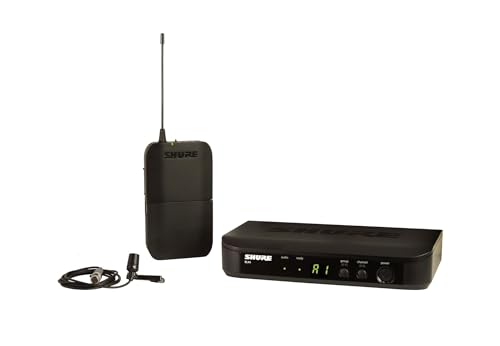
Shure BLX14/CVL Lavalier Audio System H9 Band (512–542 MHz) – BLX4 Receiver, BLX1 Bodypack & CVL Clip-On Lavalier Mic, Up to 14 Hr Battery, 300 ft Range
$359.00 Specs and sizingThe standard church lapel system. Omnidirectional, forgiving of head movement, and built on a receiver platform with a decade of parts availability behind it.
Best for: A preacher who wants nothing visible on the face
Check price on Amazon
Audio-Technica ATW-1101/L Wireless Lavalier System
$399.95 Specs and sizingA 2.4 GHz digital lapel system with automatic frequency selection, which removes UHF coordination entirely. Range of about 100 feet is ample in a small sanctuary.
Best for: A first lapel channel where nobody will manage frequencies
Check price on Amazon
Shure Centraverse CVL Lavalier Condenser Microphone
$54.00A replacement lavalier capsule for a Shure bodypack at about $54. Buy it at the same time as the system, not after the first failure.
Best for: The spare that lives in the drawer
Check price on AmazonWho should not buy this tier: Churches whose preaching channel already feeds back, where the answer is a headworn capsule rather than a better lapel.
Mid-size church: two speaking positions, $689
Once there are two people who speak regularly, a dual receiver is the efficient purchase. It halves the rack space, halves the power outlets and puts both frequencies under one display, which makes the weekly check a single glance rather than two. The second channel is also your spare, which quietly solves the redundancy problem.

Shure BLX188/CVL Dual Wireless Lavalier System - H9 Band
$689.00 Specs and sizingTwo lavalier channels in one dual receiver, which halves the rack space and the outlets for a church needing a pastor and a worship leader on lapels.
Best for: Two speaking positions, or a pastor plus a guaranteed spare
Check price on Amazon Shure BLX14/CVL Lavalier Audio System H9 Band (512–542 MHz) – BLX4 Receiver, BLX1 Bodypack & CVL Clip-On Lavalier Mic, Up to 14 Hr Battery, 300 ft Range
$359.00 Specs and sizingThe single channel version where only one lapel is genuinely needed and the budget is better spent elsewhere on the platform.
Best for: One speaking position in a 100 to 500 seat room
Check price on AmazonWho should not buy this tier: Rooms already running six or more transmitters, where analog channel spacing is wasting spectrum.
Large room or multi-campus: $737
At this level the lapel is usually a second channel rather than the primary one: the preacher wears an earset and the lapel covers a guest, a reading or an interview. What you are buying is a channel that works every week without anyone checking it, and that reliability comes from a digital platform with a wide tuning range and nothing on the transmitter to set wrong.

Sennheiser EW-D ME2 Lavalier SET (R4-9)
$737.40 Specs and sizingThe EW-D bodypack with an omnidirectional ME2 lavalier, a 56 MHz tuning range and no transmitter gain control, so there is one fewer thing for a volunteer to set wrongly.
Best for: A lapel channel that has to work without anyone checking it
Check price on Amazon Shure BLX188/CVL Dual Wireless Lavalier System - H9 Band
$689.00 Specs and sizingWhere two lapel channels are needed and the budget will not stretch to two digital systems, this keeps both in one rack unit on a well understood platform.
Best for: Two lapel positions in a busy rack
Check price on AmazonWho should not buy this tier: A church with one speaking position and four total wireless channels. The tuning range and digital transmission are solving a spectrum congestion problem you do not have, and a $359 system in the same position would be indistinguishable from the pews.
When a lavalier is genuinely the right choice
There are real cases, and it is worth naming them rather than treating every lapel as a compromise. A guest speaker who will be on the platform once and will not tolerate fitting a headworn boom. A drama or reading where the microphone must not be part of the costume. A baptistry or communion position where a headworn capsule is impractical. A pastor who has tried a headset, hated it, and whose willingness to use the system at all is the binding constraint.
In every one of those cases, the way to make a lapel work is placement and loudspeaker geometry rather than processing. Clip as high as the clothing allows, get the capsule out from under fabric, roll off the low end to tame chest resonance, and make sure no loudspeaker is behind the speaking position. The comparison is laid out in full at lavalier versus headset and handheld versus lavalier versus headset.
Lavalier systems compared
| Model | Price | Microphone type | Frequency band | Transmitter type | Rated range | Battery life | Polar pattern |
|---|---|---|---|---|---|---|---|
| Audio-Technica ATW-1101/L Wireless Lavalier System | $399.95 | Condenser lavalier | 2.4 GHz digital | Bodypack | 100 ft | 7 hours | - |
| Shure BLX14/CVL Lavalier Audio System H9 Band (512–542 MHz) – BLX4 Receiver, BLX1 Bodypack & CVL Clip-On Lavalier Mic, Up to 14 Hr Battery, 300 ft Range | $359.00 | Condenser lavalier | UHF | Bodypack | 300 ft | 14 hours | Omnidirectional |
| Shure BLX188/CVL Dual Wireless Lavalier System - H9 Band | $689.00 | Condenser lavalier | UHF | Two bodypacks | 300 ft | 14 hours | - |
| Sennheiser EW-D ME2 Lavalier SET (R4-9) | $737.40 | Condenser lavalier | UHF digital | Bodypack | - | - | Omnidirectional |
| Shure Centraverse CVL Lavalier Condenser Microphone | $54.00 | Condenser lavalier | - | - | - | - | Omnidirectional |
What usually goes wrong with lapel channels
Clothing rustle, which is a mounting problem rather than a capsule problem. The cable must be secured so it cannot drag across fabric, and the capsule must sit clear of anything that can brush it. A loop of cable taped behind the clip takes the strain and solves most of it.
Then there is the capsule itself. Lavaliers live against clothing, collect makeup and moisture, and die slowly. Budget one as a consumable. And finally the level: because the capsule is far from the mouth, the channel runs with far more gain than a handheld, so every other open microphone on the platform is competing with it. Reducing the number of open microphones is usually more effective than any processing, which is covered in eliminating feedback and reducing stage volume.
How we chose
We did not test these products in person and we never claim to. Picks are researched from manufacturer specification sheets and operator manuals, FCC rules where spectrum is involved, published standards, warranty terms, and the recurring themes in verified owner reviews. Every pick is matched to a real room size, seat count or input list rather than to a price bracket, and it is placed in the tier where its capability actually belongs. Where a product is wrong for most churches we say so on the page.
Sources
- FCC rules on legal operating bands for wireless microphones
- Shure published specifications for the BLX14/CVL and BLX188/CVL systems
- Sennheiser published specifications for the EW-D ME2 lavalier set
- Audio-Technica published specifications for the ATW-1101/L System 10 lavalier system
Frequently asked questions
Where should a lavalier microphone be clipped?
As high on the chest as the clothing allows, ideally on the collar edge or the top of a lapel, about six to eight inches from the mouth and slightly off centre. Keep it clear of fabric that can brush the capsule and never place it under a jacket lapel, which muffles high frequencies. Secure a loop of cable behind the clip so movement does not drag the capsule.
Why does our lapel microphone feed back so easily?
Because it is six to twelve inches from the mouth instead of one, so the channel needs ten to sixteen decibels more gain than a headworn capsule would, and that extra gain is exactly what the room gives back. Lavaliers are also omnidirectional, so they have no pattern rejection to help. Check that no loudspeaker sits behind or above the speaking position before blaming the microphone.
Should our church buy a lavalier or a headset microphone?
A headset, unless appearance genuinely rules it out. The headworn capsule is worth roughly six to ten decibels of gain before feedback and gives a far more consistent level. Buy a lavalier when the speaker will not wear a headset, when nothing may be visible on the face, or for guests and drama where fitting a boom is impractical. A used channel beats an unused better one.
How long does a lavalier capsule last?
Typically two to four years of weekly use. Lavaliers sit against skin and clothing, so makeup, sweat and moisture gradually clog the diaphragm, and the symptom is a slow loss of high frequency detail rather than a sudden failure. A spare capsule costs about $54 against roughly $359 for a complete system, so buy the spare with the system rather than after the failure.
Can I use one receiver for two lapel microphones?
Only with a dual receiver designed for it, such as the BLX188 system, which houses two independent channels in one rack unit with two bodypacks. A single channel receiver handles exactly one transmitter, and switching two transmitters onto one frequency produces interference rather than a shared channel. A dual unit halves rack space, outlets and the weekly check.
Do lavalier microphones need phantom power?
Not on a wireless system. The bodypack transmitter supplies the small bias voltage the condenser capsule needs from its own batteries, which is why the capsule connector is proprietary rather than XLR. Wired lavaliers intended to plug straight into a console do require phantom power, usually 48 volts, so check what the capsule expects before ordering a spare.
Researched, not professional advice. This page is compiled from published manufacturer specifications, operator manuals, FCC rules, published standards and owner-review consensus, not hands-on testing. Sound system design, rigging loudspeakers overhead, and any electrical work are jobs for a qualified professional: have flown loudspeakers and their attachment points signed off by a structural engineer or a certified rigger, and have all wiring done by a licensed electrician to your local code. Wireless microphone rules change, so confirm the current FCC position before buying. As an Amazon Associate we earn from qualifying purchases.