Wireless microphones
Best Wireless Microphones for Small Churches
Quick answer
A church under 250 seats needs two to four wireless channels, and the Sennheiser XSW 1-825 at $329 or the Shure BLX24/PG58 at $329 covers the first one properly. Budget about $1,100 for three channels, a spare capsule and a year of rechargeable batteries.
A small church is not a large church with less money. The constraints are different: one or two volunteers, no rack, no RF coordinator, and a room short enough that transmitter range is irrelevant. That combination changes the right answer. Range specifications of 300 feet mean nothing in a building 60 feet deep, and the things that actually break a small system are dead batteries, a lapel microphone pointed at a loudspeaker, and a donated receiver in a dead band. Start with the channel calculator, then look at the 100 seat sanctuary system to see where wireless sits in a whole budget.
On this page
- What two, three and four channels cost over five years
- Two channels: a preaching microphone and one handheld
- Three to four channels: adding worship vocals
- A small room that punches above its size
- Why a small building can often skip UHF
- Entry systems compared
- What to do about donated and secondhand wireless
What two, three and four channels cost over five years
The purchase price is the smaller half of the decision. Alkaline batteries in a transmitter rated at 10 to 14 hours are a recurring line item, and a church that runs two services plus a Wednesday rehearsal burns through them faster than anyone budgets for. The table below uses two AA cells per transmitter per weekend and a five year horizon, which is roughly when a volunteer-handled transmitter starts failing anyway.
Three wireless channels cost a small church about $1,450 over five years, of which roughly $440 is batteries rather than hardware.
| Channels | Hardware | Alkaline batteries, 5 years | Five year total | Rechargeable alternative |
|---|---|---|---|---|
| 2 | $658 | $290 | $948 | About $110 of packs and a charger |
| 3 | $1,007 | $440 | $1,447 | About $165 of packs and a charger |
| 4 | $1,336 | $585 | $1,921 | About $220 of packs and a charger |
| 6 | $2,024 | $880 | $2,904 | About $330 of packs and two chargers |
Hardware figures are current catalog prices for entry systems. Battery figures assume two AA cells per transmitter for two services and one rehearsal each week at about $0.55 a cell. Rechargeable packs change the arithmetic quickly above three channels, and the wireless battery calculator will run your own schedule.
Two channels: a preaching microphone and one handheld
Almost every small church wants the same two things: something on the person speaking that does not need holding, and a handheld that can go to a reader, a child or a visiting musician. Buy those two, buy a spare capsule, and stop. A fifth of the wireless in small churches is sitting in a cupboard because somebody bought a channel for a position that never moved.
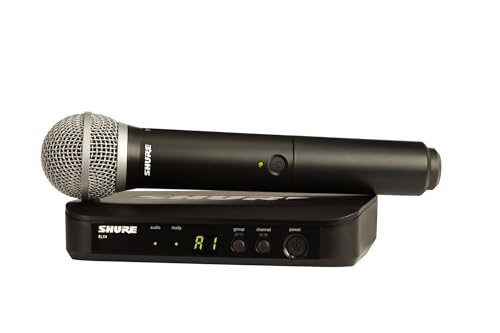
Shure BLX24/PG58 Wireless Vocal Microphone System - H10 Band
$329.00 Specs and sizingA real Shure receiver at the price of a no-name four pack. The PG58 capsule is the compromise, and the BLX4 receiver underneath it is the same one used in systems costing $200 more.
Best for: The roaming handheld that goes to whoever is speaking next
Check price on Amazon
Sennheiser Pro Audio XSW 1-825-A Vocal Wireless Microphone, A Range 548-572 MHz, Black, medium
$329.00 Specs and sizingOne button finds a clear frequency and syncs the transmitter to it. There is no scenario where a volunteer sets this up wrongly, which is the specification that matters most in a church with one tech person.
Best for: A first wireless channel with nobody to maintain it
Check price on Amazon
Audio-Technica ATW-1101/L Wireless Lavalier System
$399.95 Specs and sizingA 2.4 GHz digital lapel system with automatic frequency selection, so the UHF question never arises. About 100 feet of range, which in a 60 foot room is ample.
Best for: A first lapel channel in a small sanctuary
Check price on AmazonWho should not buy this tier: A church that already owns four channels and is fighting for spectrum rather than for budget.
Three to four channels: adding worship vocals
The third and fourth channels are usually worship vocals, and this is where capsule choice starts to matter. A small room with floor wedges is a feedback problem waiting to happen, and the capsule pattern buys you more headroom than any processing will. Consider a headworn system for the preacher at this point too, because it frees the handheld for everyone else.

Shure BLX24/SM58 Wireless Microphone System - 14-Hour Battery Life, 300 ft Range, UHF
$389.00 Specs and sizingThe SM58 capsule is worth the $60 over the PG58 for a vocal that has to sit in a mix rather than just be intelligible. It is also the capsule every guest musician expects.
Best for: Worship vocals in a 100 to 250 seat room
Check price on Amazon
Shure BLX14/P31 Wireless Headset Microphone System - H10 Band
$379.00 Specs and sizingMoves the preacher to a headworn capsule, which buys roughly 6 to 10 dB of gain before feedback over a lapel because the capsule never changes distance from the mouth.
Best for: A preacher who moves, in a room with hard surfaces
Check price on Amazon
Audio-Technica ATW-1101/H Wireless Headworn Microphone System
$399.95 Specs and sizingA headworn 2.4 GHz system at roughly half the price of the UHF equivalents, with the same caveat about sharing the band with the building network.
Best for: A small building where you control the Wi-Fi plan
Check price on AmazonWho should not buy this tier: Rooms over about 400 seats, where the 2.4 GHz range limit and the wedge volume both start to bite.
A small room that punches above its size
Some small churches are small rooms with big problems: a stone chapel with a four second reverberation tail, a school hall shared with a broadcaster, a plant meeting inside a building crowded with other tenants. That is where a small church legitimately buys equipment priced for a large one, and the justification is always the room rather than the seat count.

Sennheiser EW-D ME3 Dynamic Headset SET (R1-6)
$669.86 Specs and sizingA cardioid headworn capsule on the digital EW-D platform with a 56 MHz tuning range. The directional capsule plus the fixed mouth distance is the most feedback-resistant combination you can put on a preacher.
Best for: High ceilings, hard surfaces and a wireless preaching microphone
Check price on Amazon
Shure GLXD24+/SM58 Digital Wireless Vocal System - Z3 Band
$659.00 Specs and sizingDual band 2.4 and 5.8 GHz with automatic frequency management and rechargeable batteries. If the UHF spectrum at your address is genuinely full, this sidesteps it.
Best for: Buildings in dense urban markets with little open UHF
Check price on AmazonWho should not buy this tier: An ordinary 150 seat sanctuary with carpet and a modest platform volume. You would be buying tuning range and RF performance that a quiet room and four channels will never call on, and the money is better spent on treating the room or on a second loudspeaker.
Why a small building can often skip UHF
The standard advice to buy UHF exists because large venues need range and channel count. A 60 by 40 foot room needs neither. The unlicensed bands at 2.4 GHz and 5.8 GHz are legal everywhere in the United States, carry no risk of a future auction taking them away, and require no coordination at all. Their weaknesses are range, about 100 feet in practice, and coexistence with the building network.
That coexistence is manageable and worth stating plainly: put the church Wi-Fi on fixed channels, keep guest devices off the 2.4 GHz band where you can, and do not put a wireless access point on the platform. Do that and a 2.4 GHz system is genuinely reliable. Skip it and you get intermittent dropouts nobody can reproduce. The trade-offs are laid out in UHF versus 2.4 GHz, and the band itself in 2.4 GHz ISM.
Entry systems compared
| Model | Price | Frequency band | Transmitter type | Microphone type | Battery life | Rated range | Polar pattern |
|---|---|---|---|---|---|---|---|
| Shure BLX24/PG58 Wireless Vocal Microphone System - H10 Band | $329.00 | UHF | Handheld | Dynamic | 14 hours | 300 ft | Cardioid |
| Sennheiser Pro Audio XSW 1-825-A Vocal Wireless Microphone, A Range 548-572 MHz, Black, medium | $329.00 | UHF | Handheld | Dynamic | 10 hours | - | Cardioid |
 Audio-Technica ATW-1102 Wireless Handheld Microphone System Audio-Technica ATW-1102 Wireless Handheld Microphone System | $349.95 | 2.4 GHz digital | Handheld | Dynamic | 7 hours | 100 ft | - |
| Audio-Technica ATW-1101/L Wireless Lavalier System | $399.95 | 2.4 GHz digital | Bodypack | Condenser lavalier | 7 hours | 100 ft | - |
| Shure BLX14/P31 Wireless Headset Microphone System - H10 Band | $379.00 | UHF | Bodypack | Condenser headworn | 14 hours | 300 ft | Cardioid |
What to do about donated and secondhand wireless
Small churches are offered old wireless constantly, and a good share of it is illegal to operate. Anything tuned inside 617 to 652 MHz or 663 to 698 MHz was reallocated to mobile carriers and cannot be used, and gear in the old 700 MHz band has been prohibited since 2010. The band letter on the receiver, printed as something like H9, J11 or G20, is what tells you. Look it up against the frequency band chart before accepting the gift, because the church that accepts it inherits the disposal problem. Secondhand gear tuned to a prohibited band is worthless: it is not a bargain, it is scrap that still lights up.
How we chose
We did not test these products in person and we never claim to. Picks are researched from manufacturer specification sheets and operator manuals, FCC rules where spectrum is involved, published standards, warranty terms, and the recurring themes in verified owner reviews. Every pick is matched to a real room size, seat count or input list rather than to a price bracket, and it is placed in the tier where its capability actually belongs. Where a product is wrong for most churches we say so on the page.
Sources
- FCC guidance on legal operating bands for low power auxiliary wireless microphones
- Shure published specifications and battery life figures for the BLX platform
- Sennheiser published specifications for the XSW 1 series
- Audio-Technica published specifications for the System 10 family
Frequently asked questions
How many wireless microphones does a small church need?
Two to four. A preaching channel and a roaming handheld cover the majority of services in a church under 250 seats, and the third and fourth channels are usually worship vocals. Count only the positions that genuinely move: a lectern, a choir and a fixed keyboard all stay put and should be wired, which is cheaper to buy, cheaper to run and more reliable.
Is cheap wireless under $150 ever worth buying for a church?
Rarely. Unbranded systems in that price band typically have fixed or few frequencies, no diversity reception and no spare parts, so a single interference source takes the channel out with nothing you can do about it. The failure mode is silence during a service rather than poor sound quality. A single $329 system from a manufacturer with a service network is a better purchase than four cheap ones.
Do I need a rack mounted receiver in a small church?
No. Rack mounting matters when you have several receivers, need antenna distribution or want the equipment locked away. With two channels, a shelf near the mix position is fine as long as the receiver antennas can see the platform. Keep them out of metal enclosures and away from network switches and power supplies, which is where most range complaints actually come from.
How long do wireless microphone batteries last in a church?
Manufacturer ratings of 10 to 14 hours are for continuous transmission on fresh alkaline cells. A church running two services and a rehearsal uses roughly three to four hours a week, so a set of cells covers about three weekends. Most churches change them every Sunday anyway, which is why rechargeable packs pay for themselves above three channels. Run your own schedule through the battery calculator.
Can a small church use 2.4 GHz wireless microphones?
Yes, and it is often the better choice. The band is unlicensed and legal everywhere in the United States, systems manage their own frequencies, and range of about 100 feet is more than a small sanctuary needs. The requirement is control of the building Wi-Fi: fixed access point channels, no access point on the platform, and guest devices steered to 5 GHz where possible.
What should a small church buy first, wireless or better speakers?
Speakers, in nearly every case. A wireless channel solves a convenience problem and a loudspeaker solves an intelligibility problem, and congregations complain about intelligibility. The exception is a preacher who cannot hold a microphone while doing anything else, which is a genuine service problem rather than a preference. Work the whole budget through the AV budget allocator before deciding an order.
Researched, not professional advice. This page is compiled from published manufacturer specifications, operator manuals, FCC rules, published standards and owner-review consensus, not hands-on testing. Sound system design, rigging loudspeakers overhead, and any electrical work are jobs for a qualified professional: have flown loudspeakers and their attachment points signed off by a structural engineer or a certified rigger, and have all wiring done by a licensed electrician to your local code. Wireless microphone rules change, so confirm the current FCC position before buying. As an Amazon Associate we earn from qualifying purchases.