Loudspeakers
Best Speakers for Large Churches
Quick answer
A 1,000 seat sanctuary with a 100 foot throw needs roughly 1,200 watts per main loudspeaker across three boxes, plus two subwoofers and a delay pair for the rear third. Rooms past about 120 feet need an engineered array rather than more boxes.
Large rooms fail differently from small ones. The problem is almost never loudness, it is that the back third cannot follow speech while the front third is uncomfortable. That is a coverage and time problem, and it is solved with pattern control, delay zones and properly aimed boxes rather than with more power.
Start with the amplifier power calculator for watts per box at your throw distance, then the coverage calculator for how many boxes the shape needs. The worked example for a large room is the 1,000 seat system.
On this page
Why large rooms need delay speakers, not louder mains
Sound loses about 6 dB every time the distance doubles. In a 120 foot room, the seat at 15 feet and the seat at 120 feet differ by roughly 18 dB from the same loudspeaker. Turning the mains up to serve the back row makes the front row painfully loud long before the back becomes clear.
A delay zone fixes this. A pair of smaller loudspeakers placed two thirds of the way back, delayed so their sound arrives just after the sound from the mains, lifts the level at the back without touching the front. Getting the delay time right is what makes them disappear: set correctly, listeners still perceive the sound as coming from the platform. That timing is calculated, not guessed, in the delay speaker timing calculator, and the design is covered in under-balcony delay speakers.
The second large-room truth is that reverberation, not distance, is usually what destroys intelligibility. A large hard-surfaced sanctuary can be perfectly loud at the back and still unintelligible. Tighter pattern control aims energy at people rather than at walls, which is why large rooms favour narrow conical boxes or arrays.
System requirement by large room size
Main boxes, subwoofers and delay zones by seat count and throw.
A 1,000 seat room with a 100 foot throw typically needs three main boxes of about 1,200 watts each, two subwoofers and one delay zone.
| Seats | Throw | Main boxes | Watts per box | Subwoofers | Delay zones |
|---|---|---|---|---|---|
| 500 to 650 | 70 to 80 feet | 2 | about 700 | 1 to 2 | 0 or 1 if a balcony exists |
| 650 to 800 | 80 to 90 feet | 2 to 3 | about 900 | 2 | 1 if deeper than 80 feet |
| 800 to 1,000 | 90 to 100 feet | 3 | about 1,200 | 2 | 1 |
| 1,000 to 1,500 | 100 to 120 feet | 3 or a column array | about 1,500 | 2 to 4 | 1 to 2 |
| Over 1,500 | Over 120 feet | Engineered array | Specified by designer | 4 and up | 2 and up |
Figures assume a contemporary service at about 92 dBA with 12 dB of peak headroom, and loudspeakers flown above head height. A traditional service at 85 dBA needs roughly half the power. Rooms over about 1,500 seats should be modelled by a system designer rather than specified from a table.
The smaller large room: 500 to 650 seats
At the bottom of the large category, a well chosen pair of high output 12 inch boxes still does the job, provided they are flown and correctly aimed. The narrow conical pattern is what matters here: it throws to the back row without exciting the side walls.

QSC K12.2 Active 12" Powered 2000 Watt Loudspeaker
$899.99 Specs and sizingA published 132 dB maximum with a 75 by 75 degree conical pattern and fly points, which is enough for a 500 to 650 seat room with a properly aimed pair.
Best for: A 500 to 650 seat sanctuary with a flown pair
Check price on Amazon
Electro-Voice ELX200-12P 12" 1200W 2-Way Powered Loudspeaker
$811.80 Specs and sizingInstall-grade DSP, app control and real M10 fly points at a lower price than most of this class, for a church filling a large room on a limited budget.
Best for: A permanent flown install where budget is the binding constraint
Check price on AmazonWho should not buy this tier: Rooms deeper than about 80 feet without a delay zone, and contemporary services expecting full band weight without subwoofers.
650 to 1,000 seats: mains plus subwoofers
In this range subwoofers stop being optional for contemporary worship, because the mains are already working hard on vocals and cannot also carry a bass guitar and a kick drum. Splitting the low frequencies to a dedicated box frees the mains and typically improves vocal clarity noticeably.

JBL Professional PRX915 Next-Generation 15-Inch Powered Portable 2-Way Loudspeaker with DSP, 12-band parametric EQ, and Built-in Effects
$1,099.00 Specs and sizingA 2,000 watt 15 inch box with fly points and full DSP, giving the mains enough low end to stay full even before the subwoofers are brought up.
Best for: Full-band contemporary worship in a 650 to 1,000 seat room
Check price on Amazon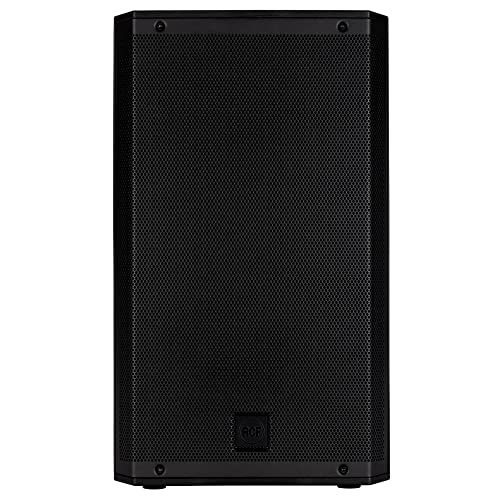
RCF ART 912-A 2,100W 12-inch Powered Speaker
$899.00 Specs and sizingA 2,100 watt 12 that is more forward and detailed than most of its class, which helps a lead vocal stay above a band in a large room.
Best for: Vocal-led worship where the lead voice must cut through
Check price on Amazon
QSC KS112 Active 12" Subwoofer
$1,299.99 Specs and sizingA compact 12 inch subwoofer that fits under a platform or beside a riser, which is often the difference between a subwoofer existing and not.
Best for: Large rooms with no floor space to spare at the platform
Check price on AmazonWho should not buy this tier: Rooms over about 1,200 seats, where a point source pair cannot cover the depth without an unacceptable front to back difference.
Over 1,000 seats or multi-campus standard
At this size the system is designed rather than assembled, and the church should expect to engage a designer and a rigger. What is bought here is pattern control and low frequency capability: the ability to place sound precisely on the seating and to reproduce a full band cleanly at the back of a very deep room. Column solutions are covered in the column array roundup, and the format decision in line array against point source.

RCF NX 912-A 2,100-watt 12-inch Powered Speaker
$1,449.00 Specs and sizingInstall and touring grade construction with a birch cabinet and a more capable processing section, for a church that replaces its system once in fifteen years.
Best for: A flagship sanctuary, or a repeated standard across several campuses
Check price on Amazon
QSC KC12-BK System Column Line Array PA
$1,999.99 Specs and sizingA column array on a 12 inch subwoofer, giving very even front-to-back coverage in a long room without flying anything from the structure.
Best for: Long narrow sanctuaries and historic buildings where nothing may be attached
Check price on Amazon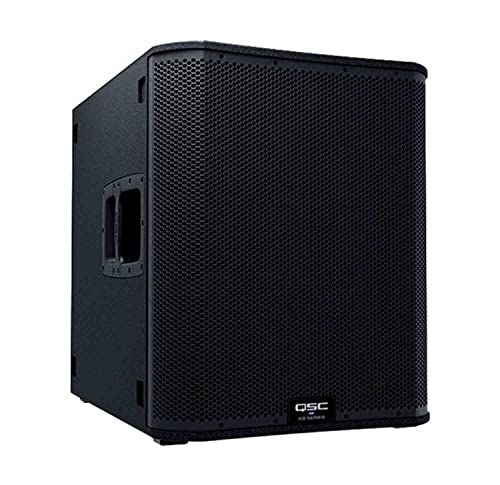
QSC KS118 Active 18" Subwoofer
$2,199.99 Specs and sizingAn 18 inch cardioid-capable subwoofer reaching into the low thirties. Cardioid mode is the point in a church: it keeps low energy off the platform and out of the open microphones.
Best for: Contemporary worship in a large room, especially where the platform booms
Check price on AmazonWho should not buy this tier: Do not buy this tier for a room under about 600 seats. Flagship boxes and large subwoofers reach their advantage at levels a mid-size room cannot use, the rigging cost is substantial, and in a smaller reverberant sanctuary the extra low frequency energy actively reduces speech intelligibility rather than improving the experience.
Commissioning a large system
A large system is not finished when it is installed. It needs each zone level matched, each delay zone timed, and the whole system equalised for the room. Skipping this step is the most common reason an expensive large church system disappoints: the boxes are capable, and nothing has been aligned.
Three checks matter most. Confirm the front to back level difference is within a few decibels once delays are set. Confirm the delay times against measurement rather than estimate. And confirm intelligibility at the worst seat in the room, usually under a balcony or on the back corner, since that seat is the true measure of the system.
The process is covered in how to tune a church sound system, and multi-site standardisation in multi-campus church AV. Large reverberant rooms should also budget for absorption, since no loudspeaker overcomes a long reverberation time.
How we chose
We did not test these products in person and we never claim to. Picks are researched from manufacturer specification sheets and operator manuals, FCC rules where spectrum is involved, published standards, warranty terms, and the recurring themes in verified owner reviews. Every pick is matched to a real room size, seat count or input list rather than to a price bracket, and it is placed in the tier where its capability actually belongs. Where a product is wrong for most churches we say so on the page.
Sources
- Manufacturer published specifications for each loudspeaker listed
- Inverse square law calculation for level loss with distance
Frequently asked questions
How many watts does a 1,000 seat church need?
Roughly 1,200 watts per main loudspeaker across three boxes for a contemporary service at about 92 dBA with headroom, plus separate amplification for two subwoofers. A traditional service at lower level needs around half that. The figure depends far more on throw distance and target level than on the seat count itself, so calculate it from your own room dimensions.
Do large churches need line arrays?
Not automatically. A properly aimed pair or trio of point source boxes covers most rooms up to about 1,200 seats. Arrays earn their cost in very deep rooms, where they deliver more consistent level from front to back, and in rooms with difficult geometry. They also cost considerably more to buy and to rig, so the decision should follow a coverage study.
Where should delay speakers be placed?
Typically about two thirds of the way back, or immediately under a balcony where the soffit blocks the mains. They should be small, aimed at the seats they serve, and delayed so their sound arrives just after the main system, usually with a small additional offset so listeners still localise the platform. Placement and timing both need calculation rather than estimation.
How many subwoofers does a large church need?
Two is the usual starting point for a contemporary service in a room of 800 to 1,000 seats, rising to four in a very large or very long room. More important than the count is placement and whether the subwoofers are cardioid, since low frequency energy on the platform gets into every open microphone and makes the whole mix muddier.
Should a large church hire a system designer?
Over about 800 seats, yes. A designer models coverage against the actual room geometry, specifies rigging that an engineer will sign, and produces the documentation the building inspection will want. The cost is small against the system, and the common alternative, assembling a large system from catalog guesswork, produces the coverage problems that are then very expensive to correct.
Why is our large church loud but still hard to understand?
Almost always reverberation rather than level. In a hard-surfaced room, reflected sound arrives after the direct sound and smears consonants, so speech becomes unclear no matter how loud it is. The fixes are tighter loudspeaker pattern control aimed at people rather than walls, delay zones so the mains need not be pushed, and absorption on the rear wall.
Researched, not professional advice. This page is compiled from published manufacturer specifications, operator manuals, FCC rules, published standards and owner-review consensus, not hands-on testing. Sound system design, rigging loudspeakers overhead, and any electrical work are jobs for a qualified professional: have flown loudspeakers and their attachment points signed off by a structural engineer or a certified rigger, and have all wiring done by a licensed electrician to your local code. Wireless microphone rules change, so confirm the current FCC position before buying. As an Amazon Associate we earn from qualifying purchases.