System design
Sanctuary Seating Coverage Calculator
Quick answer
A 300 seat sanctuary built to standard church proportions is about 39 feet wide and 59 feet deep. Reaching both back corners needs a loudspeaker with at least a 43 degree horizontal pattern, and covering the room evenly takes 3 loudspeakers once it is wide or deep enough that one box leaves the sides thin.
Two sanctuaries can seat the same 300 people and need completely different loudspeakers. A wide, shallow room and a narrow, deep one both hold 300 seats at 7.5 square feet each, but one needs a wide horizontal pattern at a short throw and the other needs a narrow pattern at a long throw. Seat count alone answers neither question.
This tool works from the room's actual shape. Enter your width, depth and seat count below, and it returns the horizontal pattern a loudspeaker needs and how many boxes the room calls for, using the same geometry model that runs the rest of this site.
Sanctuary seating coverage calculator
Pattern and loudspeaker count needed
Loudspeakers with a matching coverage pattern
Top matches update when you change your numbers.

QSC K8.2 Active 8" Powered 2000 Watt Loudspeaker
$749.99 Specs and sizingA very wide 105 degree pattern in a small box, with the same amplifier as its larger siblings. Works as a main in a small room and as a front fill or a wedge in a large one.
Best for: Small chapels, front fills for the first two rows, and side fills
Check price on Amazon
QSC K10.2 Active 10" Powered 2000 Watt Loudspeaker
$799.99 Specs and sizingThe K12.2 amplifier and DSP behind a 10 inch woofer and a wider 90 degree pattern, which suits a wide, shallow room better than the 12 does.
Best for: Wide fan-shaped rooms and balcony fills where coverage matters more than low end
Check price on Amazon
QSC K12.2 Active 12" Powered 2000 Watt Loudspeaker
$899.99 Specs and sizingThe default answer for a church main speaker, and the one most rental companies own. A 2,000 watt class D amplifier, a 75 degree conical pattern that throws evenly to the back, and preset voicings that get a volunteer close on the first try.
Best for: A 150 to 400 seat sanctuary on stands or flown, for almost any service style
Check price on Amazon
JBL Professional EON712 Powered PA Speaker, 12 inch, 1300 Watt
$549.00 Specs and sizingA waveguide-loaded 12 with onboard DSP and app control, and a 100 by 60 pattern that is wider horizontally than the QSC, so it covers the front pews better and the back wall slightly less.
Best for: Wide rooms of moderate depth, and anywhere the front rows are currently being missed
Check price on Amazon
JBL Professional EON715 Powered PA Speaker, 15 inch, 1300 Watt
$559.99 Specs and sizingThe EON712 with a 15 inch woofer, which buys real low end for a band without adding a separate subwoofer.
Best for: Contemporary worship in a mid-size room that has no budget line for subwoofers yet
Check price on Amazon
Electro-Voice ZLX-12P-G2 12in. 2-Way Powered Loudspeaker with Bluetooth
$549.00 Specs and sizingElectro-Voice horn design and a 1,000 watt amplifier at the bottom of the serious-speaker price range, with app control and a proper 90 by 60 waveguide rather than a nominal one.
Best for: The first real upgrade from consumer or unbranded PA speakers
Check price on Amazon
Electro-Voice ZLX-15P-G2 15in. 2-Way Powered Loudspeaker with Bluetooth
$649.00 Specs and sizingThe 15 inch ZLX, which trades a little pattern control for noticeably more low end at the same price point as many 12s.
Best for: Small to mid-size rooms with a band and no subwoofer budget
Check price on Amazon
Electro-Voice ELX200-12P 12" 1200W 2-Way Powered Loudspeaker
$811.80 Specs and sizingThe install-grade step above the ZLX: better DSP, app control and real M10 fly points, which is what lets it go on the wall permanently.
Best for: A permanent wall or ceiling mounted install in a mid-size room
Check price on Amazon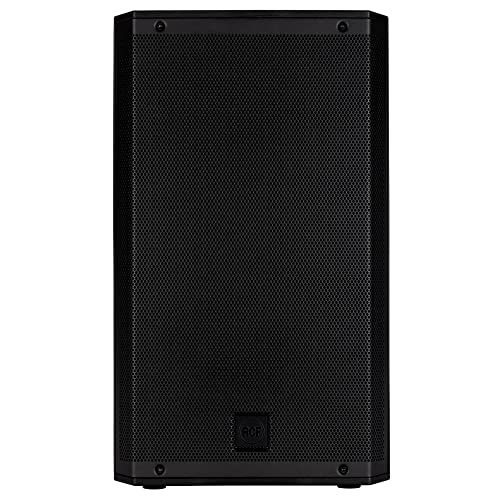
RCF ART 912-A 2,100W 12-inch Powered Speaker
$899.00 Specs and sizingAn Italian-built 12 with a 2,100 watt amplifier and RCF compression driver. Noticeably more forward and detailed than most of its price class, which flatters vocals.
Best for: Vocal-led worship where the lead voice must sit above the band
Check price on Amazon
Yamaha DXR12MKII, 12" 1100W Powered Speaker Cabinet
$909.99 Specs and sizingFIR-X crossover tuning and D-Contour processing, which keeps the voice intelligible as the level comes up rather than turning to mush.
Best for: Rooms where speech intelligibility at high level is the whole problem
Check price on Amazon
JBL Professional PRX912 Next-Generation 12-Inch Powered Portable 2-Way Loudspeaker with DSP, 12-band parametric EQ, and Built-in Effects
$999.00 Specs and sizingA 2,000 watt class D cabinet with a full DSP suite and fly points, built to be installed and left alone rather than moved weekly.
Best for: A permanent flown install in a 300 to 600 seat room
Check price on Amazon
QSC KC12-BK System Column Line Array PA
$1,999.99 Specs and sizingA column array on a 12 inch subwoofer, which gives very even front-to-back coverage in a long narrow room without flying anything from the ceiling.
Best for: Long narrow sanctuaries and historic buildings where nothing may be attached to the structure
Check price on AmazonOn this page
How is loudspeaker count and pattern decided from a room shape?
Two separate questions, and they are decided by different things. The pattern a loudspeaker needs comes from the width it must cover and the distance it is throwing from, using the same trigonometry an installer uses to read a manufacturer's coverage chart:
angle = 2 * atan( width / 2 / throw distance )
The box count comes from the seat count on its own: two loudspeakers cover most rooms up to about 250 seats, three up to about 600, and four beyond that, because past a certain size one point-source pair starts leaving the front rows too loud and the back rows too quiet at the same time. A wide fan-shaped room and a long narrow one with the same seat count get the same box count and a completely different pattern.
Where no seat count is given, this tool models the room using standard assembly-space planning figures: 7 to 8 square feet per seat, and a room roughly one and a half times as long as it is wide. Enter your own width and depth to override that model with your actual building.
Coverage angle needed by seat count, standard room proportions
Assuming the standard 1 to 1.5 width-to-depth proportion used across this site. Your own room will differ, which is the point of entering real numbers below.
A 300 seat sanctuary in standard proportions needs roughly a 43 degree horizontal pattern and 3 loudspeakers, and an 800 seat room needs a similar pattern angle but a fourth box to keep the level even front to back.
| Seats | Width | Depth | Throw to back row | Pattern needed | Loudspeakers |
|---|---|---|---|---|---|
| 100 seats | 23 ft | 35 ft | 30 ft | 42 deg | 2 |
| 200 seats | 32 ft | 48 ft | 41 ft | 43 deg | 2 |
| 300 seats | 39 ft | 59 ft | 50 ft | 43 deg | 3 |
| 500 seats | 50 ft | 75 ft | 64 ft | 43 deg | 3 |
| 800 seats | 61 ft | 92 ft | 78 ft | 43 deg | 4 |
| 1,200 seats | 75 ft | 113 ft | 96 ft | 43 deg | 4 |
Pattern needed is the horizontal angle for one box (or a matched pair on the centerline) to reach both back corners. It changes very little with seat count once the room holds its proportions, which is the reason box count and pattern are two separate answers.
Why room shape matters more than seat count
The same 300 seats and the same 2,250 square feet of floor, arranged three different ways. The loudspeaker count from seats alone stays at 3 in every case. The pattern needed does not.
The same 300 seat sanctuary needs a 77 degree pattern if it is wide and shallow, 43 degrees at standard proportions, or as little as 22 degrees if it is narrow and deep, even though the seat count and box count never change.
| Room shape | Width | Depth | Throw | Pattern needed |
|---|---|---|---|---|
| Wide and shallow | 55 ft | 41 ft | 35 ft | 77 deg |
| Standard church proportions | 39 ft | 58 ft | 49 ft | 43 deg |
| Narrow and deep | 27 ft | 83 ft | 71 ft | 22 deg |
A fan-shaped room with a shallow rear wall is the case that catches installers out: it looks like a small room because the throw is short, but it needs one of the widest patterns on the market to reach the side seats.
What if the room is not a simple rectangle?
Balconies, transepts and cross-aisles all break the single-throw-distance assumption this calculator makes, and each needs its own fix rather than a wider main pattern. A deep balcony usually needs its own delay-timed fill rather than asking the main system to throw further and louder, worked out with the delay speaker timing calculator. A distributed ceiling system in a fellowship hall or a low-ceilinged overflow room is a different problem entirely, worked out with the ceiling speaker spacing calculator rather than this one.
Treat the pattern this tool returns as the requirement for the main system covering the bulk of fixed seating, and check the edges of the room separately.
Which loudspeaker actually has this pattern?
The grid under the calculator filters to loudspeakers whose published horizontal pattern covers your number. As a guide: a wide pattern like the JBL Professional EON712 Powered PA Speaker, 12 inch, 1300 Watt at 100 by 60 degrees or the QSC K8.2 Active 8" Powered 2000 Watt Loudspeaker at 105 by 105 suits a wide, shallow room, a mid pattern like the QSC K10.2 Active 10" Powered 2000 Watt Loudspeaker at 90 by 90 or the Electro-Voice ZLX-12P-G2 12in. 2-Way Powered Loudspeaker with Bluetooth at 90 by 60 suits standard proportions, and a narrower box or a column array such as the QSC KC12-BK System Column Line Array PA suits a long narrow sanctuary where a wide pattern would waste energy on the side walls. Always check power separately with the amplifier power calculator: a loudspeaker with the right pattern and the wrong wattage still leaves the back row thin.
Frequently asked questions
How many loudspeakers does my sanctuary need?
Mostly from your seat count: two loudspeakers cover most rooms up to about 250 seats, three up to about 600, and four beyond that. That is a separate question from what horizontal pattern those loudspeakers need, which depends on your room shape rather than the headcount. A wide fan-shaped room and a long narrow room with the same seats get the same box count and very different patterns.
Does a bigger sanctuary always need a wider speaker pattern?
No, and this is the mistake this calculator exists to catch. A wide, shallow room needs a wide pattern at a short throw. A narrow, deep room with the same seat count needs a narrow pattern at a long throw, because the width to cover is smaller relative to the distance. Seat count alone tells you almost nothing about the pattern; width and depth tell you everything.
What coverage angle does a typical church sanctuary need?
For a room built to standard assembly-space proportions, roughly a width one and a half times shorter than its depth, the horizontal pattern needed lands around 40 to 45 degrees regardless of size, because the width-to-throw ratio stays constant as the room scales up. Wide fan-shaped rooms need 70 degrees or more, and narrow rooms need well under 30.
What if my sanctuary has a balcony or a cross-aisle?
Treat this calculator as answering for the main floor and its single throw distance, then solve the balcony separately with a delay-timed fill speaker rather than asking the main system to throw further and louder. A deep balcony is almost always a second, delayed sound source, not a bigger main loudspeaker.
Can one loudspeaker cover the whole sanctuary?
Sometimes, in a small room under about 150 seats with a very wide pattern box mounted centrally, but two loudspeakers as a stereo pair is the practical minimum for almost every church, because it lets the mix have left-right image and gives redundancy if one channel fails mid-service. Past 250 to 300 seats a center fill or a third box becomes worth adding regardless of pattern.
Why does this calculator ask for width and depth instead of just seats?
Because seat count sets the loudspeaker count reasonably well but says almost nothing about the pattern each one needs. Two rooms with 300 seats can need a 77 degree pattern or a 22 degree pattern depending on whether the room is wide and shallow or narrow and deep. Entering your actual dimensions is the only way to get the pattern question right.
Researched, not professional advice. This page is compiled from published manufacturer specifications, operator manuals, FCC rules, published standards and owner-review consensus, not hands-on testing. Sound system design, rigging loudspeakers overhead, and any electrical work are jobs for a qualified professional: have flown loudspeakers and their attachment points signed off by a structural engineer or a certified rigger, and have all wiring done by a licensed electrician to your local code. Wireless microphone rules change, so confirm the current FCC position before buying. As an Amazon Associate we earn from qualifying purchases.