Loudspeakers
Best Subwoofers for Churches
Quick answer
A contemporary church of 250 to 500 seats needs one or two subwoofers crossed over at about 80 to 100 Hz. A speech-led or traditional service usually needs none, because low frequency energy in a reverberant sanctuary reduces speech intelligibility.
A subwoofer takes the lowest octaves away from the main loudspeakers. That frees the mains to concentrate on vocals and instruments, which usually makes the whole system clearer as well as fuller. For contemporary worship with a kick drum and a bass guitar, it is the difference between a mix that sounds complete and one that sounds thin.
For a traditional service in a stone sanctuary it can be the wrong purchase entirely. Size the requirement honestly in the subwoofer sizing calculator and read the case against in subwoofer against no subwoofer.
On this page
When a subwoofer makes a church sound worse
Low frequencies are omnidirectional and long. In a sanctuary with hard plaster walls, a stone floor and a high ceiling, that energy does not decay quickly. It builds up, excites the room modes, and sits underneath everything as a low rumble that masks the consonants that make speech intelligible. In that room a subwoofer makes preaching harder to follow, which is the opposite of what the system is for.
Three signals suggest a subwoofer is the wrong purchase. The service is speech-led or traditional, with organ and choir rather than a rhythm section. The room is long and reverberant with no absorption. Or the platform already booms, which means low frequency energy is getting into the open microphones and muddying every channel.
In those cases the money does more good in acoustic treatment. Work out what the room needs in the acoustic treatment calculator first, because a room with a controlled reverberation time can then take a subwoofer successfully, while an untreated one cannot.
How many subwoofers by service style and room
Subwoofer count by seat count and what happens on the platform. Crossover points are typical starting values.
A contemporary service of 250 to 500 seats needs one to two subwoofers crossed at about 80 to 100 Hz, while a traditional service of any size usually needs none.
| Service style | Seats | Subwoofers | Typical crossover | Notes |
|---|---|---|---|---|
| Traditional, organ and choir | Any | 0 | Not applicable | Mains carry the organ pedal adequately |
| Speech-led with piano | Any | 0 | Not applicable | Spend on treatment and microphones instead |
| Blended, light rhythm section | Under 250 | 0 to 1 | 100 Hz | Only if the mains sound thin on bass guitar |
| Contemporary with drums | Under 250 | 1 | 90 to 100 Hz | A 12 inch sub is usually enough |
| Contemporary with drums | 250 to 500 | 1 to 2 | 80 to 100 Hz | An 18 inch, or two 12 inch either side |
| Contemporary with drums | 500 to 1,000 | 2 | 80 Hz | Cardioid worth specifying to protect the platform |
| Contemporary, large room | Over 1,000 | 2 to 4 | 80 Hz | Placement pattern matters as much as count |
Crossover points are starting values to be confirmed by measurement in the room. A 15 inch main crosses lower than a 12, and pushing the crossover too high makes the subwoofer position audible as a separate source.
A first subwoofer for a small contemporary church
A small church adding low end for the first time has two honest routes: a compact powered subwoofer that one volunteer can move, or a passive cabinet if the rack already has a spare amplifier channel. Both are a real step up from asking a 12 inch main to carry a bass guitar.
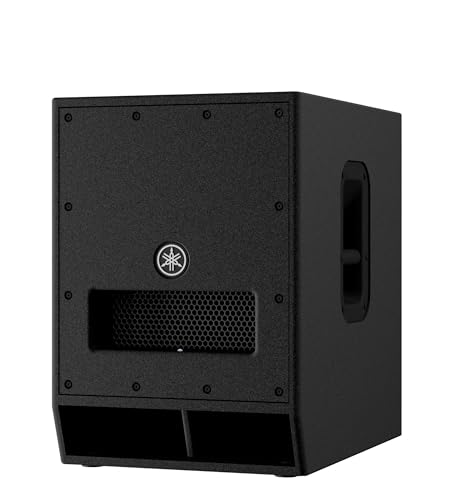
Yamaha DXS12 MKII Powered Subwoofer
$969.99 Specs and sizingYamaha processing with a cardioid mode in a 12 inch cabinet light enough for one volunteer to move, which matters for portable and small church use.
Best for: Portable setups and small rooms that want low end without a two-person lift
Check price on Amazon
JBL Professional JRX218S Portable PA, Line Array, Stage Subwoofer, 1400W Power Handling, Passive, Non-Powered, 18-Inch
$680.00 Specs and sizingA passive 18 for a system that already has amplifier channels spare. The cheapest honest route to low end when the rack has room and a channel free.
Best for: Rack-amplified systems with an unused amplifier channel
Check price on AmazonWho should not buy this tier: Traditional and speech-led services, and any untreated reverberant room where low energy has nowhere to go.
Mid-size contemporary: 250 to 500 seats
This is the tier most churches adding a subwoofer should buy. An 18 inch cabinet gives genuine extension for a kick drum and bass guitar, while a compact 12 inch model solves the very common problem of having nowhere to put it. Cardioid capability starts to matter here because the platform is close to the subwoofer.

Electro-Voice ELX200-18SP 18" 1200W Powered Subwoofer
$1,099.00 Specs and sizingAn 18 inch powered subwoofer with cardioid presets and fly points at roughly half the price of flagship options, which covers a mid-size contemporary room properly.
Best for: The first serious subwoofer for a growing contemporary church
Check price on Amazon
QSC KS112 Active 12" Subwoofer
$1,299.99 Specs and sizingA compact 12 inch subwoofer that fits under a platform or beside a riser, which is frequently the difference between a subwoofer existing and not existing.
Best for: Mid-size rooms with no floor space to spare
Check price on AmazonWho should not buy this tier: Rooms above about 700 seats running a full band, where a single mid-size subwoofer runs out of headroom.
Large room: extension and pattern control
In a large contemporary room the subwoofer is doing two jobs: producing the lowest octave with authority, and keeping that energy off the platform. Cardioid operation is what achieves the second, and in a church it matters more than the first, because low frequency energy on the platform gets into every open microphone and into the drum overheads.
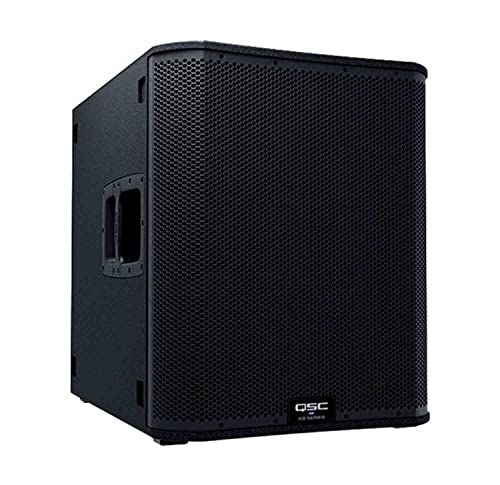
QSC KS118 Active 18" Subwoofer
$2,199.99 Specs and sizingAn 18 inch cardioid-capable cabinet reaching into the low thirties. The cardioid mode keeps low end out of the open microphones on the platform, which cleans up the whole mix.
Best for: Contemporary worship in a large room, especially where the platform booms
Check price on Amazon
JBL Professional PRX918XLF 18-Inch Powered Subwoofer, Portable PA, 2000 Watt, DSP, Parametric EQ, Bluetooth Low Energy (BLE), and APP Control
$1,499.00 Specs and sizingA deep-tuned 18 built for extended low frequency rather than maximum punch, with a full parametric section for correcting a difficult room response at the source.
Best for: Rooms with a problematic low frequency response that needs correcting
Check price on AmazonWho should not buy this tier: Do not buy this tier for a room under about 400 seats or for any traditional service. A flagship 18 inch subwoofer in a small or reverberant sanctuary produces energy the room cannot absorb, which muddies speech and gets into every open microphone. The same money spent on bass trapping and rear wall absorption will improve that room far more.
Setting the crossover and the level
Two settings determine whether a subwoofer helps or hurts. The crossover point decides where the mains hand over, and 80 to 100 Hz suits most church systems. Set it too high and listeners hear the low end coming from the floor rather than from the platform. Set it too low and the mains are still struggling with energy they cannot produce cleanly.
Level is the setting churches most often get wrong, because a subwoofer sounds exciting at the mix position and is often far too loud three rows back. Set it by walking the room during a rehearsal, not by ear from the desk. The commissioning process is covered in how to tune a church sound system.
If the platform booms once the subwoofer arrives, the fix is cardioid operation or repositioning rather than turning it down, because low energy in the open microphones affects every channel. That and the wider problem are covered in reducing stage volume in church, and the mains that pair with these subwoofers are in the powered speaker roundup.
How we chose
We did not test these products in person and we never claim to. Picks are researched from manufacturer specification sheets and operator manuals, FCC rules where spectrum is involved, published standards, warranty terms, and the recurring themes in verified owner reviews. Every pick is matched to a real room size, seat count or input list rather than to a price bracket, and it is placed in the tier where its capability actually belongs. Where a product is wrong for most churches we say so on the page.
Sources
- Manufacturer published specifications, including low frequency limits and cardioid capability
- Consensus of verified owner reviews across major retailers
Frequently asked questions
Does every church need a subwoofer?
No. A subwoofer is for contemporary worship with a kick drum and a bass guitar. A traditional service with organ and choir, or a speech-led service with a piano, is usually better without one, because the added low frequency energy in a reverberant sanctuary masks the consonants that make preaching intelligible. In those rooms, acoustic treatment is the better purchase.
What size subwoofer does a church need?
A 12 inch subwoofer suits a small contemporary room or a portable rig and is light enough for one person to move. An 18 inch cabinet gives genuine extension into the low thirties and is the right choice from roughly 250 seats upward. Two smaller subwoofers are sometimes better than one large one where floor space at the platform is limited.
What is a cardioid subwoofer and does a church need one?
A cardioid subwoofer reduces the low frequency energy radiated behind it, towards the platform. In a church that is valuable, because low energy on the platform enters every open microphone, muddies the drum overheads and makes in-ear mixes harder to balance. If the platform already booms, cardioid capability is worth prioritising over raw output.
Where should a church subwoofer be placed?
Usually on the floor near the centre of the platform rather than split wide to each side, since widely spaced subwoofers interact and create uneven coverage across the seats. Corners produce more apparent output because the room boundaries reinforce it, but the result is typically uneven. Always verify by walking the room during a rehearsal before fixing the position.
What crossover frequency should we use?
Between 80 and 100 Hz for most church systems, set a little lower when the mains have 15 inch woofers and a little higher with 12 inch mains. The goal is a handover the congregation cannot localise. If people can hear that the low end comes from the floor rather than the platform, the crossover is probably set too high.
Can we add a subwoofer to powered main speakers?
Yes, and it is the usual arrangement. A powered subwoofer takes the signal, reproduces the low frequencies and passes a high-passed feed onward to the mains, which relieves the mains of energy they cannot produce cleanly. Check that the subwoofer provides that high-passed output, since running the mains full range alongside a subwoofer wastes headroom and muddies the crossover region.
Researched, not professional advice. This page is compiled from published manufacturer specifications, operator manuals, FCC rules, published standards and owner-review consensus, not hands-on testing. Sound system design, rigging loudspeakers overhead, and any electrical work are jobs for a qualified professional: have flown loudspeakers and their attachment points signed off by a structural engineer or a certified rigger, and have all wiring done by a licensed electrician to your local code. Wireless microphone rules change, so confirm the current FCC position before buying. As an Amazon Associate we earn from qualifying purchases.