Monitoring
Best Earphones for In-Ear Monitoring in Church
Quick answer
Church in-ear monitoring needs earphones with real isolation, and about 37 dB is what a properly fitted sealed pair delivers. That isolation, not the driver count, is what lets the whole platform get quieter, and the Shure SE215 at $119.00 is where most churches should start.
Churches buy in-ear systems and then hand musicians whatever earphones were in a drawer, which wastes most of the purchase. The transmitter and the belt pack deliver a mix. The earphones decide whether the musician hears that mix or hears the drum kit through it, and that difference is what determines whether the platform can get quieter.
Isolation is the specification that matters. A sealed earphone with the right tip blocks roughly 37 dB of what is happening in the room, which means a drummer can hear a vocal at a comfortable level instead of chasing the cymbals. Read how to set up in-ear monitors in church for the transition, and in-ear monitors against floor wedges for whether to make it at all.
On this page
Isolation is the specification that matters
What each listening option blocks, and what that means for a musician standing four feet from a drum kit.
A sealed in-ear monitor blocks about 37 dB of room sound, which is roughly the difference between standing beside a drum kit and standing outside the building.
| Option | Published isolation | What the musician hears | Suitable for |
|---|---|---|---|
| Open earbuds | Almost none | The room, with a mix on top | Nothing on a worship platform |
| HD 280 Pro closed headphones | About 32 dB | Mostly the mix, but bulky to play in | The sound booth, not the platform |
| SE215 sealed in-ear | About 37 dB | The mix, with the room well down | Every musician on the platform |
| Sealed in-ear with foam tips | Highest of the sealed options | The mix, room almost gone | Drummers and anyone beside the kit |
| Custom moulded earphones | Highest available | The mix, with a fit that never moves | Musicians playing weekly for years |
Isolation figures are published manufacturer values for a correctly fitted seal. A loose tip gives back most of the isolation, which is why the fit kit that comes in the box matters and why a musician complaining that in-ears sound thin is usually describing a seal problem rather than a frequency response problem.
Why isolation lowers platform volume
The chain is simple. A musician who can hear themselves clearly does not ask for more. A musician wearing leaky earphones hears the drum kit acoustically, turns their mix up to sit above it, and now needs the drums louder in the mix as well, which everybody else then competes with. Leaky earphones start the same arms race that floor wedges do.
Sealed earphones break it. With 37 dB of isolation, the acoustic drum kit in the room is no longer the reference, so the musician sets their mix to a comfortable absolute level and leaves it. Churches that make this transition properly usually report that the whole service can run several decibels quieter, and that is the actual benefit being bought. See reducing stage volume in church.
The counterintuitive corollary is that in-ear monitoring does not automatically protect hearing. It moves the sound source into the ear canal, where the musician controls the level and nobody else can hear how loud it is. Isolation makes it possible to run quieter, and a limiter and some teaching are what make it happen. The transmitters and packs that carry these mixes are covered in in-ear monitor systems for churches.
Small church: the cheapest honest way in
A small church should find out whether the band will accept in-ears before spending money on them. A belt amplifier on a spare aux send plus a sealed earphone is under two hundred dollars a position and answers the question. The complete entry system is the other route, and it includes earphones, which is what makes it a single purchase decision rather than three.

Behringer P2 Ultra-Compact Personal In-Ear Monitor Amplifier
$39.90A belt-clip amplifier that takes an aux send and drives earphones. Paired with a sealed earphone it is a complete wired in-ear position for well under two hundred dollars, and it tells you whether your musicians will wear them at all.
Best for: Testing in-ear monitoring before committing to a system
Check price on Amazon
Shure PSM300 P3TR112GR Wireless in-Ear Personal Monitoring System with SE112 Earphones - G20 Band
$799.00 Specs and sizingTransmitter, bodypack and earphones in one box, so a church can start wireless in-ear monitoring with one purchase and no compatibility questions. The included earphones are the weak link and the obvious first upgrade.
Best for: The first in-ear channel, usually the worship leader
Check price on AmazonWho should not buy this tier: Drummers, who need the higher isolation of a properly sealed earphone before in-ears help them at all.
Mid-size: real isolation for every musician
This is the tier where the purchase actually works. A sealed earphone with a published isolation figure, fitted properly with the right tip, is the difference between in-ear monitoring that lowers stage volume and in-ear monitoring that everybody quietly abandons. Buy the earphones first and the transmitters second if the budget will not stretch to both.

Shure SE215 PRO Wired Earbuds - Professional Sound Isolating Earphones, Clear Sound & Deep Bass, Single Dynamic MicroDriver, Secure Fit In Ear Monitor, plus Carrying Case & Fit Kit - Clear (SE215-CL)
$119.00About 37 dB of isolation from a single dynamic driver, with a replaceable cable and a fit kit in the box. The replaceable cable matters on a volunteer rota, because the cable is what fails and a new one costs a fraction of a new pair.
Best for: Every musician moving from wedges to in-ears
Check price on Amazon
Shure PSM300 P3TRA215CL Pro Wireless in-Ear Personal Monitoring System with SE215-CL Earphones
$989.00 Specs and sizingThe standard wireless in-ear system supplied with the isolating earphones rather than the entry pair, which removes the most common mistake churches make when specifying their first system.
Best for: A musician who needs real isolation, especially the drummer
Check price on AmazonWho should not buy this tier: Churches that have not solved the monitor mix itself, because good earphones make a bad mix easier to hear clearly.
Large or multi-campus: standard issue and hearing protection
A large church has a rota of musicians, several campuses and a genuine duty of care. What changes at this size is standardisation and limiting: the same earphones issued to every position so a visiting musician knows what to expect, and a limiter in the bodypack so nobody can be injured by a patch cable fault or a burst of feedback straight into the ear canal. Beyond this tier the real upgrade is custom moulded earphones fitted by an audiologist, which are not an online purchase.

Sennheiser Pro Audio Sennheiser ew IEM G4-A1 In Ear Monitor system Range (470-516Mhz), Single
$1,249.00 Specs and sizingA wide tuning range for dense radio environments and a proper limiter in the bodypack. That limiter is a hearing protection feature rather than a convenience, and it is the reason to specify this system for a church with a large rota.
Best for: Bands large enough that in-ear channels compete with the microphones for spectrum
Check price on Amazon
Shure PSM300 Twin Pack Pro Wireless in-Ear Monitor System - G20
$1,539.00 Specs and sizingOne transmitter feeding two bodypacks, which is the efficient way to put two backing vocalists who want the same balance on in-ears without a second radio channel. In a crowded spectrum plan, halving the channel count is worth real money.
Best for: Two vocalists sharing a mix in a busy radio environment
Check price on Amazon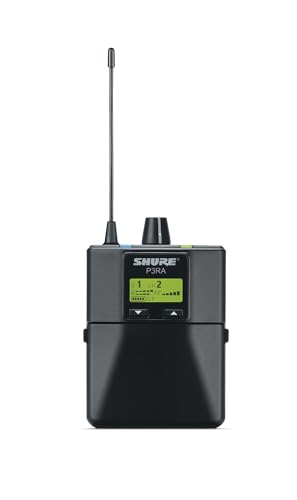
Shure P3RA Premium Wireless Bodypack Receiver for PSM300 Personal Monitoring Systems - G20 Band
$499.00A metal-bodied receiver that survives being dropped, stood on and packed away by a different volunteer every week, sold on its own so a church can add a musician without another transmitter.
Best for: Growing an in-ear system one musician at a time
Check price on AmazonWho should not buy this tier: Do not buy this tier for a band of three in a 120 seat room. A church at that size gets nearly all of the benefit from sealed earphones on wired belt amplifiers, and the radio channels, the battery management and the coordination time that come with this equipment are a weekly cost somebody has to pay.
The earphones and systems compared
| Model | Price | Wired | Frequency band | Personal mixes | Isolation | Battery life | Rated range |
|---|---|---|---|---|---|---|---|
| Shure SE215 PRO Wired Earbuds - Professional Sound Isolating Earphones, Clear Sound & Deep Bass, Single Dynamic MicroDriver, Secure Fit In Ear Monitor, plus Carrying Case & Fit Kit - Clear (SE215-CL) | $119.00 | Yes | - | - | 37 dB | - | - |
| Shure PSM300 P3TR112GR Wireless in-Ear Personal Monitoring System with SE112 Earphones - G20 Band | $799.00 | No | UHF | 1 | - | 8 hours | 300 ft |
| Shure PSM300 P3TRA215CL Pro Wireless in-Ear Personal Monitoring System with SE215-CL Earphones | $989.00 | No | UHF | 1 | 37 dB | 8 hours | 300 ft |
| Sennheiser Pro Audio Sennheiser ew IEM G4-A1 In Ear Monitor system Range (470-516Mhz), Single | $1,249.00 | No | UHF | 1 | - | - | - |
Getting the fit right
- Try every tip in the fit kit. The tips in the box are there because ear canals differ. A tip that is too small gives no seal, and no seal means no isolation and no low frequency, which is what people mean when they say in-ears sound thin.
- Check the seal by listening to the room, not the mix. With nothing playing, a good seal makes the room sound distant and muffled. If the room sounds normal, the earphone is not sealed and nothing else about the system is going to work.
- Run the cable over the ear. Cable over the ear and down the back holds the earphone in place and turns cable movement into nothing. Cable hanging straight down transmits every bump into the ear as a thump.
- Set the level with the band playing, not during silence. A level set in a quiet room is always too loud once the drums start, and the natural correction is to turn up. Set it during the loudest part of the set and leave it there.
- Clean the tips and keep a spare set. Shared earphones on a rota need cleaning, and foam tips wear out. A bag of spare tips costs very little and prevents the most common complaint about a church in-ear system.
How we chose
We did not test these products in person and we never claim to. Picks are researched from manufacturer specification sheets and operator manuals, FCC rules where spectrum is involved, published standards, warranty terms, and the recurring themes in verified owner reviews. Every pick is matched to a real room size, seat count or input list rather than to a price bracket, and it is placed in the tier where its capability actually belongs. Where a product is wrong for most churches we say so on the page.
Sources
- Manufacturer published isolation and specification figures for each earphone and system listed
- NIOSH recommended exposure limit of 85 dBA over eight hours
- Consensus of verified owner reviews across major retailers
Frequently asked questions
What earphones should a church buy for in-ear monitoring?
Sealed in-ear monitors with a published isolation figure around 37 dB, and a replaceable cable. Isolation is what makes in-ears work, because it removes the room as a competing reference and lets each musician set a comfortable absolute level. Consumer earbuds and open earphones give no isolation, so the musician still hears the drums and still turns up.
Do more drivers make better in-ear monitors?
Not in any way a church will notice. Multi-driver earphones split the signal between dedicated drivers and can sound more detailed, and in a room with a live band a correct seal matters far more than driver count. A well-fitted single driver earphone beats an expensive multi-driver pair with the wrong tip, every time.
Can musicians use their own earphones?
Yes, and it is worth checking what they are. Musicians who bring consumer earbuds are getting almost no isolation, which undermines the whole system and is usually why one person insists in-ears do not work for them. Issuing a house pair to every position solves that and gives everyone the same reference to mix against.
Are custom moulded in-ear monitors worth it for church?
For someone playing every week for years, yes. A custom mould fitted by an audiologist gives the best isolation available and stays put with no adjustment, which removes the weekly fit problem entirely. It is a personal purchase rather than a church one, since the mould fits one set of ears, and it starts at several times the price of a universal pair.
Why do our in-ears sound thin and lifeless?
Almost always a seal problem. Without a seal the low frequencies escape, leaving a thin midrange, and the fix is a different tip rather than equalisation. The second cause is a mono mix in both ears, which sounds flat and fatiguing. A simple stereo spread, or at least the musician panned slightly away from centre, makes a large difference.
Should in-ear mixes be stereo or mono?
Stereo where the system supports it. A stereo image lets the brain separate instruments, which means the musician needs less level to pick out what they are listening for. That directly reduces the volume they run at. Mono works and is more fatiguing, and it is usually the reason a musician plays with one earphone out.
Researched, not professional advice. This page is compiled from published manufacturer specifications, operator manuals, FCC rules, published standards and owner-review consensus, not hands-on testing. Sound system design, rigging loudspeakers overhead, and any electrical work are jobs for a qualified professional: have flown loudspeakers and their attachment points signed off by a structural engineer or a certified rigger, and have all wiring done by a licensed electrician to your local code. Wireless microphone rules change, so confirm the current FCC position before buying. As an Amazon Associate we earn from qualifying purchases.