Monitoring
Best Headphone Amplifiers for Churches
Quick answer
A headphone amplifier distributes one mix to several listeners with individual volume control, and eight outputs in one rack unit costs about $24 per listener. Musicians who each need a different balance need personal mixers instead, at roughly eight times that price.
A headphone amplifier solves a specific problem: several people need to hear the same thing at their own level. That describes a church booth with a sound operator and a stream operator, a choir rehearsal room, a wired in-ear system where everybody is happy with the same mix, and a recording session in a side room.
It does not describe a worship band, where every musician wants a different balance. That is a personal mixer job, covered in personal monitor mixers, and the price difference between the two is the whole decision. Work out how many distinct mixes you actually need with the monitor mix calculator before choosing.
On this page
One mix or many: the decision that sets the price
What each approach gives a listener, and what it costs per position at catalog prices.
Distributing one mix to eight listeners costs about $24 per position, while giving each of them their own mix costs about $204 per position.
| Approach | Listeners | Mixes | Total cost | Cost per listener |
|---|---|---|---|---|
| P2 belt amplifier per person | 1 each | 1, set by the operator | $39.90 each | $39.90 |
| P1 at a fixed position | 1 each | 1, set by the operator | $55.90 each | $55.90 |
| HA4700 with per-channel EQ | 4 | 1 feed, shaped per channel | $259.00 | About $65 |
| HA8000 V2 distribution | 8 | 1 feed, level per channel | $189.00 | About $24 |
| P16-HQ personal mixers | 1 each | 16 channels, per musician | $203.99 each | $203.99 |
Cost per listener assumes the outputs are actually used. A four channel unit serving two people costs about $130 a head, which is why counting the positions before buying matters more than the headline price.
Where a headphone amplifier is the right answer
Four situations in a church genuinely call for one. A booth with several operators, where everybody is listening to the same programme feed and only the level differs. A choir rehearsal room, where a section needs a click or a piano at their own level. A wired in-ear setup for a small band where the operator sets one monitor mix and each musician only wants control of how loud it is. And a recording or overflow position that needs a feed with no console channel spare.
What they all share is that the content is the same for everyone. As soon as the drummer wants more click and the bass player wants less vocal, the headphone amplifier has run out of capability and no amount of per-channel equalisation rescues it. The four channel unit with equalisation per channel narrows that gap slightly, which is genuinely useful for two listeners with different tastes and still not a personal mix.
The other advantage is electrical. Driving eight pairs of headphones from one console output through splitters gives everybody a quiet, badly loaded feed. A proper distribution amplifier drives each output independently, so adding a listener does not make it quieter for everybody else.
Small church: one or two listeners at a time
With one or two people needing a feed, a rack unit is overkill. A belt amplifier per person takes an aux send, gives that person a volume knob, and costs less than a night out. This is also the cheapest possible way to put a musician on in-ears, and the honest first step for any church wondering whether the band will accept them.

Behringer P2 Ultra-Compact Personal In-Ear Monitor Amplifier
$39.90A belt-clip headphone amplifier that takes an aux send on a balanced connector and drives earphones, with a volume control the musician can reach. Forty dollars per position and no rack space at all.
Best for: One or two musicians on a wired in-ear feed
Check price on Amazon
Behringer POWERPLAY P1 Personal In-Ear Monitor Amplifier
$55.90A wired personal monitor amplifier with a stereo or mono switch and a limiter, designed to sit on a keyboard rig or beside a drum stool rather than to be worn. The limiter is worth having anywhere earphones are involved.
Best for: A drummer or keyboard player at a fixed position
Check price on AmazonWho should not buy this tier: A booth with three or more listeners, which needs proper distribution rather than a box per person.
Mid-size: one rack unit, four to eight listeners
A mid-size church usually has a booth with two or three people in it and a rehearsal room that needs a feed. One rack unit covers both, fed from a spare aux send or a matrix output. The choice between the four channel and eight channel units is about whether the listeners want to shape their feed or only to set its level.
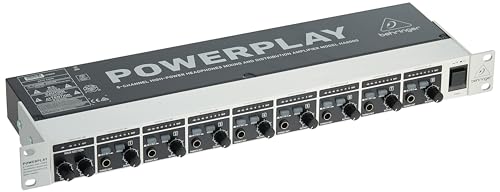
Behringer HA8000 V2 8-Channel High-Power Headphone Mixing and Distribution Amplifier
$189.00Eight independently level-controlled outputs in one rack unit, which is enough for every listener in a large booth plus a rehearsal position. At roughly twenty four dollars per output it is the cheapest distribution available.
Best for: Distributing one mix to many wired listeners
Check price on Amazon
Behringer POWERPLAY HA4700 4 Channel High-Power Headphones Mixing and Distribution Amplifier
$259.00Four channels with per-channel equalisation and a stereo or mono switch, so each listener can shape their own feed a little. Useful where a vocalist wants more presence and a drummer wants more low end from the same source mix.
Best for: Four positions that each want something different
Check price on AmazonWho should not buy this tier: Bands where each musician needs a genuinely different balance, which requires personal mixers.
Large or multi-campus: give the band their own mixes
The honest expert answer is that a large church with a full band should stop distributing one mix and give each musician their own. That is a different product category and it is the correct spend once the band is past four or five people, because the complaint a headphone amplifier cannot fix is the one that actually costs rehearsal time every week. Plan the rack with church AV rack planning.

Behringer POWERPLAY P16-D 16 Channel Digital ULTRANET Distributor
$139.00The distribution hub for a personal mixer system, splitting one network feed to eight positions and powering them down the same cable. It replaces the headphone amplifier entirely for a band, and no platform position needs a mains outlet.
Best for: Any platform with more than two monitor positions
Check price on Amazon
Behringer Powerplay P16-HQ 16-Channel Digital Personal Monitoring Mixer
$203.99Sixteen channels of personal mix control at each position with a strong headphone stage, which is the thing a distribution amplifier fundamentally cannot provide. The right answer once musicians are asking for different balances.
Best for: A band of five or more, each wanting their own mix
Check price on Amazon Behringer HA8000 V2 8-Channel High-Power Headphone Mixing and Distribution Amplifier
$189.00Even with personal mixers on the platform, the booth still has several people listening to the same programme feed at their own level. That is exactly what a distribution amplifier is for, and it stays in the rack.
Best for: The booth and the broadcast positions
Check price on AmazonWho should not buy this tier: Do not buy this tier for a church with one operator and a three piece band. A personal mixer network is infrastructure with cabling, a hub and a configuration to maintain, and a church at that size is better served by two belt amplifiers on aux sends and the money spent on sealed earphones instead.
The distribution options compared
| Model | Price | Rack space | Amplifier channels | Wired |
|---|---|---|---|---|
| Behringer HA8000 V2 8-Channel High-Power Headphone Mixing and Distribution Amplifier | $189.00 | 1U | 8 | - |
| Behringer POWERPLAY HA4700 4 Channel High-Power Headphones Mixing and Distribution Amplifier | $259.00 | 1U | 4 | - |
| Behringer P2 Ultra-Compact Personal In-Ear Monitor Amplifier | $39.90 | - | - | Yes |
| Behringer POWERPLAY P16-D 16 Channel Digital ULTRANET Distributor | $139.00 | 1U | - | Yes |
How we chose
We did not test these products in person and we never claim to. Picks are researched from manufacturer specification sheets and operator manuals, FCC rules where spectrum is involved, published standards, warranty terms, and the recurring themes in verified owner reviews. Every pick is matched to a real room size, seat count or input list rather than to a price bracket, and it is placed in the tier where its capability actually belongs. Where a product is wrong for most churches we say so on the page.
Sources
- Manufacturer published specifications for each amplifier and mixer listed
- NIOSH recommended exposure limit of 85 dBA over eight hours
- Consensus of verified owner reviews across major retailers
Frequently asked questions
What does a headphone amplifier do in a church?
It takes one mix and drives several pairs of headphones or earphones, each with its own volume control. That covers a booth with multiple operators, a rehearsal room and a simple wired in-ear setup. It does not create different mixes for different people, which is the job of a personal monitor mixer and costs roughly eight times as much per position.
Can we just use a headphone splitter?
For two listeners in a pinch, yes. Beyond that the shared output gets quieter and more loaded with every pair added, and everybody is stuck at the same level. A distribution amplifier drives each output independently, so adding a listener changes nothing for anyone else, and each person controls their own volume without arguing about it.
How many headphone outputs does a church need?
Count the people who actually listen at the same time. A typical booth has a sound operator, a livestream operator and sometimes a director or a trainee, which is three or four. A rehearsal room might need four to eight. Eight outputs in one rack unit covers nearly every church, and buying eight when three will be used is still cheap.
Is a headphone amplifier the same as a personal monitor mixer?
No, and the difference decides the purchase. A headphone amplifier distributes one mix with a volume control per listener. A personal monitor mixer sends sixteen separate channels to each position so each musician builds their own balance. If your band is asking for different mixes rather than different volumes, the amplifier will not solve the complaint.
What do you feed a headphone amplifier from?
A spare aux send, a matrix output or a monitor output on the console, depending on what the listeners need to hear. A booth wants the main mix or the broadcast feed. A wired in-ear position wants a dedicated monitor aux, so the operator can shape it for the platform without changing what the congregation hears.
Do headphone amplifiers need to match headphone impedance?
Broadly, yes, and the units built for live use handle the range church equipment actually uses. High impedance studio headphones need more voltage to reach a given level, so a weak output leaves them quiet. If a pair sounds quiet on one output and fine on another, impedance matching is the likely cause rather than a fault.
Researched, not professional advice. This page is compiled from published manufacturer specifications, operator manuals, FCC rules, published standards and owner-review consensus, not hands-on testing. Sound system design, rigging loudspeakers overhead, and any electrical work are jobs for a qualified professional: have flown loudspeakers and their attachment points signed off by a structural engineer or a certified rigger, and have all wiring done by a licensed electrician to your local code. Wireless microphone rules change, so confirm the current FCC position before buying. As an Amazon Associate we earn from qualifying purchases.