System specification by size
What Sound System Does a 400 Seat Church Need?
Quick answer
A 400 seat sanctuary needs about 785 watts per loudspeaker, or roughly 2,355 watts of amplification across 3 main boxes, for blended, piano and small band at 88 dBA with 12 dB of peak headroom. The room runs about 3,000 square feet with a 58 foot throw to the back row, and needs a 32 channel console, 6 wireless channels and 16 assistive listening receivers.
Every number on this page is computed from one input: the seat count. A 400 seat room at about 7.5 square feet per person is roughly 3,000 square feet, which makes it about 45 feet wide and 68 feet deep with a 21 foot ceiling. From that geometry everything else follows, and the loudspeaker at the top of this page is the one whose rated power actually matches the answer.
On this page
How much amplifier power does a 400 seat sanctuary need?
Power is decided by three numbers and the seat count is only one of them: how far the furthest seat is from the loudspeaker, how sensitive that loudspeaker is, and how much peak headroom the service style needs. For a room this size, worked from about 7.5 square feet per seat, the geometry comes out at roughly 45 feet wide by 68 feet deep with a throw of about 58 feet to the back row.
A 400 seat sanctuary throwing about 58 feet needs roughly 785 watts per loudspeaker for blended, piano and small band, or about 2,355 watts of total amplification across 3 boxes.
| Service style | Target level | Peak headroom | Watts per box | Amplifier size |
|---|---|---|---|---|
| Speech and teaching only | 75 dBA | 10 dB | 25 W | 100 W |
| Traditional, hymns and organ | 82 dBA | 12 dB | 197 W | 200 W |
| Blended, piano and small band | 88 dBA | 12 dB | 785 W | 800 W |
| Contemporary worship band | 95 dBA | 12 dB | 3,935 W | 4,000 W |
| Modern, full band with in-ears | 100 dBA | 12 dB | 12,442 W | 4,000 W |
Assumes a loudspeaker rated 96 dB sensitivity at one watt at one metre, which is typical of a powered 12 inch cabinet. Levels are A-weighted averages at the mix position. Anything at or above 92 dBA carries a real hearing-exposure obligation: NIOSH allows about an hour at 94 dBA and fifteen minutes at 100 dBA.
Why loudspeaker sensitivity changes the answer more than the room does
Sensitivity is the level a loudspeaker produces from one watt at one metre. Every 3 dB of sensitivity halves the power needed, so a 99 dB cabinet needs roughly an eighth of the amplifier a 90 dB cabinet does in the same room. This is the single most overlooked number on a specification sheet.
In this room, moving from a 90 dB loudspeaker to a 99 dB one cuts the amplifier requirement from about 3,125 watts to about 393 watts per box.
| Sensitivity (1W/1m) | Watts per box | Total watts | Typical of |
|---|---|---|---|
| 90 dB | 3,125 W per box | 9,376 W total | Small format or ceiling speaker |
| 93 dB | 1,566 W per box | 4,699 W total | Compact or budget cabinet |
| 96 dB | 785 W per box | 2,355 W total | Typical powered 12 inch box |
| 99 dB | 393 W per box | 1,180 W total | Horn-loaded or larger format |
What does the rest of the system look like at 400 seats?
Seat count drives the whole specification, not just the speakers. Here is the first-pass system for a room this size, which is the list a building committee should be looking at before anybody calls an integrator.
A 400 seat church typically needs 3 main loudspeakers, no subwoofer, a 32 channel console, about 6 wireless microphone channels and 16 assistive listening receivers.
| Element | Specification | Why this number |
|---|---|---|
| Room area | 3,000 sq ft | About 7.5 sq ft per seat in fixed seating, including aisles |
| Approximate dimensions | 45 ft wide by 68 ft deep | A 1.5 to 1 depth to width ratio, the common assembly proportion |
| Ceiling height | 21 ft | Rises with the span; it sets reverberation as much as the floor area does |
| Throw to back row | 58 ft | Where the level must still be adequate, and where the power calculation is done |
| Main loudspeakers | 3 boxes | A pair plus a centre or third box to reach the middle seats |
| Amplification | 2,400 W total | 785 W per box with 12 dB of peak headroom |
| Subwoofers | None needed | Speech and traditional programme does not need them |
| Console channels | 32 | About 24 inputs today plus 25 percent growth, rounded to a size that is sold |
| Wireless channels | 6 | Preaching, worship leader, roaming handheld and spares |
| Monitor mixes | 6 | Counted by ear rather than by musician: the drummer never shares |
| Assistive listening receivers | 16 | The 2010 ADA count for 400 seats, of which 4 must be hearing-aid compatible |
| Reverberation target | 1 to 1.4 seconds | The RT60 range for blended service |
| Projection screen | About 10.2 ft high, 250 in diagonal | The six times rule: the furthest seat sits no more than six screen heights back |
What this system costs, roughly
Equipment cost for a church system lands in a fairly narrow band per seat once you have decided the service style. A speech-only room can be equipped for well under half what a full band room costs, because the loudspeakers, the subwoofers, the console channel count and the monitor system all scale with the band rather than with the seats. Use the system cost calculator for a figure you can take to a meeting, and the budget allocator to split it across the seven lines that matter.
The mistake worth naming: a beautiful console feeding inadequate loudspeakers is the most common way a church wastes a building fund. Loudspeakers and their amplification set the ceiling on everything else, so they get roughly a third of the audio budget and they get bought first.
Which loudspeakers fit a 400 seat room?
Sorted by how closely their rated power matches the 785 watts per box this room needs. Every one of these is a real current model with a verified listing.
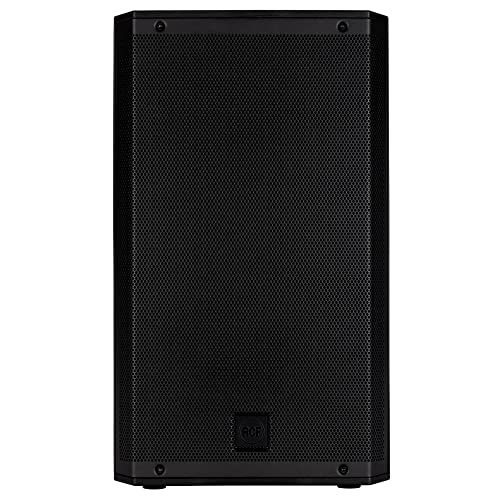
RCF ART 912-A 2,100W 12-inch Powered Speaker
$899.00 Specs and sizingAn Italian-built 12 with a 2,100 watt amplifier and RCF compression driver. Noticeably more forward and detailed than most of its price class, which flatters vocals.
Best for: Vocal-led worship where the lead voice must sit above the band
Check price on Amazon
RCF NX 912-A 2,100-watt 12-inch Powered Speaker
$1,449.00 Specs and sizingThe install and touring grade RCF 12, with a birch cabinet and a more capable DSP section than the ART.
Best for: A flagship room, or a church that buys once every fifteen years
Check price on Amazon
QSC K12.2 Active 12" Powered 2000 Watt Loudspeaker
$899.99 Specs and sizingThe default answer for a church main speaker, and the one most rental companies own. A 2,000 watt class D amplifier, a 75 degree conical pattern that throws evenly to the back, and preset voicings that get a volunteer close on the first try.
Best for: A 150 to 400 seat sanctuary on stands or flown, for almost any service style
Check price on Amazon
QSC K10.2 Active 10" Powered 2000 Watt Loudspeaker
$799.99 Specs and sizingThe K12.2 amplifier and DSP behind a 10 inch woofer and a wider 90 degree pattern, which suits a wide, shallow room better than the 12 does.
Best for: Wide fan-shaped rooms and balcony fills where coverage matters more than low end
Check price on AmazonWhich console fits 24 inputs?
A 400 seat church typically runs about 24 inputs today, which means buying a 32 channel console so there is room to grow. Work out your own number with the mixer channel calculator.

Behringer 32 40-Input 25-Bus Digital Mixing Console, Black (X32)
$1,999.00 Specs and sizingThe console most churches actually end up with, and for good reason: 32 Midas-designed preamps, 25 motorized faders, full scene recall and an AES50 port that carries a 32 channel stage box on one cable.
Best for: A 250 to 800 seat room with a band, where volunteers rotate weekly and scene recall saves the service
Check price on Amazon
Behringer X32 Rack Digital Mixer
$979.99 Specs and sizingThe same X32 engine and the same 32 channel mix capability in three rack units, driven from a tablet. Sixteen preamps are on the box itself and the rest arrive over AES50 from a stage box.
Best for: Churches with no booth space, or a mixer who wants to walk the room while setting the mix
Check price on Amazon
Behringer X32 Producer Digital Mixer
$1,499.00 Specs and sizingA rack-mountable X32 with 17 motorized faders and 16 onboard preamps. It keeps physical faders, which volunteers find far easier than a tablet, in a much smaller footprint than the full console.
Best for: A tight booth that still needs real faders in front of the operator
Check price on Amazon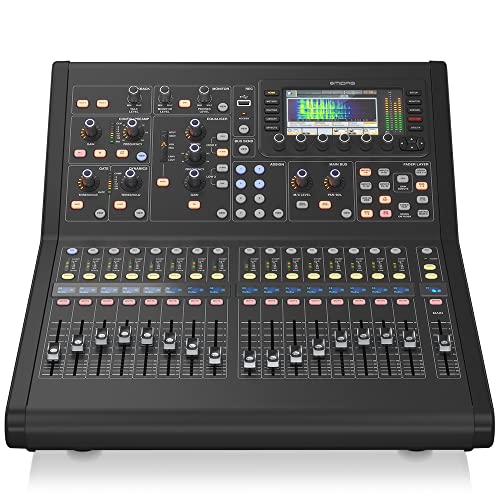
Midas M32 LIVE Digital Console for Live and Studio with 40 Input Channels, 32 Midas PRO Microphone Preamplifiers and 25 Mix Buses and Live Multitrack Recording
$2,499.00 Specs and sizingThe X32 platform with Midas PRO preamps and a heavier build. What you are paying for is the preamp stage and the chassis, not extra channels.
Best for: Churches that want the X32 workflow with a longer service life and better front end
Check price on AmazonHow we chose
We did not test these products in person and we never claim to. Picks are researched from manufacturer specification sheets and operator manuals, FCC rules where spectrum is involved, published standards, warranty terms, and the recurring themes in verified owner reviews. Every pick is matched to a real room size, seat count or input list rather than to a price bracket, and it is placed in the tier where its capability actually belongs. Where a product is wrong for most churches we say so on the page.
Sources
- 2010 ADA Standards for Accessible Design, section 219.3, assistive listening receiver counts
- NIOSH recommended exposure limit for occupational noise, 85 dBA over eight hours
- Manufacturer published sensitivity and power figures for the loudspeakers listed on this page
Frequently asked questions
How many watts do I need for a 400 seat church?
About 785 watts per loudspeaker, or roughly 2,355 watts total across 3 boxes, assuming a 96 dB sensitivity cabinet, a 58 foot throw to the back row and 12 dB of peak headroom above a 88 dBA average. A speech-only service in the same room needs far less, and a modern full band service needs more, which is why the service style is part of the question.
How many speakers does a 400 seat sanctuary need?
3 main loudspeakers. A left and right pair leaves the centre seats weak in a room this wide, so a third box or a centre cluster is normal. Under-balcony seats always need their own delayed fills.
How many wireless microphones can a 400 seat church run?
This room typically needs about 6 channels, but how many it can legally run depends entirely on how many TV channels are empty at your address, not on the seat count. A digital system fits roughly eight compatible channels per empty 6 MHz TV channel and an analog one about four. Check with the wireless microphone channel calculator before you buy more than four channels.
How many assistive listening receivers does a 400 seat church need?
16 receivers under the 2010 ADA Standards, of which at least 4 must be hearing-aid compatible, which in practice means supplied with a neck loop. Houses of worship are exempt from ADA Title III, so this is not a legal requirement for most churches, but it binds a church that rents its auditorium to the public or runs a school, and most churches choose to meet it anyway.
Does the ceiling height change the amplifier power?
Not directly: amplifier power is set by distance and loudspeaker sensitivity, not by the ceiling. What a high ceiling changes is reverberation. A 21 foot ceiling over 3,000 square feet gives roughly 50,400 cubic feet of air, and the more volume there is the longer sound hangs around, which destroys intelligibility no matter how much power you add. Treat the room first.
Should we buy powered or passive loudspeakers?
Powered speakers put an amplifier and processor in each box, so there is less to specify and nothing to match. Passive speakers put every amplifier in one rack, which is easier to secure, easier to service and the usual choice for a permanent install with flown boxes. For a 400 seat room either works; the deciding factor is normally whether you can get mains power to the loudspeaker positions.
Researched, not professional advice. This page is compiled from published manufacturer specifications, operator manuals, FCC rules, published standards and owner-review consensus, not hands-on testing. Sound system design, rigging loudspeakers overhead, and any electrical work are jobs for a qualified professional: have flown loudspeakers and their attachment points signed off by a structural engineer or a certified rigger, and have all wiring done by a licensed electrician to your local code. Wireless microphone rules change, so confirm the current FCC position before buying. As an Amazon Associate we earn from qualifying purchases.