Mixing consoles
Tablet-Controlled vs Surface Mixer
Quick answer
Give a rotating volunteer team a surface, because a physical fader is found by touch in about one second against five to ten on a tablet layer. Choose tablet control when the mixer must be invisible, when the booth has no room, or when the operator needs to walk the congregation.
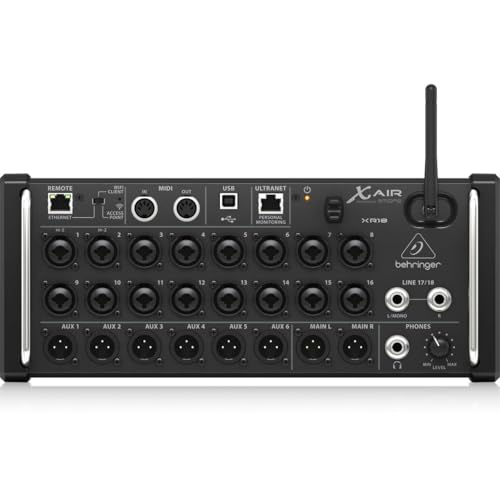
Behringer X AIR XR18 18-Channel, 12-Bus Digital Mixer for iPad/Android Tablets with 16 Programmable Midas Preamps, Integrated Wifi Module and Multi-Channel USB Audio Interface
$509.00 Specs and sizingSixteen preamps, no surface at all, and built-in Wi-Fi, so the whole mixer hides in a rack and the operator stands where the congregation sits.
Best for: A church plant or a 100 to 250 seat room where the mixer can stand in the congregation
Check price on Amazon
Behringer X32 Producer Digital Mixer
$1,499.00 Specs and sizingSeventeen motorized faders and a channel strip in a rack-mountable chassis, which is the smallest honest way to keep real faders in the booth.
Best for: A tight booth that still needs real faders in front of the operator
Check price on AmazonIf different people mix on different Sundays, buy a surface. The speed of a physical fader under pressure and the fact that it works with no network, no app and no battery are worth more to a volunteer team than any feature a tablet adds. If the constraint is that the mixer must not be seen or the booth does not exist, tablet control is the right tool and the risks below are manageable.
This is a workflow comparison, not an audio one. A tablet mixer and a surface mixer at similar capability sound the same. What differs is what the operator can do in three seconds and what happens when a device fails.
A tablet mixer and a surface mixer side by side
| Model | Price | Input channels | Mic preamps | Mix buses | Digital | Scene recall | Rack space |
|---|---|---|---|---|---|---|---|
| Behringer X AIR XR18 18-Channel, 12-Bus Digital Mixer for iPad/Android Tablets with 16 Programmable Midas Preamps, Integrated Wifi Module and Multi-Channel USB Audio Interface | $509.00 | 18 | 16 | 12 | Yes | Yes | 3U |
| Behringer X32 Producer Digital Mixer | $1,499.00 | 32 | 16 | 25 | Yes | Yes | 6U |
The five things that decide it
Everything else is preference. These five are the ones churches report back on.
A physical fader is located by touch in roughly one second, while the same move on a tablet takes five to ten seconds including finding the right layer.
| Factor | Tablet control | Physical surface |
|---|---|---|
| Speed of an urgent unmute | Five to ten seconds | About one second |
| Works during a network failure | No | Yes |
| Mixing from the congregation | Yes, anywhere in range | No, only at the desk |
| Teaching a new volunteer | Screen sharing and menus | Point at the fader |
| Visual footprint in the sanctuary | None | A desk and a light |
| Two people working at once | Yes, on two devices | One operator |
| Ongoing device management | Tablet, app and Wi-Fi | None |
The two device advantage of tablets is real and underused: a monitor engineer can set wedge mixes on a second tablet during soundcheck without touching the house mix.
Choose a surface if the rota is the risk
Ask what happens when the scheduled operator does not arrive. On a surface, someone can be shown four faders and a mute group in five minutes and get through a service. On a tablet, that person has to install an app, join a network, find a layer and understand a scene. The gap between those two situations is what a surface is really for.
A surface is also the only option that works when the network does not. No access point, no pairing, no firmware, no battery. In an older building with marginal Wi-Fi and thick masonry walls, that is not theoretical. Read the Sunday checklist for how to test this before it matters.
The cost is space and money. A surface needs a booth with a sight line and a work surface, and at the same capability it costs more than a rack box. If the room cannot provide the booth, do not force it.
Choose tablet control if the room or the budget says no desk
Tablet control genuinely solves three problems. It removes the visual footprint in a room where a desk would be wrong. It lets the operator stand where the congregation sits, which is the fastest way to fix a system tuned from a bad mix position. And it costs less for the same channel count, which for a church plant is decisive.
It also enables a workflow a surface cannot: two people on two devices. A musician can set their own wedge from the platform while the operator works the house mix. For a band rehearsal that is a large time saving. Our stage volume guide leans on exactly that ability.
Manage the risk deliberately. Use a dedicated tablet that is not somebody personal device, turn off automatic updates, keep it on a charger in the booth, pair a second device, and run a wired network drop to the mixer as a fallback. Churches that do these five things almost never lose a service to a tablet.
Sources
- Behringer published X AIR and X32 specifications
- Manufacturer control application system requirements
Frequently asked questions
Which tablet should a church buy for a mixer?
Whatever the manufacturer app officially supports, bought new enough that it will still receive operating system updates for several years. The most common cause of a dead tablet mixer is an app that stopped supporting an old device. Buy a dedicated unit, keep it in the booth, and do not let it become a personal device.
Can we use a laptop instead of a tablet?
Most manufacturers ship a desktop editor, and a laptop with a mouse is faster than a tablet for building a scene. For live operation a tablet is usually better because it is held rather than placed. Many churches use both: a laptop for setup work and a tablet for Sunday.
Does the mixer need its own Wi-Fi network?
Yes. Put the mixer and its control devices on a dedicated access point with a password, separate from the guest network and from the streaming traffic. Shared networks are the single most common cause of laggy or dropping mixer control, and the fix costs less than a hundred dollars of access point.
How many faders does a volunteer really need?
Four to eight on a normal Sunday: vocals, the preaching microphone, a band group and playback. That is why a 17 fader surface is enough for most churches and why fader count is a poor thing to overspend on. Build a scene, lock everything else, and teach the eight that move.
Is a control surface worth adding to a rack mixer later?
Often yes, and it is a common upgrade path. A small control surface over the network restores motorized faders to a rack mixer without replacing the engine. It is the right answer for a church that chose a rack mixer for space reasons and then found a dedicated operator.
Researched, not professional advice. This page is compiled from published manufacturer specifications, operator manuals, FCC rules, published standards and owner-review consensus, not hands-on testing. Sound system design, rigging loudspeakers overhead, and any electrical work are jobs for a qualified professional: have flown loudspeakers and their attachment points signed off by a structural engineer or a certified rigger, and have all wiring done by a licensed electrician to your local code. Wireless microphone rules change, so confirm the current FCC position before buying. As an Amazon Associate we earn from qualifying purchases.