Loudspeakers and amplification
70 Volt vs 8 Ohm Speaker Systems
Quick answer
Use 70 volt when you have more than about four loudspeakers on one amplifier channel or cable runs beyond 100 feet, because a transformer tap sets each speaker level and the thin wire loss stops mattering. Use 8 ohm for two to four main loudspeakers on short runs.

Crown CDi 1000 Two-Channel, 500-Watt @ 4Ω, 70V/140V Power Amplifier
$1,487.52 Specs and sizingA true install amplifier with direct 70V and 140V outputs, so a distributed ceiling system needs no output transformer of its own.
Best for: Any 70V ceiling or distributed system
Check price on Amazon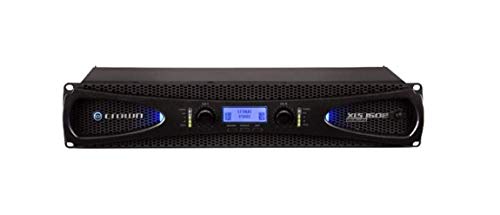
Crown XLS1502 2-Channel Class D DriveCore Professional Power Amplifier with DSP, Band Pass Filters & Peak Limiters. XLR/RCA Inputs, 525W at 4 Ohm, PureBand Crossover System. Black
$579.99 Specs and sizingA 2 channel low impedance amplifier with onboard crossover and limiting, which is what a pair of passive mains actually wants.
Best for: A 150 to 400 seat room with passive mains and no separate DSP
Check price on AmazonThese are two different distribution schemes for two different jobs, and choosing wrongly is expensive to undo. A 70 volt system steps the amplifier output up to a higher voltage, sends it down thin wire with low loss, and steps it back down at each speaker through a transformer with selectable taps. An 8 ohm system connects speakers directly, which is more efficient and sounds better, but limits how many you can put on a channel and how far the cable can run.
The practical rule: a 70V amplifier for distributed ceiling and ancillary-space systems, an 8 ohm amplifier for main loudspeakers. Size the tap budget on the 70 volt system calculator before ordering anything.
A 70 volt amplifier and an 8 ohm amplifier
| Model | Price | Amplifier channels | Power at 4 ohms | Class D | Rack space | Power at 70V | Power at 8 ohms |
|---|---|---|---|---|---|---|---|
| Crown CDi 1000 Two-Channel, 500-Watt @ 4Ω, 70V/140V Power Amplifier | $1,487.52 | 2 | 500 W per channel | Yes | 1U | 500 W | - |
| Crown XLS1502 2-Channel Class D DriveCore Professional Power Amplifier with DSP, Band Pass Filters & Peak Limiters. XLR/RCA Inputs, 525W at 4 Ohm, PureBand Crossover System. Black | $579.99 | 2 | 525 W per channel | Yes | 1U | - | 300 W per channel |
Which scheme your system needs
Four factors decide it, and they usually all point the same way.
A 70 volt line carries many speakers on one channel over runs of several hundred feet, while an 8 ohm run past about 100 feet needs heavy and expensive cable.
| Factor | 70 volt | 8 ohm | Which wins |
|---|---|---|---|
| Speakers per amplifier channel | Dozens, within the tap budget | Two to four | 70 volt |
| Practical cable distance | Several hundred feet | Under about 100 feet | 70 volt |
| Cable gauge needed | Light, 16 or 18 AWG | Heavy, 12 to 14 AWG | 70 volt |
| Setting level per speaker | Tap selection at the speaker | Not possible | 70 volt |
| Low frequency quality | Limited by the transformer | Full range | 8 ohm |
| Efficiency | Transformer losses | Direct, no loss | 8 ohm |
| Cost per speaker | Transformer adds cost | Lower | 8 ohm |
Keep total tap load at or below about 80 percent of the amplifier rating so the amplifier is not running at its limit continuously, and so there is room to add a speaker later.
Choose 70 volt for distributed and ancillary systems
The classic case is a ceiling full of speakers: sixteen ceiling speakers on one amplifier channel, each set to its own wattage tap, on light cable running hundreds of feet through a building. Doing that at 8 ohms is impossible, because the speakers in parallel would present an impedance no amplifier could drive and the cable loss would be severe.
Tap selection is the underrated benefit. A speaker in a quiet corridor takes a low tap, one over a busy foyer takes a higher one, and the balance is set at each speaker rather than at the amplifier. That is how you get one system covering a sanctuary overflow, a nursery, a foyer and a corridor without four amplifiers. Tap values by application are in the 70 volt tap chart.
Accept the limitation: the transformers restrict low frequency response, so a 70V line is a speech and background music system. Do not run a worship band through it.
Choose 8 ohm for main loudspeakers
Main loudspeakers are few, close to the rack and expected to reproduce music with full bandwidth, which is exactly what low impedance wiring is good at. No transformer means no low frequency limitation, no insertion loss and no tap to set wrong. A pair of passive mains on an XLS 1502 with a processor in front is the standard church main system and it is the correct architecture.
Keep the runs short and the wire thick. Cable resistance should stay under about 5 percent of the loudspeaker impedance to keep loss under roughly four tenths of a decibel, which on a long run means 12 AWG cable. Size it properly on the cable gauge calculator rather than guessing.
Watch the impedance arithmetic. Two 8 ohm cabinets in parallel present 4 ohms, which most amplifiers handle; four present 2 ohms, which many do not. That limit is the reason distributed systems exist at all.
Sources
- Crown published CDi and XLS series specifications
- Constant voltage distribution system design principles
Frequently asked questions
Can I mix 70 volt and 8 ohm in one building?
Yes, and most churches should. Run the main loudspeakers at 8 ohms from a low impedance amplifier, and run the ceiling, foyer, nursery and overflow speakers on a separate 70 volt line from an install amplifier. They are separate systems fed from separate outputs, which is the normal and correct arrangement.
What tap setting should each speaker use?
Match the tap to how loud that space needs to be. A corridor might take 2 watts, a foyer 8 watts, an overflow room with seating 16 watts. Add every tap on the line and keep the total at or below 80 percent of the amplifier rating so there is headroom and room to expand.
Does 70 volt sound worse than 8 ohm?
For music, yes, because the step-down transformer at each speaker limits low frequency response and adds a small insertion loss. For speech, the difference is largely inaudible, which is why distributed systems are standard for announcements, paging and spoken word in every kind of building.
How many speakers can one 70 volt amplifier drive?
As many as the tap budget allows. A 500 watt channel at 80 percent gives 400 watts of taps, which is twenty five speakers at 16 watts or fifty at 8 watts. The limit is watts, not speaker count, which is exactly what makes the scheme so useful in a large building.
Is 100 volt the same thing?
It is the same principle at a higher voltage, common outside North America, and it allows slightly longer runs or thinner cable. Equipment is often marked 70V and 100V because the transformers support both. Use whichever the amplifier and speaker taps in your building are specified for, and never mix the two on one line.
Researched, not professional advice. This page is compiled from published manufacturer specifications, operator manuals, FCC rules, published standards and owner-review consensus, not hands-on testing. Sound system design, rigging loudspeakers overhead, and any electrical work are jobs for a qualified professional: have flown loudspeakers and their attachment points signed off by a structural engineer or a certified rigger, and have all wiring done by a licensed electrician to your local code. Wireless microphone rules change, so confirm the current FCC position before buying. As an Amazon Associate we earn from qualifying purchases.