Loudspeakers and amplification
Crown XLS1502 vs Behringer NX3000D
Quick answer
The Crown XLS1502 at $579.99 is the right amplifier for a pair of passive church mains, because its published 300 watts per channel into 8 ohms is honest and its limiters protect the drivers. The NX3000D at $339.00 is the better buy for driving passive subwoofers.
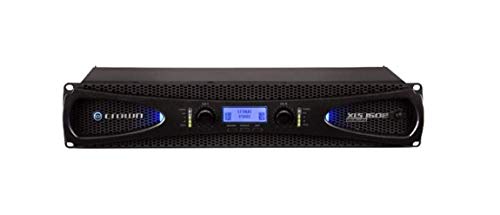
Crown XLS1502 2-Channel Class D DriveCore Professional Power Amplifier with DSP, Band Pass Filters & Peak Limiters. XLR/RCA Inputs, 525W at 4 Ohm, PureBand Crossover System. Black
$579.99 Specs and sizingThree hundred watts per channel into 8 ohms with onboard crossover, limiting and delay, in one rack unit that has been the church standard for years.
Best for: A 150 to 400 seat room with passive mains and no separate DSP
Check price on Amazon
Behringer NX3000D Ultra-Lightweight 3000 Watt Class-D Power Amplifier with DSP Control and SmartSense Loudspeaker Impedance Compensation
$339.00 Specs and sizingFifteen hundred watts per channel into 4 ohms with DSP, at a price that makes driving passive subwoofers affordable.
Best for: A passive main and subwoofer system with no separate loudspeaker processor
Check price on AmazonBuy the Crown for main loudspeakers and the Behringer for subwoofers, because these amplifiers are specified for different jobs despite looking like competitors on a price list. The NX3000D headline number is 1,500 watts per channel into 4 ohms, which is a subwoofer specification, not a main loudspeaker one.
The trap is comparing headline watts. What a church main loudspeaker needs is roughly twice its continuous rating with a limiter set to protect it, which for most passive church mains is 300 to 500 watts per channel at 8 ohms. More power than that is not better, it is just a bigger number and a faster way to destroy a driver. Size it properly on the amplifier power calculator.
Side by side
| Model | Price | Amplifier channels | Power at 4 ohms | Class D | Onboard DSP | Rack space | Power at 8 ohms |
|---|---|---|---|---|---|---|---|
| Crown XLS1502 2-Channel Class D DriveCore Professional Power Amplifier with DSP, Band Pass Filters & Peak Limiters. XLR/RCA Inputs, 525W at 4 Ohm, PureBand Crossover System. Black | $579.99 | 2 | 525 W per channel | Yes | Yes | 1U | 300 W per channel |
| Behringer NX3000D Ultra-Lightweight 3000 Watt Class-D Power Amplifier with DSP Control and SmartSense Loudspeaker Impedance Compensation | $339.00 | 2 | 1,500 W per channel | Yes | Yes | 1U | - |
Matching an amplifier to a loudspeaker
Work from the loudspeaker rating, never from the amplifier. This is the table that prevents an expensive mistake.
Size an amplifier at roughly twice the loudspeaker continuous rating, so a 250 watt passive cabinet wants about 500 watts per channel with the limiter engaged.
| Speaker continuous rating | Target amplifier power | Suitable amplifier | Typical use |
|---|---|---|---|
| 100 W at 8 ohms | About 200 W per channel | XLS 1002 | A small chapel pair |
| 250 W at 8 ohms | About 500 W per channel | XLS 1502 | Passive church mains |
| 400 W at 8 ohms | About 800 W per channel | XLS 2002 | Larger mains or a sub |
| 350 W at 8 ohms subwoofer | About 700 W per channel | NX3000D | Passive subwoofers |
| Two subwoofers per channel | 1,500 W at 4 ohms or more | NX6000D | Large contemporary room |
Headroom above the speaker rating is only safe with a working limiter. An amplifier running well above a driver rating with the limiter defeated will destroy the loudspeaker, not improve it.
Choose the Crown XLS1502 for main loudspeakers
Crown publishes power into 8 ohms as well as 4, which matters because church mains are almost always 8 ohm cabinets and an amplifier specified only at 4 ohms is hiding the number you need. Three hundred watts per channel at 8 ohms is exactly right for a pair of passive mains rated around 250 watts continuous.
The onboard PureBand crossover, limiting and delay is the second reason. It means a simple system needs no separate processor at all: high-pass the mains, set the limiter, and time-align a fill from the same box. For a church that is not buying a DriveRack, that is a real saving and a simpler rack. Our rack planning guide assumes this arrangement.
The reliability argument is worth stating plainly: this amplifier family has been in church racks for a very long time, and the consensus of published owner reviews is that they keep running. For equipment in a locked closet that nobody checks, that matters.
Choose the NX3000D for subwoofers and for tight budgets
Passive subwoofers are where the NX3000D makes sense. A JRX218S rated 350 watts continuous at 8 ohms wants serious power, and a pair of them on one amplifier is exactly the load this Behringer is built for. At $339.00 it makes adding low end to a passive system genuinely affordable.
The onboard DSP with crossovers, delay and EQ covers what a simple two-way system needs, so a church can run mains on one amplifier and subwoofers on this one with the crossover set in the amplifier itself. Weight is the other practical benefit: these class D amplifiers are light enough that one person can rack them.
Be honest about the trade. Behringer publishes the big 4 ohm figure prominently, the build is lighter than the Crown, and for a critical main system in a room where nobody will notice a fault until Sunday, the Crown is the safer specification. Keep a cheap spare on the shelf either way.
Sources
- Crown published XLS DriveCore series specifications
- Behringer published NX series specifications
Frequently asked questions
Is more amplifier power dangerous for my speakers?
Only without a limiter. A larger amplifier with its limiter set correctly to the driver rating is safer than a small amplifier driven into clipping, because clipped signal is what actually burns high frequency drivers. The rule is headroom plus limiting, never headroom alone, and both of these amplifiers have limiters.
Why does the Behringer quote so much more power?
It is quoted into 4 ohms, which roughly doubles the number compared with an 8 ohm rating, and it is aimed at subwoofer duty where that load is normal. Always compare amplifiers at the impedance your speakers actually present. Comparing a 4 ohm figure with an 8 ohm figure is the most common amplifier buying mistake.
Do I still need a DriveRack with these?
Not for a simple two-speaker system, since both amplifiers include crossover, limiting and delay. A separate processor earns its place when you have mains, subwoofers, delay fills and room tuning to manage from one point, or when you want the automatic room tuning wizard that the DriveRack provides.
How many rack units should I allow?
Both are one rack unit, but allow a vented unit above each for airflow, plus a power conditioner at the top of the rack and two genuinely empty units for future equipment. Our rack space calculator adds these allowances so the case you order still fits the system in three years.
Can one amplifier drive mains and a subwoofer?
Yes, with a two channel amplifier and a crossover: one channel to the mains and one to the sub. It works and many churches do it. The limitation is that both channels share a power supply, so a demanding subwoofer can reduce what is available for the mains during loud passages.
Researched, not professional advice. This page is compiled from published manufacturer specifications, operator manuals, FCC rules, published standards and owner-review consensus, not hands-on testing. Sound system design, rigging loudspeakers overhead, and any electrical work are jobs for a qualified professional: have flown loudspeakers and their attachment points signed off by a structural engineer or a certified rigger, and have all wiring done by a licensed electrician to your local code. Wireless microphone rules change, so confirm the current FCC position before buying. As an Amazon Associate we earn from qualifying purchases.