Loudspeakers and amplification
Ceiling Speakers vs Wall Mounted Speakers
Quick answer
Ceiling speakers give very even coverage for speech and are the right answer for flat, low-ceilinged rooms. Wall mounted boxes aim energy at the congregation and are the only option for a band. A ceiling system is not a cheaper main system, it is a different one.

JBL Professional Control 47LP Low Profile Loudspeaker, Sold as Pair
$590.00 Specs and sizingA low-profile coaxial ceiling speaker with the back can included, giving even 110 degree coverage from a standard suspended grid.
Best for: Suspended ceiling installs at normal ceiling heights
Check price on Amazon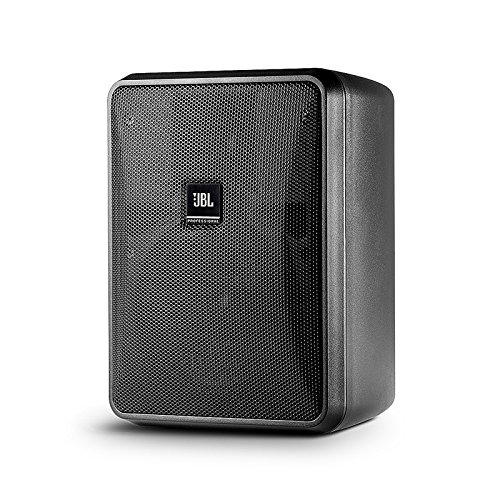
JBL Professional Control 25-1 Compact Indoor/Outdoor Background/Foreground Speaker, Black, Sold as Pair
$457.98 Specs and sizingA surface-mount cabinet on an aiming bracket, 8 ohm or 70V, indoor or outdoor rated, which puts energy where you point it.
Best for: Under-balcony fills, foyers, cry rooms and side aisles
Check price on AmazonThese are different tools and the honest answer is that most churches need both. A distributed ceiling system produces very even speech coverage with almost no level variation from front to back, which is unbeatable in a flat room with a low ceiling. A wall mounted or flown box aims energy at the congregation and away from the surfaces, which is the only way to reinforce music.
The mistake to avoid is treating a ceiling system as a cheap alternative to mains. It is not. A ceiling of Control 47LPs will carry a sermon beautifully and will fall apart under a worship band, and no amount of amplifier will change that. Space them properly with the ceiling speaker spacing calculator.
A ceiling speaker and a surface mount speaker
| Model | Price | Powered | Woofer | Impedance | 70V taps | Coverage pattern | Back can included |
|---|---|---|---|---|---|---|---|
| JBL Professional Control 47LP Low Profile Loudspeaker, Sold as Pair | $590.00 | No | 6.5 in | 8 ohms | Yes | 110 degrees conical | Yes |
| JBL Professional Control 25-1 Compact Indoor/Outdoor Background/Foreground Speaker, Black, Sold as Pair | $457.98 | No | 5.25 in | 8 ohms | Yes | 100 degrees conical | - |
What each format is for
Pick by what the room has to reproduce and by what the ceiling is made of.
A distributed ceiling system holds level within about 3 dB across a whole room, which no aimed system matches, but it cannot reproduce a worship band.
| Application | Ceiling system | Wall or flown boxes | Better choice |
|---|---|---|---|
| Spoken word, flat low ceiling | Excellent | Uneven | Ceiling |
| Worship band | Poor | Good | Wall or flown |
| Level consistency front to back | Within about 3 dB | Varies 6 to 12 dB | Ceiling |
| Very high or exposed ceiling | Impractical | Good | Wall or flown |
| Overflow rooms and foyers | Excellent | Overkill | Ceiling |
| Historic room, nothing visible | Needs a grid | Visible boxes | Depends on the building |
| Under-balcony fill | Good | Good | Either, delayed |
Coverage evenness is why ceiling systems are used in conference rooms and airports. It is a genuine advantage, and it applies to speech far more than to music.
Choose ceiling speakers for speech in flat rooms
A fellowship hall, a chapel with a 10 to 14 foot ceiling, a multi-purpose room or a wide flat sanctuary with no height to fly anything is exactly what a distributed system is for. Every seat is roughly the same distance from a loudspeaker, so nobody is blasted and nobody strains. Because each speaker is close to its listeners, the whole system runs at a much lower level than a main system would, which puts far less energy into the room and helps intelligibility.
Ceiling systems are also the right answer for every ancillary space in the building: the foyer, the cry room, the nursery, corridors and overflow seating. Those spaces need to be heard, not impressed, and a 70V line with Atlas FAP62T style speakers handles all of them from one amplifier. See overflow room audio.
The limits are real: no low end, no impact, and a ceiling that must be able to take them. In an exposed structure ceiling, pendant speakers are the alternative.
Choose wall or flown boxes when there is a band
The moment a worship band is part of the service, aimed loudspeakers are the only answer. Music needs low frequency output, headroom and a system that can be pointed at the congregation and away from the hard surfaces. A ceiling system asked to do this will sound thin and will excite the room badly, because it is radiating into every surface at once.
Aimed boxes also let you control what the microphones hear. Pointing energy at the congregation and away from the platform is the foundation of gain before feedback, and a ceiling full of speakers above open microphones is the opposite of that. Our feedback guide starts from exactly this geometry.
Surface mount cabinets such as the Control 25-1 are the middle ground: small, bracket-aimed, available in 70V or 8 ohm, and suitable for side aisles, under balconies and foyers where a full main cabinet would be too much.
Sources
- JBL Professional published Control series specifications
- Distributed loudspeaker system design principles
Frequently asked questions
Can ceiling speakers handle a worship band?
No, and this is the most important thing on the page. Small ceiling drivers have no meaningful output below about 100 Hz and very little headroom, so a band through a ceiling system sounds thin and strained. If your church has a band, budget for aimed loudspeakers and use the ceiling system for ancillary spaces.
How far apart should ceiling speakers be?
It depends on ceiling height and the speaker coverage angle, not on a fixed number. Higher ceilings need narrower patterns, which is why high-ceiling models exist. Our ceiling speaker spacing calculator works out spacing and speaker count for edge to edge, minimum overlap or tight overlap coverage from your actual ceiling height.
Do I need 70 volt for a ceiling system?
For more than about four speakers on one run, yes, because 70V lets you put many speakers on one amplifier channel with long cable runs and set each one level with a tap. Below that, 8 ohm wiring is simpler. The 70 volt against 8 ohm comparison page works through the whole decision.
What ceiling height is too high for ceiling speakers?
Above roughly sixteen feet a standard 90 degree ceiling speaker covers a very large and very thin circle, so you need a narrower high-ceiling model such as a 75 degree design, or you need many more speakers. Past about 20 feet, aimed boxes or pendants are usually the better engineering answer.
Can I combine a ceiling system with main speakers?
Yes, and many churches do it well. Mains carry the platform and the music, while a ceiling system covers under a balcony, a side transept or an overflow area with delayed speech. Time the delayed zone properly or the two systems will smear speech rather than reinforce it.
Researched, not professional advice. This page is compiled from published manufacturer specifications, operator manuals, FCC rules, published standards and owner-review consensus, not hands-on testing. Sound system design, rigging loudspeakers overhead, and any electrical work are jobs for a qualified professional: have flown loudspeakers and their attachment points signed off by a structural engineer or a certified rigger, and have all wiring done by a licensed electrician to your local code. Wireless microphone rules change, so confirm the current FCC position before buying. As an Amazon Associate we earn from qualifying purchases.