Console and signal
Power Draw and Circuit Load Calculator
Quick answer
A rack with 4,000 watts of rated class D amplification draws about 800 watts on program material, not its full rating. Add 200 watts for the console and wireless gear and the whole rack pulls under 9 amps, well inside one 20 amp circuit, whose continuous rating tops out at 16 amps.
Amplifiers almost never draw their rated output, and that single fact is why a "4,000 watt" rack usually runs on one ordinary circuit rather than the dedicated feed the label suggests. What actually matters for a breaker is average program draw, not peak rated wattage, and the National Electrical Code adds one more rule on top: anything running three hours or more counts as a continuous load and is limited to 80 percent of the breaker.
Enter your rack's rated amplifier wattage and the rest of the gear below. This is planning guidance, not a substitute for an electrician, who must size and install the actual circuit.
Power draw calculator
Amps drawn
Amplifiers and power conditioners for this load
Top matches update when you change your numbers.

Furman PL-8C Classic 15A Power Conditioner, 9 Outlets & LED Rack Lights
$254.97Nine filtered outlets with series mode surge protection and pull-out rack lights. The lights matter: a volunteer patching in a dark booth is how cables get pulled out.
Best for: The top of every equipment rack
Check price on Amazon
Furman M-8Dx Merit X Series 8 Outlet Power Conditioner & Surge Protector with LED Voltmeter & Dual Lights Plus Hosa 18 Gauge Electrical Extension Cable
$199.95Eight outlets with a voltmeter, so the operator can see the building sag when the air handling kicks in, which is a real cause of odd audio faults.
Best for: A first rack, or an older building with unreliable power
Check price on Amazon
Furman Power Conditioner, Black (M-8S)
$415.95A power sequencer, which brings the rack up in order and, more importantly, shuts the amplifiers down first. That is what stops the thump through the speakers at the end of a service.
Best for: Any rack where a volunteer flips one switch at the end
Check price on Amazon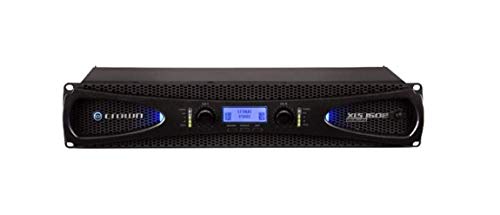
Crown XLS1502 2-Channel Class D DriveCore Professional Power Amplifier with DSP, Band Pass Filters & Peak Limiters. XLR/RCA Inputs, 525W at 4 Ohm, PureBand Crossover System. Black
$579.99 Specs and sizingThe amplifier most often specified for a pair of passive church mains: enough headroom for a band, onboard crossover and limiting, and one rack unit.
Best for: A 150 to 400 seat room with passive mains and no separate DSP
Check price on Amazon
Crown XLS2002 2-Channel Class D DriveCore Professional Power Amplifier with DSP, Band Pass Filters & Peakx Limiters. XLR/RCA Inputs, 650W at 4 Ohm, PureBand Crossover System. Black
$629.96 Specs and sizingThe step up when the mains are rated above about 400 watts each, or when a passive subwoofer is on the same amplifier.
Best for: Larger passive mains, or one channel to the mains and one to a sub
Check price on Amazon
Crown XLS2502 2-Channel Class D DriveCore Professional Audio Power Amplifier with DSP, Band Pass Filters & Peakx Limiters. XLR/RCA Inputs, 775W at 4 Ohm, PureBand Crossover System. Black
$843.98 Specs and sizingThe largest of the XLS range, for a passive subwoofer pair or high-sensitivity mains in a large room.
Best for: Passive subwoofers, or mains in a 500 seat and up sanctuary
Check price on Amazon
Behringer NX3000D Ultra-Lightweight 3000 Watt Class-D Power Amplifier with DSP Control and SmartSense Loudspeaker Impedance Compensation
$339.00 Specs and sizingAdds onboard DSP with crossovers, delay and EQ to the NX platform, which covers the processing a simple two-way system needs.
Best for: A passive main and subwoofer system with no separate loudspeaker processor
Check price on Amazon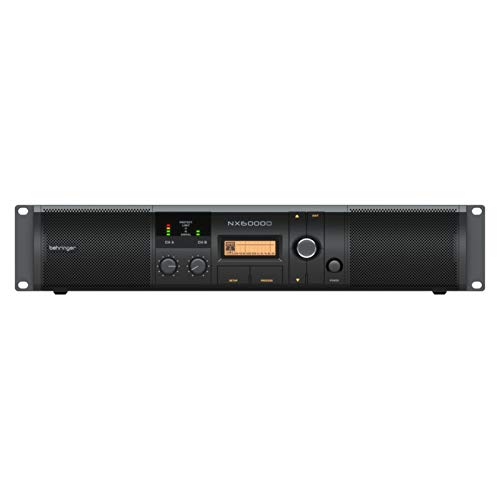
Behringer NX6000D Power Amplifier
$519.00 Specs and sizingEnough power for a pair of passive subwoofers in a large room, with the same DSP section as the NX3000D.
Best for: Driving passive subwoofers in a large contemporary room
Check price on Amazon
Crown CDi 1000 Two-Channel, 500-Watt @ 4Ω, 70V/140V Power Amplifier
$1,487.52 Specs and sizingA true install amplifier with direct 70V and 140V outputs, so a distributed ceiling system needs no output transformer of its own.
Best for: Any 70V ceiling or distributed system
Check price on Amazon
Crown CDi 2000 Two-Channel, 800-Watt @ 4Ω, 70V/140V Power Amplifier
$1,125.00 Specs and sizingThe larger CDi, for a 70V line long enough or dense enough that 500 watts per channel runs out of tap budget.
Best for: Large distributed systems, or a 70V line shared with several ancillary rooms
Check price on AmazonOn this page
How is amplifier power draw and circuit load calculated?
Two separate steps. First, rated wattage becomes real draw:
draw = rated watts * 0.33 (class AB) or * 0.2 (class D)
A class AB amplifier draws roughly a third of its rated output on typical program material, and a class D amplifier roughly a fifth, because both figures are peak ratings and music is not a peak signal continuously. Then real draw is checked against the circuit:
circuit limit = breaker rating * 0.8
That 80 percent figure is not a safety margin someone picked, it is the National Electrical Code's definition of a continuous load, meaning anything expected to run three hours or more, which a Sunday service is. A 20 amp circuit therefore carries 16 amps continuously, or 1,920 watts at 120 volts, and a 15 amp circuit carries 12 amps, or 1,440 watts.
How much do amplifiers actually draw, by rated wattage and class?
Rated wattage is what is printed on the amplifier. Draw is what the circuit actually has to supply on typical program material.
4,000 watts of rated class D amplification draws about 800 watts on program material, and the same rated wattage in class AB draws about 1,320 watts, a real difference for circuit planning.
| Rated wattage | Class D draw | Class AB draw |
|---|---|---|
| 1,000 W | 200 W | 330 W |
| 2,000 W | 400 W | 660 W |
| 4,000 W | 800 W | 1,320 W |
| 6,000 W | 1,200 W | 1,980 W |
| 8,000 W | 1,600 W | 2,640 W |
| 10,000 W | 2,000 W | 3,300 W |
These are typical program-material figures from manufacturer application guides, not worst-case sine-wave draw, which is higher and is not what a rack actually pulls during a service.
How many circuits does a given load need?
Circuits needed at three common breaker sizes, for a range of total rack loads.
A 1,920 watt load needs only one 20 amp circuit but two 15 amp circuits, and a 4,000 watt rack needs three 20 amp circuits or two 30 amp circuits.
| Total load | 15A circuits | 20A circuits | 30A circuits |
|---|---|---|---|
| 500 W | 1 | 1 | 1 |
| 1,000 W | 1 | 1 | 1 |
| 1,500 W | 2 | 1 | 1 |
| 1,920 W | 2 | 1 | 1 |
| 2,500 W | 2 | 2 | 1 |
| 4,000 W | 3 | 3 | 2 |
Circuits needed jumps in whole numbers because a continuous load cannot legally exceed 80 percent of one breaker, so a load even slightly over that limit needs a second circuit entirely, not a bigger fraction of the first.
What else draws power in a church AV rack besides amplifiers?
The console, wireless receivers, a digital stage box, DI box power and a power conditioner's own draw all add up, and none of them derate the way an amplifier does, because they run near their full rating continuously rather than following program peaks. A digital console can draw 100 to 300 watts on its own, and a rack of eight wireless receivers adds another 50 to 100. None of this is large individually, but a rack planned around the amplifiers alone and forgotten everything else is how a circuit ends up closer to its limit than the paperwork suggested.
Once the rack itself is sized, use the rack space calculator to check the gear physically fits, since a circuit that can carry the load is only half the planning question.
What if the rack needs more than one circuit?
Split it, and do it by function rather than by convenience: put the amplifiers on one circuit and the console, wireless and processing on another, so a single breaker trip during a service does not take out audio entirely. A power conditioner such as the Furman Power Conditioner, Black (M-8S) sequences the rack on and off in the right order, which is worth having regardless of circuit count, since it is what prevents the thump through the speakers when the system shuts down. For the amplifiers themselves, a two channel unit like the Crown XLS1502 2-Channel Class D DriveCore Professional Power Amplifier with DSP, Band Pass Filters & Peak Limiters. XLR/RCA Inputs, 525W at 4 Ohm, PureBand Crossover System. Black or the higher output Crown XLS2502 2-Channel Class D DriveCore Professional Audio Power Amplifier with DSP, Band Pass Filters & Peakx Limiters. XLR/RCA Inputs, 775W at 4 Ohm, PureBand Crossover System. Black makes the per-circuit math easier to plan than several smaller single-channel amplifiers scattered across the rack.
Frequently asked questions
How many amps does a church sound system draw?
It depends on rated amplifier wattage and class rather than seat count. A rack with 4,000 watts of rated class D amplification draws roughly 800 watts of real current on program material, which is under 7 amps at 120 volts before adding the console and wireless gear. Class AB amplifiers draw more of their rating, roughly a third rather than a fifth, so the same rated wattage pulls noticeably more current.
Why does an amplifier not draw its full rated wattage?
Because rated wattage is a peak figure and music is not a sustained peak. A class AB amplifier draws roughly a third of its rating and a class D amplifier roughly a fifth on typical program material, which is why a rack labeled at several thousand watts of amplification usually runs comfortably on one ordinary circuit rather than the dedicated feed the label alone might suggest.
What is a continuous load and why does it matter for a church rack?
The National Electrical Code defines anything expected to run three hours or more as a continuous load, which describes almost every Sunday service, and limits it to 80 percent of the breaker rating rather than the full number. A 20 amp circuit therefore carries 16 amps continuously, or 1,920 watts at 120 volts, and planning to the full 20 amps is a code violation, not a safety margin someone is choosing to skip.
Should the sound rack be on its own circuit?
Yes, wherever the building wiring allows it. Sharing a circuit with house lighting, HVAC or an outlet other ministries plug into is a common cause of unexplained hum, dimmer noise and dropouts when something else on the circuit switches on. A dedicated circuit for the AV rack, sized and installed by a licensed electrician, removes an entire category of intermittent fault.
What if my rack needs more amperage than one circuit provides?
Split it across two or more circuits, ideally by function so that amplifiers are on one circuit and the console, wireless and processing gear are on another. That way a single breaker trip during a service does not take out the entire system. A licensed electrician should size and install any additional circuit; this calculator only estimates the load for planning.
Does a power conditioner change how many circuits I need?
No, a power conditioner filters and sequences power, it does not reduce how many amps the gear plugged into it actually draws. What it does provide is a clean power-up and power-down order, which stops the thump through the speakers at the end of a service, and often a voltmeter that reveals building power problems an operator would otherwise only notice as odd audio faults.
Researched, not professional advice. This page is compiled from published manufacturer specifications, operator manuals, FCC rules, published standards and owner-review consensus, not hands-on testing. Sound system design, rigging loudspeakers overhead, and any electrical work are jobs for a qualified professional: have flown loudspeakers and their attachment points signed off by a structural engineer or a certified rigger, and have all wiring done by a licensed electrician to your local code. Wireless microphone rules change, so confirm the current FCC position before buying. As an Amazon Associate we earn from qualifying purchases.