Loudspeakers
Best Ceiling Speakers for Churches
Quick answer
A 12 foot ceiling with 90 degree speakers needs them spaced about 12 feet apart for even coverage at ear height, which is roughly one speaker per 145 square feet. Higher ceilings need a narrower pattern, not wider spacing.
A distributed ceiling system puts many small loudspeakers overhead so that every listener is close to one. It produces very even coverage at low level, which is exactly right for speech in a low-ceilinged room, a foyer, a fellowship hall or an overflow space.
It is the wrong answer for a worship band, and this page says so before recommending anything. Where a ceiling system is right, spacing is the whole design: work it out in the ceiling speaker spacing calculator or read the worked example for a 14 foot ceiling.
On this page
When a ceiling system is the wrong answer
Ceiling speakers are designed to deliver even, moderate level sound to a listener directly below. They are small, they have limited low frequency output, and they fire down from above. For a spoken service, a hymn with organ, or background music in a foyer, that is ideal.
For a worship band it is not. A drum kit, a bass guitar and an electric guitar need output and low end that a 5 or 6 inch ceiling driver cannot produce, and pushing a distributed system to band levels produces a thin, harsh result with no weight. Worse, the sound arrives from above the congregation rather than from the platform, so the visual and aural sources disagree and the experience feels disconnected.
The honest guidance is this: use ceiling speakers for speech-led services in low rooms, and for every ancillary space in the building. For contemporary worship, buy main loudspeakers at the platform, as covered in the main speaker roundup, and use ceiling speakers only as fills where the mains cannot reach. The full comparison is in ceiling against wall mounted speakers.
Ceiling height drives spacing and speaker count
Coverage diameter at seated ear height, and the spacing that follows, for a 90 degree conical speaker. Listener ear height is taken as 4 feet seated.
At a 12 foot ceiling a 90 degree speaker covers about a 16 foot circle at seated ear height, giving roughly 12 foot spacing and one speaker per 145 square feet.
| Ceiling height | Height above ears | Coverage circle | Edge to edge spacing | Approx area per speaker |
|---|---|---|---|---|
| 8 feet | 4 feet | about 8 feet | about 8 feet | about 64 square feet |
| 10 feet | 6 feet | about 12 feet | about 10 feet | about 100 square feet |
| 12 feet | 8 feet | about 16 feet | about 12 feet | about 145 square feet |
| 14 feet | 10 feet | about 20 feet | about 14 feet | about 200 square feet |
| 16 feet | 12 feet | about 24 feet | about 17 feet | about 290 square feet |
| 20 feet | 16 feet | about 32 feet | use a 75 degree speaker instead | pattern control matters more |
Figures are geometric, for a 90 degree conical pattern measured to the point where output falls 6 dB. Tighter overlap gives more even coverage and is normally specified for speech. Above about 16 feet, a narrower pattern speaker gives better intelligibility than wider spacing of a 90 degree model.
Ancillary spaces: corridors, nurseries and cry rooms
Not every speaker in a building needs to be good. Paging and overflow audio in a corridor, a restroom or an office needs intelligibility and nothing else, and spending heavily there takes money from the sanctuary. These are the honest budget options for those spaces.

AtlasIED 8" Dual Cone in-Ceiling Speaker with 25V/70V 5-Watt Transformer and 62-8 Baffle with Volume Control
$61.74The least expensive 70 volt ceiling speaker here with a real transformer and enclosure. A dual cone design, so it is a speech speaker and not a music speaker.
Best for: Speech-only paging and overflow audio on a tight budget
Check price on Amazon
JBL Professional Control 24CT 4-Inch Background/ForegroundCeiling Speaker, Black, Sold as Pair
$350.00 Specs and sizingA 4 inch ceiling speaker with back can for spaces that need coverage rather than impact, from a brand whose install range stays consistent across the building.
Best for: Corridors, nurseries, restrooms and the cry room
Check price on Amazon
Atlas Sound FAP40T Ceiling Speaker, 4"
A complete 4 inch system with baffle, back can and transformer in one part number, which is why installers keep them on the truck.
Best for: Hallways, offices and small rooms on the same 70 volt line
Check price on AmazonWho should not buy this tier: Any space where music matters, and anywhere over the main congregation seating.
Main rooms with a normal ceiling: 9 to 14 feet
This is the core of a church ceiling system: a fellowship hall, a chapel with a low ceiling, or an overflow room that needs to carry both speech and music acceptably. A coaxial driver matters here, because it keeps the high and low frequencies arriving from the same point and holds the tone steady as a listener moves between speakers.

JBL Professional JBL-Control 416C/T 6.5” 2-Way, Coaxial, 50 Watt, in-Ceiling Speaker with Backcan, 8 Ohm or 70V / 100V, Magnetic Grill
$494.00 Specs and sizingA 50 watt coaxial ceiling speaker with back can and a 70 volt transformer built in, which is the whole install in one box.
Best for: A distributed ceiling system in a low or flat-ceilinged room
Check price on Amazon
Atlas Sound AtlasIED FAP62T Strategy II 6-inch 32W 70/100V Ceiling Speaker System
$350.95 Specs and sizingA complete 6 inch 70 volt system with baffle, back can and transformer in one part number, at a price that scales across a whole building.
Best for: A straightforward 70 volt distributed system with no surprises at install time
Check price on Amazon
Bose Professional DesignMax DM2C-LP in-Ceiling Loudspeaker
$389.00 Specs and sizingA very shallow ceiling speaker for spaces with almost no depth above the grid, which is a real and common constraint in older buildings.
Best for: Retrofits where there is no room above the ceiling tile
Check price on Amazon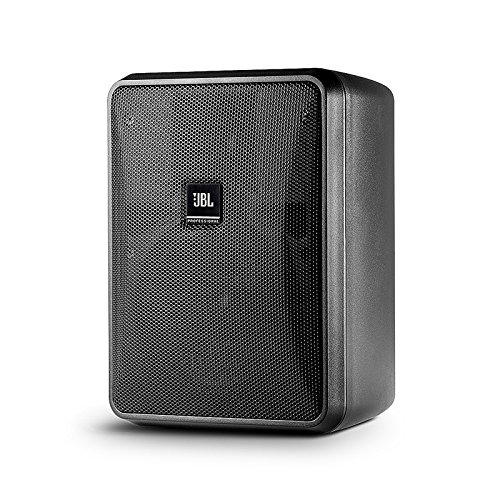
JBL Professional Control 25-1 Compact Indoor/Outdoor Background/Foreground Speaker, Black, Sold as Pair
$457.98 Specs and sizingA surface-mount cabinet that runs at 8 ohms or 70 volts, indoor or outdoor rated, with a bracket that aims it properly. Sold as a pair.
Best for: Under-balcony fills, foyers and side aisles with solid ceilings
Check price on AmazonWho should not buy this tier: Rooms with ceilings above about 16 feet, where a 90 to 110 degree pattern spreads too thin to stay intelligible.
High ceilings and rooms that must carry music
Two situations need better ceiling speakers. A high ceiling, where a wide pattern covers too large an area too thinly and intelligibility collapses, and a room where the distributed system has to carry music rather than just speech. Both are solved with better pattern control and more even off-axis response.

JBL Professional Control 47HC High Ceiling Loudspeaker, Sold as Pair
$794.00 Specs and sizingA narrower 75 degree pattern so the coverage circle does not become uselessly large from twenty feet up, which is what keeps speech intelligible in a tall room.
Best for: Ceilings above about sixteen feet
Check price on Amazon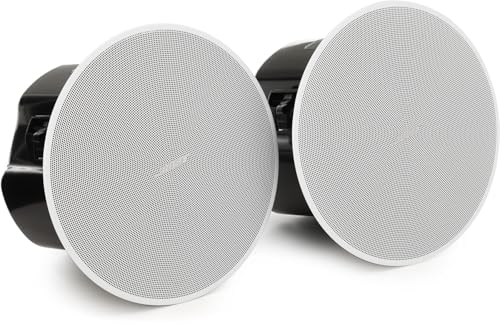
Bose Professional DesignMax DM5C 60W 5.25-inch in-Ceiling Loudspeaker - White, 1-Pair
$821.00 Specs and sizingUnusually even off-axis response, which is what makes a distributed system sound like one system rather than a row of separate speakers as people walk beneath it.
Best for: A ceiling system that has to carry music, not just the spoken word
Check price on Amazon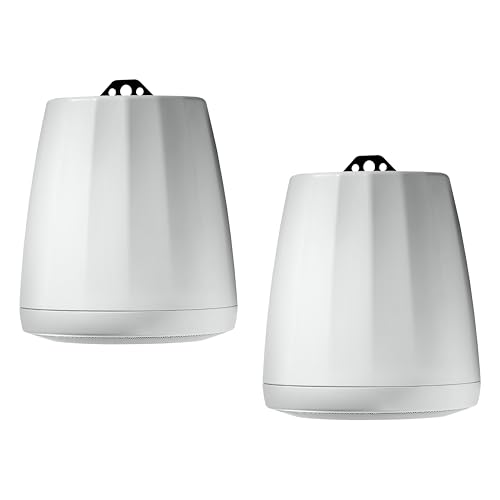
JBL Professional C65P/T-WH Compact Full-Range Hanging Pendant Speaker, 8 Ohm or 70V, 5.25-Inch. White, Sold as Pair
$550.00 Specs and sizingA hanging pendant speaker for open or exposed ceilings, where there is no grid to cut into and dropping speakers from the deck is the only option.
Best for: Exposed structure ceilings, warehouses and modern open-plan auditoriums
Check price on AmazonWho should not buy this tier: Do not buy this tier as a substitute for main loudspeakers in a contemporary worship room. No ceiling speaker at any price produces the output or low frequency extension a band needs, and a distributed system that puts the music above the congregation while the musicians are in front of them is an experience churches consistently regret paying for.
Wiring a ceiling system on a 70 volt line
Distributed systems almost always run at 70 volts rather than at 8 ohms. Instead of matching impedance, each speaker takes a wattage tap, the taps are added up, and the amplifier is sized to the total with headroom. That is what allows twenty speakers to share two conductors around a building without the impedance collapsing.
The arithmetic is simple but unforgiving: total the taps, add about 20 percent headroom, and buy an amplifier that meets it. The 70 volt system calculator does it, the tap figures are in the tap chart, and the wiring practice is in how to wire a 70 volt system.
The amplifier itself must have 70 volt outputs rather than a low impedance amplifier with a transformer bolted on. Those options are covered in the 70 volt amplifier roundup.
How we chose
We did not test these products in person and we never claim to. Picks are researched from manufacturer specification sheets and operator manuals, FCC rules where spectrum is involved, published standards, warranty terms, and the recurring themes in verified owner reviews. Every pick is matched to a real room size, seat count or input list rather than to a price bracket, and it is placed in the tier where its capability actually belongs. Where a product is wrong for most churches we say so on the page.
Sources
- Manufacturer published coverage patterns and power ratings for each ceiling speaker listed
- Standard geometric coverage method for distributed ceiling systems at seated ear height
Frequently asked questions
Can ceiling speakers replace main speakers in a sanctuary?
Only for a speech-led service in a low room. A distributed ceiling system gives very even coverage at moderate level, which suits preaching, readings and an organ, but it cannot produce the output or low frequency weight a worship band needs. It also places the sound above the congregation while the musicians are in front, which most churches find disconnecting.
How far apart should ceiling speakers be?
Spacing follows ceiling height and coverage angle. With 90 degree speakers and a 12 foot ceiling, roughly 12 feet apart gives even coverage at seated ear height, or about one speaker per 145 square feet. Tighter overlap gives more consistent coverage and is normally specified for speech, while wider spacing produces audible loud and quiet patches as people walk through the room.
What size ceiling speaker does a church need?
A 4 inch speaker is a paging speaker suited to corridors and small rooms. A 6 or 6.5 inch coaxial model is the workhorse for a fellowship hall, chapel or overflow room, and is where most church budget should go. Larger is not automatically better, since the coverage pattern and ceiling height matter far more than driver size for intelligibility.
Do ceiling speakers need a back can?
Yes, in almost every case. A back can gives the driver a defined enclosure so it sounds consistent, stops sound leaking into rooms above, and is often required by code in a plenum ceiling. Models sold with the back can included avoid a separate purchase and usually cost less than buying the two parts, which is why installers prefer them.
Is 70 volt or 8 ohm better for a ceiling system?
For more than about four speakers, 70 volt is clearly better. Each speaker takes a wattage tap rather than contributing to a falling impedance, so a long line of speakers can share one cable pair around a building. For two or three speakers on a short run, 8 ohms is simpler and avoids transformer losses entirely.
How many ceiling speakers does a fellowship hall need?
Divide the floor area by the area each speaker covers at your ceiling height. A 2,000 square foot hall with a 12 foot ceiling and 90 degree speakers covering about 145 square feet each needs roughly fourteen. Round up rather than down, since a slightly denser layout costs little and produces noticeably more even coverage across the room.
Researched, not professional advice. This page is compiled from published manufacturer specifications, operator manuals, FCC rules, published standards and owner-review consensus, not hands-on testing. Sound system design, rigging loudspeakers overhead, and any electrical work are jobs for a qualified professional: have flown loudspeakers and their attachment points signed off by a structural engineer or a certified rigger, and have all wiring done by a licensed electrician to your local code. Wireless microphone rules change, so confirm the current FCC position before buying. As an Amazon Associate we earn from qualifying purchases.