Wireless microphones
Best Budget Wireless Microphones for Churches
Quick answer
The floor worth buying is about $329 per channel, which is where frequency agility, diversity reception and spare parts begin. The Shure BLX24/PG58 and the Sennheiser XSW 1-825 both sit exactly there. Below roughly $150 a channel, the failure mode is silence during a service.
Budget wireless is the part of church AV where saving money most reliably costs money. The systems selling in four packs for under $150 a channel are not simply worse sounding: they have few or fixed frequencies, no diversity reception, no spare parts and nobody to call, so a single interference source takes a channel out with nothing anyone can do about it. That failure happens in front of a congregation. This page is about the cheapest wireless a church should actually buy, and about the two ways churches get wireless for even less and regret it: donated gear in a reallocated band, and a fourth channel nobody needed. Start with the honest channel count from the channel calculator. Figures are researched from published manufacturer specifications.
On this page
- What each price band actually buys
- The cheapest real saving is buying fewer channels
- Small church: the cheapest channel worth owning, $329
- Mid-size church: stretching a real budget, $349 to $399
- Lowest cost per channel at scale: $649 to $689 for two
- The budget systems compared
- The running costs nobody budgets for
What each price band actually buys
The price of a wireless channel maps onto specific capabilities rather than onto vague quality, and this is the table that shows where each one appears. The important row is the first one, because it is where most of the regret in church wireless is concentrated, and the important column is the last, because it describes what happens on a Sunday rather than what appears on a specification sheet.
The floor worth buying is about $329 a channel, which is where frequency agility, diversity reception and replaceable parts all begin at once.
| Price per channel | Frequencies | Diversity | Parts and support | What goes wrong |
|---|---|---|---|---|
| Under $150 | Fixed or a handful | None | None, it is disposable | A channel dies mid-service and cannot be moved |
| $329 to $400 | 10 to 12 compatible | True or automatic | Capsules and parts available for years | Very little, if the batteries are managed |
| $400 to $700 | Wider tuning range | True diversity, scan function | Full service network | Almost nothing you did not cause |
| $700 and up | Digital, tight spacing | Digital diversity | Full service network | Only what the spectrum itself does |
Prices are per channel for a complete system including transmitter and receiver, researched from current published listings. Batteries are separate and are the largest ongoing cost: at two AA cells per transmitter per weekend, a four channel church spends well over a hundred dollars a year on alkalines alone.
The cheapest real saving is buying fewer channels
Before comparing prices, cut the list. Count only the positions that genuinely move. A lectern does not move. A choir does not move. A fixed keyboard does not move. Every one of those should be wired, which is cheaper to buy, cheaper to run, more reliable and impossible to leave switched off. A wired SM58 costs $109.00 against $329.00 for the cheapest wireless channel, and it never needs a battery.
A church that trims two unnecessary wireless channels has saved more than any brand comparison on this page will save it, and it has also freed two frequencies in a spectrum that gets tighter every year. The honest test for each position is whether the person holding the microphone has to walk while using it. If not, run a cable. For how the whole budget should be split, see the AV budget allocator and church AV upgrade priorities.
Small church: the cheapest channel worth owning, $329
Two systems sit exactly at the floor, from two manufacturers with real service networks, and either is a defensible purchase. The Shure has the better upgrade path, because the capsule can be swapped later for an SM58 on the same receiver. The Sennheiser has the easier setup, because one button finds a clear frequency and syncs the transmitter to it. Choose on which of those matters more to your team.
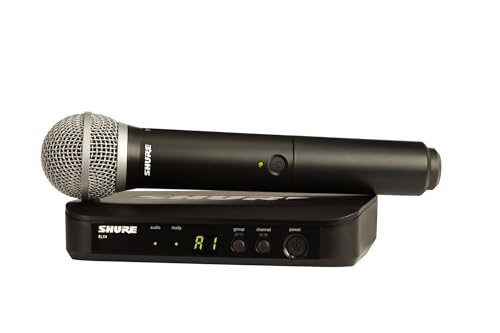
Shure BLX24/PG58 Wireless Vocal Microphone System - H10 Band
$329.00 Specs and sizingA real Shure receiver at the price of an unbranded four pack. Twelve compatible channels, 300 feet of range, and a capsule you can upgrade later without replacing the system.
Best for: A first wireless channel for announcements and a roaming speaker
Check price on Amazon
Sennheiser Pro Audio XSW 1-825-A Vocal Wireless Microphone, A Range 548-572 MHz, Black, medium
$329.00 Specs and sizingA 24 MHz tuning range with automatic frequency setup and ten compatible channels. There is effectively no way for a volunteer to configure it wrongly, which in a church with one tech person is the specification that counts.
Best for: A church with nobody available to learn frequency coordination
Check price on AmazonWho should not buy this tier: Churches that need a lapel or headworn channel, where a bodypack system rather than a handheld is the correct starting point.
Mid-size church: stretching a real budget, $349 to $399
Three or four channels on a modest budget, and the question becomes where to spend the extra sixty dollars. On a worship vocal, the SM58 capsule is worth it, because a vocal has to sit in a mix rather than merely be intelligible. On an announcements handheld, it is not. The 2.4 GHz digital systems are also worth a hard look here: they cost about the same and remove frequency coordination entirely.

Shure BLX24/SM58 Wireless Microphone System - 14-Hour Battery Life, 300 ft Range, UHF
$389.00 Specs and sizingThe SM58 capsule is worth $60 over the PG58 for any position that has to sit in a mix. On the same BLX receiver, so nothing else about the system changes.
Best for: Worship vocals rather than announcements
Check price on Amazon
Audio-Technica ATW-1102 Wireless Handheld Microphone System
$349.95 Specs and sizingA 2.4 GHz digital system with automatic frequency selection and three levels of diversity, at a price comparable to entry UHF. The TV band question simply never arises.
Best for: A small building with the Wi-Fi under your own control
Check price on Amazon
Audio-Technica ATW-1101/L Wireless Lavalier System
$399.95 Specs and sizingThe least expensive route to a digital lapel channel with no frequency planning, at roughly 100 feet of range which a small sanctuary will never exhaust.
Best for: A first lapel channel on a tight budget
Check price on AmazonWho should not buy this tier: Buildings deeper than about 100 feet or with uncontrolled guest Wi-Fi, where the 2.4 GHz options give up range you actually need.
Lowest cost per channel at scale: $649 to $689 for two
A church buying several channels at once should be comparing cost per channel rather than cost per box, and dual receivers are where that number improves. A two channel receiver also halves the rack space, the power outlets and the weekly check, which is a real saving in a busy rack even when the money is close. This is the budget tier for a church that has outgrown buying one system at a time.

Sennheiser Pro Audio XSW 1-825 DUAL-A Channel Wireless Microphone System
$649.00 Specs and sizingTwo handheld channels in one receiver at $649.00, which is about $325 a channel, and one rack unit instead of two. The cheapest honest way to add a second channel.
Best for: A church adding worship vocals to an existing handheld
Check price on Amazon
Shure BLX188/CVL Dual Wireless Lavalier System - H9 Band
$689.00 Specs and sizingTwo lavalier channels in one dual receiver at $689.00, about $345 a channel, which halves the rack space and outlets for a church needing a pastor and a worship leader on lapels.
Best for: Two speaking positions, or a pastor plus a guaranteed spare
Check price on AmazonWho should not buy this tier: A church that genuinely needs one channel. A dual receiver buys a second channel you will not use, and the correct budget purchase in that case is one system plus a spare capsule for about $54. Put the difference into stands or cables, which are the other quiet cause of unreliable services.
The budget systems compared
| Model | Price | Frequency band | Transmitter type | Microphone type | Battery life | Rated range | Polar pattern |
|---|---|---|---|---|---|---|---|
| Shure BLX24/PG58 Wireless Vocal Microphone System - H10 Band | $329.00 | UHF | Handheld | Dynamic | 14 hours | 300 ft | Cardioid |
| Sennheiser Pro Audio XSW 1-825-A Vocal Wireless Microphone, A Range 548-572 MHz, Black, medium | $329.00 | UHF | Handheld | Dynamic | 10 hours | - | Cardioid |
| Audio-Technica ATW-1102 Wireless Handheld Microphone System | $349.95 | 2.4 GHz digital | Handheld | Dynamic | 7 hours | 100 ft | - |
| Audio-Technica ATW-1101/L Wireless Lavalier System | $399.95 | 2.4 GHz digital | Bodypack | Condenser lavalier | 7 hours | 100 ft | - |
| Shure BLX24/SM58 Wireless Microphone System - 14-Hour Battery Life, 300 ft Range, UHF | $389.00 | UHF | Handheld | Dynamic | 14 hours | 300 ft | Cardioid |
| Sennheiser Pro Audio XSW 1-825 DUAL-A Channel Wireless Microphone System | $649.00 | UHF | Two handhelds | Dynamic | 10 hours | - | - |
The running costs nobody budgets for
Batteries are the real price of wireless, and they are invisible at the point of purchase. Two AA cells per transmitter per weekend, across two services and a rehearsal, is roughly a set every three weekends at manufacturer rated life, and most churches change them every Sunday regardless because nobody wants to gamble. At four channels that is well over a hundred dollars a year in alkalines, and rechargeable packs pay for themselves above about three channels. Run your own schedule through the wireless battery calculator before deciding.
The second running cost is capsules. A lavalier or headworn capsule sits against skin and clothing, collects makeup and moisture, and gradually loses high frequency detail rather than failing outright. Budget one spare as a consumable rather than as an emergency purchase: about $54 against $329 for a whole system. The third is the one nobody costs at all, which is volunteer time spent chasing a channel that drops out because a receiver was moved behind a metal panel. Keep receiver antennas in line of sight of the platform and most of that disappears. For buying decisions on the used market, see buying used church sound equipment.
How we chose
We did not test these products in person and we never claim to. Picks are researched from manufacturer specification sheets and operator manuals, FCC rules where spectrum is involved, published standards, warranty terms, and the recurring themes in verified owner reviews. Every pick is matched to a real room size, seat count or input list rather than to a price bracket, and it is placed in the tier where its capability actually belongs. Where a product is wrong for most churches we say so on the page.
Sources
- FCC guidance on legal operating bands for low power auxiliary wireless microphones
- Shure published specifications and battery life figures for the BLX platform
- Sennheiser published specifications for the XSW 1 series and XSW 1 Dual
- Audio-Technica published specifications for the System 10 family
Frequently asked questions
How much should a church spend per wireless channel?
About $329 is the floor worth buying, which is where frequency agility, diversity reception and replaceable parts all begin. Between $400 and $700 buys a wider tuning range and a scan function for crowded radio environments, and above $700 you are buying digital channel density. Add batteries, which cost a four channel church well over a hundred dollars a year in alkalines.
Is cheap wireless under $150 ever worth buying for a church?
Rarely. Systems at that price typically have fixed or very few frequencies, no diversity reception and no spare parts, so a single interference source takes a channel out with nothing anyone can do. The failure mode is silence during a service rather than merely poor sound. One system at $329 from a manufacturer with a service network is a better purchase than four cheap ones.
What is the cheapest way to add a wireless channel?
Check first whether the position needs to be wireless at all: a lectern, a choir and a fixed keyboard do not move, and a wired SM58 at $109.00 is cheaper to buy and to run. If it genuinely has to be wireless, a dual receiver at about $325 a channel is the lowest cost per channel, and a spare capsule at $54 is cheaper than a spare system.
Should we accept donated wireless microphones?
Only after checking the band letter on the receiver. Systems tuned to 617 to 652 MHz or 663 to 698 MHz are illegal to operate in the United States and cannot be retuned, and gear in the old 700 MHz band has been prohibited since 2010. A donated rack in a reallocated band is a disposal problem, not a gift, and the church that accepts it inherits that problem.
Do cheap wireless microphones sound worse or just fail more?
Both, but the failures are what matter. Budget systems use simpler companding and cheaper capsules, which is audible but liveable. The real difference is operational: without frequency agility a channel that hits interference cannot be moved, and without diversity reception a transmitter in a dead spot drops out entirely. Those happen during services, in front of everyone.
Are rechargeable batteries worth it for church wireless?
Above about three channels, yes. Manufacturer ratings of 10 to 14 hours assume continuous transmission on fresh alkalines, and most churches change cells every Sunday anyway rather than gamble. At four channels that is well over a hundred dollars a year, against roughly $220 of packs and a charger that last for years. Below three channels alkalines are simpler and the saving is small.
Researched, not professional advice. This page is compiled from published manufacturer specifications, operator manuals, FCC rules, published standards and owner-review consensus, not hands-on testing. Sound system design, rigging loudspeakers overhead, and any electrical work are jobs for a qualified professional: have flown loudspeakers and their attachment points signed off by a structural engineer or a certified rigger, and have all wiring done by a licensed electrician to your local code. Wireless microphone rules change, so confirm the current FCC position before buying. As an Amazon Associate we earn from qualifying purchases.