Speaking positions
Microphone for a Pulpit or Lectern
Quick answer
Fit an 18 inch gooseneck condenser on a shock mount, with the capsule about 12 inches from the mouth and angled up at it. A fixed speaker at a fixed microphone is the one position in the building whose feedback behaviour you can tune out permanently.
The lectern is the easiest microphone position in a church and the one most often done badly, usually by clamping a handheld vocal microphone to a desk stand and hoping. A gooseneck condenser exists because this job has a specific shape: a fixed source, a fixed distance, a hard reflective surface underneath and a reader who looks down at notes rather than at the capsule. Get the length and the shock mounting right and this channel will run for years without anyone touching it. See how to mic a pulpit for the full installation and the roundup for the shortlist.
On this page
Gooseneck length is the decision
Length sets working distance, and working distance sets both gain margin and how intrusive the microphone looks. Longer reaches closer to the mouth and buys margin. Shorter is tidier and demands that the speaker stay close. Choose length by how disciplined the speakers are, not by how the pulpit looks in a photograph.
An 18 inch gooseneck reaches roughly 12 inches from the mouth, which is about 6 dB more usable gain than a 12 inch neck at 16 to 20 inches.
| Gooseneck length | Typical distance to mouth | Relative gain margin | Best for |
|---|---|---|---|
| 12 inches | 16 to 20 inches | Reference | A live room, a disciplined speaker, a tidy look |
| 18 inches | 10 to 14 inches | About 6 dB better | Most churches. The default choice. |
| Two goosenecks, both 18 inches | 10 to 14 inches each | Same, but two open channels | Only where two people share the lectern at once |
| Handheld clamped to a desk stand | 12 to 24 inches, uncontrolled | Worst. Varies every service. | Nothing. Replace it. |
Two open microphones on one lectern costs about 3 dB of gain before feedback compared with one, because doubling the number of open channels doubles the loop gain. Use one unless two people genuinely speak at once.
Cardioid or supercardioid, and which to choose
A cardioid gooseneck rejects what is directly behind it, which in a lectern is the reader. A supercardioid rejects more of the room overall but has a small rear lobe, so it picks up a little of whatever is directly behind. The rule that works: choose supercardioid when the loudspeakers are in front of and to the sides of the lectern, which is the usual arrangement, and cardioid when there is something loud directly behind the reader, such as a choir or a platform monitor.
The supercardioid also buys a little more raw gain margin, which is why the 12 inch version is offered in that pattern: it is the combination for a live room where the longer neck would look wrong. Neither pattern rescues a microphone aimed at a loudspeaker, so settle the loudspeaker aiming first. For the underlying behaviour see the polar pattern chart.
What to buy
All four below are condensers and all four need phantom power. Check that your console supplies it on the channel you intend to use, which is covered in the phantom power chart.

Shure MX418/C Cardioid Condenser Gooseneck Microphone
$296.00 Specs and sizingAn 18 inch gooseneck with the preamp in the base and a proper shock mount, so page turns and knocks on the lectern do not arrive in the house. This is the standard answer for a fixed pulpit.
Best for: A fixed pulpit where the preacher stays put
Check price on Amazon
Shure MX412/S Supercardioid Condenser Microphone, 12" Gooseneck with Attached XLR Preamp, Shock & Flange Mount, Snap-Fit Foam Windscreen
$296.00 Specs and sizingThe 12 inch supercardioid version, less visually intrusive and rejecting more of the room. The shorter neck means the speaker has to stay closer, so match it to disciplined readers.
Best for: A lectern in a reverberant room where a longer neck rings
Check price on Amazon
Audio-Technica U857QL Cardioid Condenser Quick-Mount Gooseneck Microphone
$239.00A quick-mount gooseneck that unplugs from its base, so the microphone can be locked away between services without unbolting anything from the woodwork.
Best for: A shared or unsupervised lectern
Check price on Amazon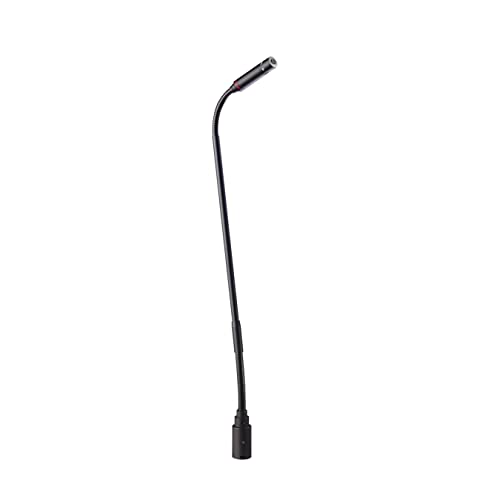
Audio-Technica PRO49QL Propoint Gooseneck Microphone
$129.00The affordable quick-mount gooseneck, and a genuine step up from a handheld clamped to a desk stand at a price that does not need a committee.
Best for: A first proper lectern microphone
Check price on AmazonMounting and the surface underneath
Mount through the lectern top with the supplied flange and shock mount rather than standing the microphone on the surface. A lectern is a drum: a reader tapping notes, resting a hand or turning a page sends that energy straight into an unmounted capsule, and it arrives in the house as a thump that is louder than the voice. The shock mount is the difference between a channel you leave alone and a channel someone rides all service.
The hard flat surface also produces a reflection that arrives at the capsule slightly after the direct sound, which thins and hollows the voice. Aim the capsule up toward the mouth rather than across the surface, and if the lectern top is glass or polished stone, a thin felt or leather pad under the notes area helps more than any EQ. Run the cable through the lectern and out of sight, with a service loop so the microphone can be removed without dismantling anything.
Channel setup and the feedback problem here
A lectern is the one position whose acoustics never change, which means its feedback behaviour is a fixed property of the room. You can find the ringing frequencies once, notch them, and be finished.
A high pass at 120 Hz plus one or two narrow notches found by ringing the room out is a permanent setting for a fixed lectern.
| Setting | Starting point | Why |
|---|---|---|
| Phantom power | On, 48 volts | Every gooseneck condenser needs it. Check the channel supplies it. |
| High pass filter | 120 Hz | Lectern thump and handling energy live below this |
| Narrow notches | One or two, found once by ringing out | A fixed position in a fixed room rings at fixed frequencies |
| Compression | About 3:1, light | Readers vary in level far more than preachers do |
| Presence | 2 to 4 kHz, gentle | Intelligibility for readers who are not practised speakers |
| Monitor sends | Off | Nothing good comes of a lectern channel in a wedge |
Ring the room out before a service, not during one. Raise the fader slowly until the system just begins to ring, notch that frequency narrowly, and repeat once or twice. Stop at two or three notches: more than that is a geometry problem.
What usually goes wrong
The first failure is a microphone that is too short for the people using it, so every reader leans in differently and the operator rides the fader all service. The second is no shock mount, which turns every page turn into a thump. The third is two goosenecks fitted because the lectern is wide, costing 3 dB of gain margin for a second channel that is almost never used at the same time as the first.
The fourth is subtler and very common: the lectern sits inside the coverage of the main loudspeakers because the speakers were aimed at the platform rather than at the seats. No microphone choice survives that, and the fix is aiming the loudspeakers so their pattern starts at the first row. Where a reader also needs to be heard away from the lectern, give them a separate channel rather than a longer gooseneck, and see the preaching position for the wireless option.
How we chose
We did not test these products in person and we never claim to. Picks are researched from manufacturer specification sheets and operator manuals, FCC rules where spectrum is involved, published standards, warranty terms, and the recurring themes in verified owner reviews. Every pick is matched to a real room size, seat count or input list rather than to a price bracket, and it is placed in the tier where its capability actually belongs. Where a product is wrong for most churches we say so on the page.
Sources
- Shure published specifications for the MX418 and MX412 Microflex gooseneck microphones
- Audio-Technica published specifications for the U857QL and PRO 49QL gooseneck microphones
Frequently asked questions
What length gooseneck microphone should a church pulpit have?
Eighteen inches for most churches, which puts the capsule roughly 12 inches from the mouth and buys about 6 dB of gain margin over a 12 inch neck. Choose 12 inches only where the room is very live and the speakers are disciplined about staying close, since the shorter neck demands a consistent working distance.
Cardioid or supercardioid for a lectern microphone?
Supercardioid where the loudspeakers are in front of and to the sides of the lectern, which is the usual arrangement, because it rejects more of the room overall. Choose cardioid when something loud sits directly behind the reader, such as a choir or a platform monitor, since a supercardioid has a small rear lobe that would pick it up.
Why does our pulpit microphone thump when someone turns a page?
Because it is not shock mounted. A lectern behaves like a drum, and a capsule rigidly attached to the surface hears every tap, page turn and hand rest as structural energy. Fit the gooseneck through the lectern top with its shock mount and flange rather than standing a microphone on the surface, and add a high pass filter at 120 Hz.
Can we use a regular handheld microphone at the lectern?
It works but it is the weakest option, because the working distance varies with every reader and the channel needs constant attention. A gooseneck fixes the distance, adds shock mounting and disappears visually. If you do keep a handheld on a stand there, it is most useful as the permanently patched fallback for when the wireless fails.
Should we fit two microphones on a wide lectern?
Only if two people genuinely speak at the same time. Doubling the number of open microphones doubles the loop gain and costs about 3 dB of gain before feedback, which is real margin given away for a channel that is usually unused. One well placed 18 inch gooseneck covers a single reader at any position along a wide lectern.
Do gooseneck microphones need phantom power?
Yes. Gooseneck lectern microphones are condensers and need 48 volt phantom power from the console or from an inline supply. Check the specific channel you intend to use actually provides it, since some analog consoles switch phantom in banks rather than per channel, and a condenser with no phantom simply produces silence.
Researched, not professional advice. This page is compiled from published manufacturer specifications, operator manuals, FCC rules, published standards and owner-review consensus, not hands-on testing. Sound system design, rigging loudspeakers overhead, and any electrical work are jobs for a qualified professional: have flown loudspeakers and their attachment points signed off by a structural engineer or a certified rigger, and have all wiring done by a licensed electrician to your local code. Wireless microphone rules change, so confirm the current FCC position before buying. As an Amazon Associate we earn from qualifying purchases.