Instruments
Microphone for Acoustic Guitar
Quick answer
Take an acoustic guitar with a direct box rather than a microphone. Use an active DI for a passive piezo pickup and a passive DI for an active preamp system. A microphone on a platform with wedges will feed back at the guitar body resonance long before it sounds good.
This is the position where the honest answer costs a microphone sale. A condenser in front of an acoustic guitar sounds lovely in a quiet room and is close to unusable on a church platform, because the guitar is quiet at 75 to 85 dBA while the drums behind it are at 105 to 120, and because the guitar body is a tuned resonant chamber that will happily feed back at around 100 Hz. Almost every church should take the guitar through its pickup with a direct box. Which direct box depends entirely on the pickup, and getting that pairing wrong is the most common cause of a thin, quacking acoustic sound.
On this page
Which direct box for which pickup
The rule is the opposite of what people expect, and it catches almost everyone. A passive pickup needs an active direct box, and an active pickup is happy with a passive one. The reason is impedance: a passive piezo element has a very high output impedance, and a passive transformer loads it down, which is heard as a thin, brittle, quacking tone with no low end.
A passive piezo pickup needs an active DI, and a guitar with an onboard preamp and a battery is well served by a passive one.
| Pickup in the guitar | How to tell | Direct box to use | Why |
|---|---|---|---|
| Passive piezo under the saddle | No battery compartment, no onboard controls | Active DI, phantom powered | Very high output impedance. A passive DI loads it down and thins it out. |
| Active preamp with a battery | Battery door, onboard volume and tone controls | Passive DI | The onboard preamp has already done the impedance work |
| Magnetic soundhole pickup | Visible pickup in the soundhole | Passive DI | Behaves like an electric guitar pickup |
| Guitar with an XLR output | Onboard XLR socket | No DI needed | Straight to the console. Check whether it wants phantom power. |
If an acoustic guitar sounds thin and quacky through the system and everyone blames the guitar, this table is the first thing to check. The fix is often a fifteen dollar difference in which box is in the line.
What to buy
Buy one of each type and keep them both in the rack, because a church platform sees both kinds of guitar as visiting musicians come and go. For the full shortlist see direct boxes for churches.
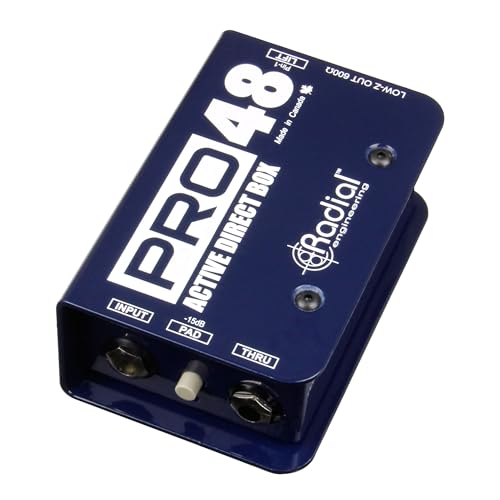
Radial Pro48 Active 48-Volt Compact Direct Box
$134.99An active direct box powered from the console phantom, which suits the passive under-saddle pickups that a transformer would load down. This is the box that fixes a thin acoustic sound.
Best for: Passive piezo acoustic guitar pickups
Check price on Amazon
Radial Pro DI Passive Direct Box
$134.99A passive direct box with a high grade transformer in a chassis built to be stood on. Passive means no power and nothing to fail mid-service, which is what a permanent platform position wants.
Best for: Acoustic guitars with an onboard preamp and battery
Check price on Amazon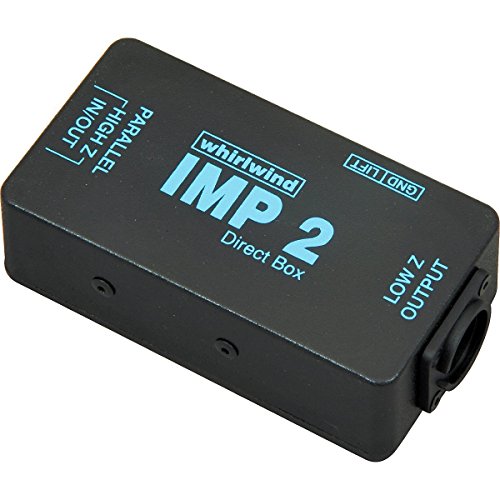
Whirlwind IMP 2 1-Channel Passive Instrument Direct Box
$79.00The workhorse passive direct box that has been in rental stock for decades. It does one thing and it is very hard to break, which makes it the right thing to keep spares of.
Best for: A first direct box, or the spares in the case
Check price on Amazon
Behringer Ultra-DI DI100 1-Channel Active Microphone/Instrument Direct Box
$45.90An active direct box that also runs on a 9 volt battery, at a price where a church can equip every platform position at once rather than one a year.
Best for: Fitting out a whole platform cheaply
Check price on AmazonWhen a microphone is genuinely the right answer
There is one case: a solo acoustic guitar in a quiet service with no drums, no wedges and nothing else competing. A special music item, a communion piece or a small acoustic gathering all qualify. In that situation a small condenser aimed at the twelfth fret from six to twelve inches away, angled slightly toward the soundhole, sounds far better than any pickup.
Everything about that changes the moment a drum kit starts. The microphone hears the kit at nearly the same level as the guitar, the guitar body couples with the wedge wash, and the channel has to be pushed hard because the source is quiet. If your church does both kinds of service, the workable arrangement is a direct box permanently patched for band services and a microphone on a stand that comes out for the quiet ones, rather than trying to make one approach serve both.
Channel setup and the feedback problem here
An acoustic guitar body is a Helmholtz resonator tuned somewhere around 90 to 110 Hz, which is exactly where a wedge has plenty of energy. That resonance is what rings first, and it rings whether the guitar is taken by microphone or by pickup, because the body still couples with the room and the pickup still hears it.
A high pass at 80 Hz plus a narrow cut near 100 Hz controls the body resonance that makes an acoustic guitar ring on a loud platform.
| Setting | Starting point | Why |
|---|---|---|
| High pass filter | 80 Hz | Nothing musical from an acoustic guitar lives below this on a platform |
| Narrow cut | Near 100 Hz, found by ear | The body resonance. This is what rings first in a wedge. |
| Low mid cut | 200 to 300 Hz if boxy | Under-saddle pickups build up here |
| Piezo quack | Cut narrowly around 2 to 4 kHz | The brittle edge characteristic of piezo elements |
| Compression | About 3:1, light | Evens out strumming against picking |
| Phantom power | On for an active DI, off for passive | An active DI needs it. A passive one does not care. |
A soundhole cover is the mechanical version of the 100 Hz notch and works better, because it stops the resonance happening rather than removing it afterwards. It is worth trying before reaching for EQ.
What usually goes wrong
The wrong direct box for the pickup, which produces the thin quacking tone everyone blames on the guitar. A microphone used on a platform that was always going to be too loud for it. Low frequency ringing from the body resonance, treated by pulling the whole channel down instead of by a narrow cut or a soundhole cover. And a guitarist who also sings into a headworn capsule, so the guitar arrives twice, once in the direct box and once in the vocal channel, at slightly different times.
That last one is worth watching for, because it sounds like a phase problem rather than a bleed problem and it is fixed by moving the vocal capsule rather than by touching the guitar channel. Keep the headworn element at the corner of the mouth rather than out in front where it points down toward the instrument, which is covered in the worship leader position.
How we chose
We did not test these products in person and we never claim to. Picks are researched from manufacturer specification sheets and operator manuals, FCC rules where spectrum is involved, published standards, warranty terms, and the recurring themes in verified owner reviews. Every pick is matched to a real room size, seat count or input list rather than to a price bracket, and it is placed in the tier where its capability actually belongs. Where a product is wrong for most churches we say so on the page.
Sources
- Radial Engineering published specifications for the ProDI and Pro48 direct boxes
- Whirlwind published specifications for the IMP 2 direct box
Frequently asked questions
Should an acoustic guitar be miked or taken with a direct box?
A direct box, in almost every church. A microphone hears the drum kit at nearly the same level as the quiet guitar, and the guitar body resonance feeds back readily against wedges. Use a microphone only for a solo acoustic item in a quiet service with no drums, where it will sound considerably better than any pickup.
Which direct box does an acoustic guitar need?
An active DI for a passive under-saddle piezo pickup, and a passive DI for a guitar with an onboard preamp and battery. The rule surprises people but it is about impedance: a passive transformer loads down a high impedance piezo element, which is heard as a thin, brittle, quacking tone with no low end.
Why does our acoustic guitar sound thin and quacky?
Most often a passive direct box on a passive piezo pickup, which is an impedance mismatch rather than a fault in the guitar. Swap to an active DI powered from the console phantom. If it persists, cut narrowly around 2 to 4 kHz, which is where the characteristic piezo edge lives, and check the low mids around 250 Hz.
How do we stop an acoustic guitar feeding back?
A soundhole cover is the most effective fix, because it stops the body resonance happening rather than removing it afterwards. Failing that, high pass at 80 Hz and take a narrow cut near 100 Hz where the body resonates. Turning the whole channel down works too but costs you the instrument in the mix.
Can one direct box serve every guitar that visits?
Not well, because visiting musicians bring both pickup types. Keep one active and one passive direct box permanently in the rack and choose per guitar at soundcheck. They are inexpensive enough that having both is cheaper than the time spent diagnosing a thin acoustic sound halfway through a service.
Does an acoustic guitar direct box need phantom power?
An active direct box does, usually 48 volts from the console, though many will also run on a 9 volt battery. A passive direct box needs no power at all, which is one of its advantages for a permanent platform position since there is nothing to fail mid-service and no battery to check.
Researched, not professional advice. This page is compiled from published manufacturer specifications, operator manuals, FCC rules, published standards and owner-review consensus, not hands-on testing. Sound system design, rigging loudspeakers overhead, and any electrical work are jobs for a qualified professional: have flown loudspeakers and their attachment points signed off by a structural engineer or a certified rigger, and have all wiring done by a licensed electrician to your local code. Wireless microphone rules change, so confirm the current FCC position before buying. As an Amazon Associate we earn from qualifying purchases.