Processing
Best Graphic Equalizers for Churches
Quick answer
A dual channel 31 band graphic equaliser gives one third octave control from 20 Hz to 20 kHz, and the dbx 231s at $335.00 is the one to buy. Churches building a new system should usually put that money into a loudspeaker processor with parametric equalisation instead.
A graphic equaliser divides the spectrum into fixed bands, one third of an octave apart, and gives each band a fader. Thirty one bands per channel covers 20 Hz to 20 kHz. It is the most immediately understandable piece of processing ever built, which is exactly why it survives in church racks long after the engineering argument moved on.
The engineering argument is that a fixed one third octave band is a blunt tool for a problem that is usually much narrower than that. A room resonance might be a tenth of an octave wide, and cutting a full third of an octave to catch it removes a great deal of the voice along with it. Parametric equalisation, which lets you set the exact frequency and the exact width, does the same job with far less collateral damage. Before touching either, read how to tune a church sound system.
On this page
Which frequency bands matter in a sanctuary
The standard one third octave centre frequencies a 31 band equaliser provides, and what typically lives in each region of a church system.
The 200 to 500 Hz region is where most church systems are muddy, and it is the first place to cut rather than boost.
| Region | Centre frequencies | What lives there | Usual church action |
|---|---|---|---|
| Sub and rumble | 20, 25, 31.5, 40, 50, 63 Hz | Air handling, footfall, handling noise, kick drum | High pass every microphone channel above 80 Hz |
| Low end | 80, 100, 125, 160 Hz | Bass guitar, kick, male voice weight, room modes | Cut a narrow room mode, do not boost broadly |
| Mud | 200, 250, 315, 400 Hz | Body of most instruments, boxy room build-up | Cut 2 to 4 dB, the most common useful move |
| Honk | 500, 630, 800 Hz, 1 kHz | Horn resonance, boxy vocals, guitar amp bark | Cut narrowly where it rings |
| Intelligibility | 1.25, 1.6, 2, 2.5, 3.15 kHz | Consonants, where speech is understood | Leave alone, or lift gently for an older congregation |
| Presence and sibilance | 4, 5, 6.3, 8 kHz | Sibilance, cymbals, feedback frequencies | Cut narrowly, never boost broadly |
| Air | 10, 12.5, 16, 20 kHz | Room ambience, hiss, very little useful content | Usually flat, roll off if the system hisses |
These are the standard ISO one third octave centre frequencies every 31 band equaliser provides. Which bands need cutting in your room depends on measurement, not on this table, but the 200 to 500 Hz cut and the high pass filter on every microphone channel are safe starting moves in nearly every sanctuary.
Cut, do not boost
The single most useful equalisation rule in a church is that cutting solves problems and boosting creates them. If the vocal sounds dull, the correct move is usually to cut the muddy region around 250 Hz rather than to boost 3 kHz, because a cut leaves headroom while a boost consumes it. A system with six bands boosted by 6 dB has thrown away 6 dB of amplifier headroom and moved 6 dB closer to feedback.
The second rule is that a graphic equaliser on the main output is for correcting the room and the system, and it is set once. It is not a tone control to be moved during a service. If a volunteer is reaching for the system equaliser mid service, the problem is on a channel, and that is usually a gain structure problem rather than a tonal one.
The third is that sustained boosts at feedback frequencies are self-defeating. Everything in the feedback eliminator roundup about gain before feedback applies here, and a graphic equaliser used carefully as a ringing-out tool is worth 3 to 6 dB, the same as a dedicated suppressor.
Small church: one problem, narrow tools
A small church usually does not need a system graphic equaliser at all. The mixer already has equalisation on every channel, and modern powered loudspeakers have their own voicing presets. Where a small church does need something, it is normally a narrow filter on one ringing frequency, and a parametric unit does that far better than a third octave fader.

Behringer FEEDBACK DESTROYER PRO FBQ2496 Automatic and Ultra-Fast Feedback Destroyer/Parametric EQ with 40 FBQ Filters and 96 kHz Audio Performance
$169.00A parametric equaliser with automatic feedback filters, which can sit on one problem channel and place narrow cuts exactly where the ring is. Narrower filters mean less of the voice removed for the same amount of feedback control.
Best for: One problem microphone, or a first attempt at ringing out a room
Check price on Amazon
Crown XLS1002 2-Channel Class D DriveCore Professional Power Amplifier with DSP, Band Pass Filters & Peakx Limiters. XLR/RCA Inputs, 350W at 4 Ohm, PureBand Crossover System. Black
$439.88 Specs and sizingBand pass filters and a crossover section built into the amplifier, which covers the high pass filtering a small speech system actually needs. In many small churches this plus the mixer channel equalisation is the whole requirement.
Best for: A small passive system with no separate processing rack
Check price on AmazonWho should not buy this tier: Churches with a volunteer team that specifically wants physical faders and a visible system curve.
Mid-size: the classic dual 31 band
This is the tier where a graphic equaliser makes genuine sense: a traditional installation with a volunteer team that has used one for twenty years, where a rack of software would be a step backwards in usability. The faders are the feature. Anybody can see what the system is doing and return it to flat, and nobody needs a laptop to do it.

dbx 231s Dual Channel 31-Band Equalizer
$335.00Two channels of 31 band control in two rack units, built to survive a long install life. It is the traditional way to tune a room and the one an experienced volunteer will already understand without training.
Best for: Traditional installs and teams more comfortable with faders than with software
Check price on Amazon
dbx 286s Microphone Processor.
$345.00A microphone channel processor with compression, de-essing, an expander gate and an enhancer. On a preaching channel this evens out a voice that moves, which solves the complaint that usually sends a church looking for an equaliser in the first place.
Best for: One channel: the preaching microphone, especially for a speaker who paces
Check price on AmazonWho should not buy this tier: New system builds, where a processor with parametric equalisation does the same job more precisely for similar money.
Large room: what replaced the graphic equaliser
In a new large-room design the 31 band graphic is no longer specified. Its job is absorbed into the loudspeaker processor, where each output has its own parametric filters with adjustable width, plus crossover, delay and limiting. That is not fashion: a parametric filter can take out a 40 Hz wide room mode without touching the octave around it, and a third octave fader cannot. Plan the rack with the rack space calculator.

dbx DriveRack PA2 2x6 PA Complete Professional Loudspeaker Management System, Rack Mountable with Android and iOS Control. Black
$426.00 Specs and sizingGraphic and parametric equalisation together with the crossover, delay, limiting and automatic room tuning, in one rack unit rather than two. For a church replacing an ageing graphic equaliser, this is the upgrade that also solves four other problems.
Best for: Any system being rebuilt rather than patched
Check price on Amazon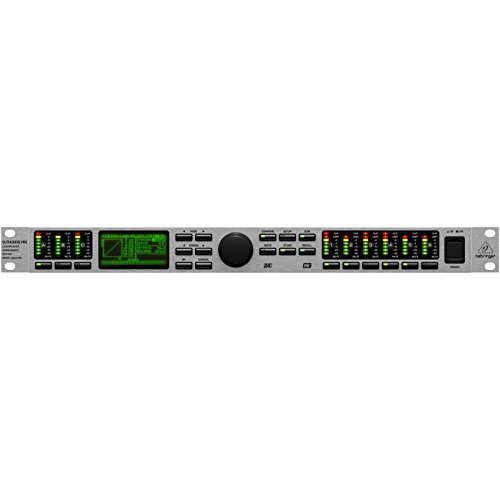
Behringer Ultradrive Pro Dcx2496 Ultra High-Precision Digital 24-Bit/96 Khz Loudspeaker Management System
$339.00 Specs and sizingSix outputs, each with its own equalisation, delay and limiting. A large room needs different correction for the mains, the subwoofer and the under-balcony fills, and a two channel graphic equaliser physically cannot provide that.
Best for: Multi-zone systems with fills or delay speakers
Check price on AmazonWho should not buy this tier: Do not buy this tier for a volunteer team that will not open a screen. A processor whose settings live behind a menu is worse than a graphic equaliser nobody is afraid of, because an unusable tuning tool gets left wrong for years. Match the equipment to who will actually operate it on a Sunday.
The equalisation options compared
| Model | Price | Video inputs | Video outputs | Rack space | Onboard DSP |
|---|---|---|---|---|---|
| dbx 231s Dual Channel 31-Band Equalizer | $335.00 | 2 | 2 | 2U | - |
| Behringer FEEDBACK DESTROYER PRO FBQ2496 Automatic and Ultra-Fast Feedback Destroyer/Parametric EQ with 40 FBQ Filters and 96 kHz Audio Performance | $169.00 | 2 | 2 | 1U | Yes |
| dbx DriveRack PA2 2x6 PA Complete Professional Loudspeaker Management System, Rack Mountable with Android and iOS Control. Black | $426.00 | 2 | 6 | 1U | Yes |
How we chose
We did not test these products in person and we never claim to. Picks are researched from manufacturer specification sheets and operator manuals, FCC rules where spectrum is involved, published standards, warranty terms, and the recurring themes in verified owner reviews. Every pick is matched to a real room size, seat count or input list rather than to a price bracket, and it is placed in the tier where its capability actually belongs. Where a product is wrong for most churches we say so on the page.
Sources
- Manufacturer published specifications for each equaliser listed
- Standard ISO one third octave centre frequencies
- Consensus of verified owner reviews across major retailers
Frequently asked questions
Does a church still need a graphic equaliser?
Only if the team wants physical faders. The functions a graphic equaliser provides are included in any modern loudspeaker processor, with adjustable filter width that a fixed third octave band cannot match. Where a graphic equaliser still wins is usability: an experienced volunteer can read the curve at a glance and reset it to flat without a screen or a laptop.
What is the difference between graphic and parametric equalisation?
A graphic equaliser has fixed frequencies and fixed bandwidths, one per fader. A parametric filter lets you choose the exact frequency, the exact amount and the width of the cut. For removing a narrow room resonance, parametric removes far less of the wanted sound. For a volunteer who needs to see the whole system curve, graphic is much easier to read.
Should the graphic equaliser be flat?
Close to it. A well-placed, well-aimed system in an acceptable room needs a few cuts of a couple of decibels and very little else. If the curve looks like a mountain range, the equaliser is compensating for a physical problem such as a loudspeaker aimed at a wall or a serious room resonance, and that problem will keep reappearing in other ways.
Why do we cut rather than boost?
Because every boost consumes amplifier headroom and moves the system closer to feedback, while a cut gives headroom back. If the vocal sounds dull, cutting the muddy region around 250 Hz achieves the same perceived brightness as boosting 3 kHz, without the lost headroom. As a habit, cut what is wrong instead of boosting what is missing.
Can a graphic equaliser help with feedback?
Yes, used as a ringing-out tool. Raise the microphone gain slowly until the system just begins to ring, pull down the fader at that frequency, and repeat two or three times. That typically recovers 3 to 6 dB, the same as an automatic suppressor. Stop after three cuts, because beyond that you are removing enough of the voice to hear the difference.
Where does the equaliser go in the signal chain?
Across the main output, between the console and the amplifier or the powered loudspeakers, because it is correcting the system and the room. If it is being used to fix one microphone, it belongs on that channel insert instead. An equaliser placed after the loudspeaker processor limiters also undoes the driver protection those limiters were providing.
Researched, not professional advice. This page is compiled from published manufacturer specifications, operator manuals, FCC rules, published standards and owner-review consensus, not hands-on testing. Sound system design, rigging loudspeakers overhead, and any electrical work are jobs for a qualified professional: have flown loudspeakers and their attachment points signed off by a structural engineer or a certified rigger, and have all wiring done by a licensed electrician to your local code. Wireless microphone rules change, so confirm the current FCC position before buying. As an Amazon Associate we earn from qualifying purchases.