Projector brightness
How Many Lumens for a 12 Foot Wide Church Screen?
Quick answer
A 12 foot wide screen is about 6.8 feet high and 81 square feet, with a 165 inch diagonal. With lights down, blackout shades you are aiming for 16 foot-lamberts, which needs about 1,178 lumens on a standard 1.1 gain screen. Buy a projector rated 1,500 ANSI lumens or more.
"How many lumens do I need" has no single answer, and that is why every projector recommendation you have read contradicts the last one. Lumens is a quantity of light; what your eyes judge is foot-lamberts, which is that light spread over the screen area and bounced back at you. A 5,000 lumen projector is blinding on a 6 foot screen and dim on a 20 foot one. The arithmetic is simply lumens = screen area in square feet x target foot-lamberts / screen gain.
On this page
Why 1,500 lumens, and not a round number off a forum
A 12 by 6.8 foot screen is 81 square feet. Lights down, blackout shades calls for about 16 foot-lamberts at the screen: that is the cinema standard, and it only works if the lights genuinely come down. Multiply 81 square feet by 16 foot-lamberts and divide by a standard 1.1 screen gain and you get 1,178 lumens, so a 1,500 ANSI lumen projector is the size to buy.
Two adjustments to make before ordering. Light output falls over the life of a lamp or a laser, commonly 20 to 30 percent, so buying exactly at the number leaves you dim in year four. And a single-chip DLP projector's headline figure is white brightness; its colour brightness can be substantially lower, while a 3-chip 3LCD projector produces the same figure for both. Compare colour brightness, not white brightness.
How much does room lighting change the answer?
More than the screen size does, in most churches. This is the same screen under three different lighting conditions.
The same 12 foot screen needs about 1,178 lumens with the lights down and about 3,682 lumens in a bright room, a difference of roughly three times.
| Room condition | Target | Lumens needed | Projector to buy |
|---|---|---|---|
| Lights down, blackout shades | 16 fL | 1,178 lm | 1,500 lm |
| Normal service lighting | 35 fL | 2,577 lm | 3,000 lm |
| Bright room or daylight windows | 50 fL | 3,682 lm | 4,000 lm |
All on a standard 1.1 gain matte white screen. An ambient-light-rejecting screen changes this picture more than a brighter projector does, because it rejects light arriving from above while still reflecting the projector.
What screen gain does to the number
Gain is how much more light the screen reflects back at the viewer than a perfect diffuse white surface would. Higher gain buys brightness and costs viewing angle, which matters in a wide sanctuary where the outside seats are well off axis.
Moving from a 1.1 gain screen to a 1.8 gain screen cuts the projector requirement for this screen from about 1,178 lumens to about 720 lumens, at the cost of a much narrower usable viewing cone.
| Screen gain | Lumens needed | Projector to buy | Typical surface |
|---|---|---|---|
| 0.8 | 1,620 lm | 2,000 lm | Grey or ambient-light-rejecting surface |
| 1.0 | 1,296 lm | 1,500 lm | Standard matte white |
| 1.1 | 1,178 lm | 1,500 lm | Standard matte white |
| 1.3 | 997 lm | 1,000 lm | Mild gain, still wide viewing |
| 1.8 | 720 lm | 1,000 lm | High gain, narrow viewing cone |
High gain screens hot-spot: the centre looks brighter than the edges to anyone sitting off to the side. In a fan-shaped sanctuary that is usually a worse problem than a slightly dimmer image.
Is a 12 foot screen the right size for your room?
Brightness is only half the specification. The other half is whether the image is big enough to read from the back row. The rule that matters for lyrics and sermon points is the six times rule: the furthest seat should sit no more than six screen heights back. A 6.8 foot high image serves a back row about 41 feet away, so if your sanctuary is deeper than that the screen is too small no matter how bright the projector is. Check with the screen size calculator or the screen size by room depth pages.
Also check the bottom of the image sits at least 4 feet off the floor, or the heads in front will block it for everyone behind.
Projectors bright enough for a 12 foot screen with the lights down
Rated at or above the 1,500 ANSI lumens this combination calls for. Prefer a laser light source if you can: there is no lamp to replace, no gradual dimming, and for a church buying a bulb every eighteen months it pays for itself.
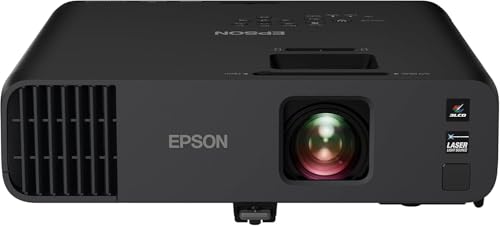
Epson Pro EX11000 3-Chip 3LCD Full HD 1080p Wireless Laser Projector
$1,399.99 Specs and sizingA laser light source, so there is no lamp to replace and no gradual dimming over the years. For a church that replaces a bulb every 18 months, the laser pays for itself.
Best for: A mid-size sanctuary that is tired of buying projector lamps
Check price on Amazon
OPTOMA ZH450 Projector FHD 4500lm
$1,498.00The previous generation of the same design, often available for less. Same caveat about single chip color brightness.
Best for: Stretching a projection budget in a moderately lit room
Check price on Amazon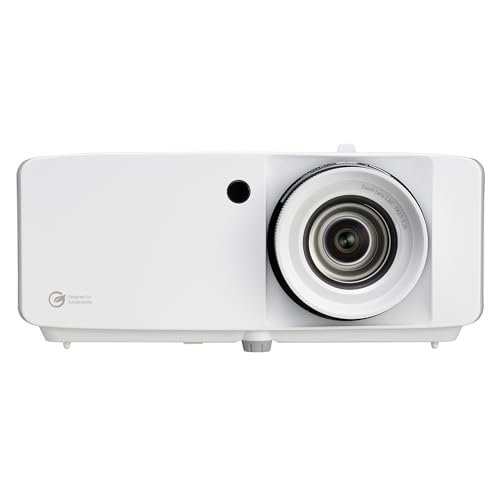
Optoma ZH551 - 1080p Full HD, 5600 Lumens, Laser, IP6X Dust Resistant, DuraCore 30,000 Hour Maintenance-Free, Miracast Wireless Screen Sharing Projector, 1080p
$1,499.00A brighter laser with a dust-resistant sealed engine, which matters in a building with an old air handling system and a projector fifteen feet up.
Best for: Ceiling mounts nobody wants to get a lift out to clean
Check price on Amazon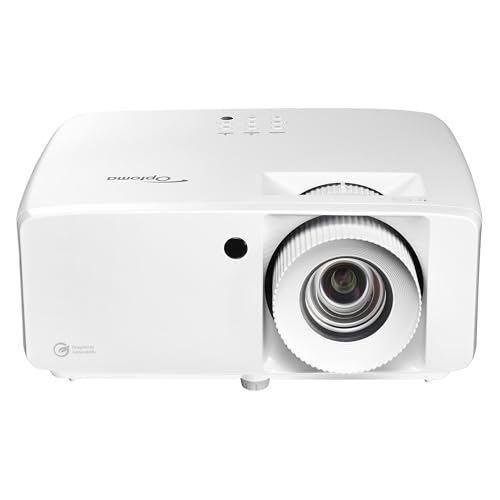
Optoma ZH451 - Full HD 1080p, 4,600 Lumens, Miracast Wireless Display, Laser, Compact, Business and Classroom Projector, Regular Throw 1080p Miracast
$1,099.00A bright 1080p laser with a 30,000 hour rated light source at a mid-range price. Single chip DLP, so check color brightness rather than the white lumens figure.
Best for: A bright room on a budget that cannot stretch to a 3-chip laser
Check price on AmazonScreens at around this size
A 12 foot wide 16 by 9 screen is about a 165 inch diagonal. A fixed frame with a black velvet border looks far crisper than a painted wall, because the border absorbs the overspill at the image edge.
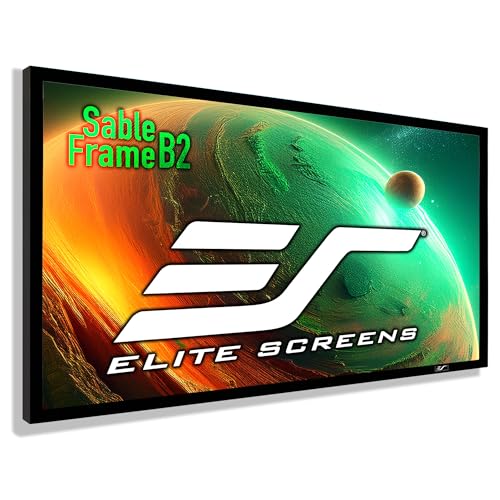
Elite Screens Sable Frame B2 120" Fixed Frame Projector Screen SB120WH2
$352.55 Specs and sizingA fixed frame screen with a black velvet border. The border is not decoration: it absorbs overspill and makes the image edge look crisp, which a painted wall never does.
Best for: A permanent screen position in a small to mid-size room
Check price on Amazon
Elite Screens Manual Series, 150-INCH 16:9, Pull Down Manual Projector Screen with AUTO LOCK, Movie Home Theater 8K / 4K Ultra HD 3D Ready, 2-YEAR WARRANTY, M150UWH2
$379.84 Specs and sizingThe 150 inch pull-down. At this size a manual screen is heavy and awkward, and it is the point where a motorized screen starts to be worth the money.
Best for: A large image in a shared room, if someone strong is on the rota
Check price on Amazon
Elite Screens Manual Series, 120-INCH 16:9, Pull Down Projector Screen with AUTO Lock, Movie Home Theater 8K / 4K Ultra HD 3D Ready, 2-Year Warranty, M120UWH2
$292.56 Specs and sizingA pull-down screen with an auto lock, for a shared room where the screen must disappear for the rest of the week.
Best for: Multi-use rooms, fellowship halls and rented spaces
Check price on AmazonHow we chose
We did not test these products in person and we never claim to. Picks are researched from manufacturer specification sheets and operator manuals, FCC rules where spectrum is involved, published standards, warranty terms, and the recurring themes in verified owner reviews. Every pick is matched to a real room size, seat count or input list rather than to a price bracket, and it is placed in the tier where its capability actually belongs. Where a product is wrong for most churches we say so on the page.
Sources
- Manufacturer published ANSI lumen, contrast and light source life figures for the projectors listed
- Published screen gain figures for the projection screens listed
Frequently asked questions
How many lumens do I need for a 12 foot church screen?
About 1,500 ANSI lumens with lights down, blackout shades, on a standard 1.1 gain screen. That comes from 81 square feet of screen at 16 foot-lamberts. Buy above the number rather than exactly at it, because projector light output falls over the life of the lamp or laser.
What are foot-lamberts and why does nobody quote them?
A foot-lambert is the brightness your eye actually sees at the screen: lumens spread over the screen area and reflected back. Manufacturers quote lumens because it is a property of the projector alone, but lumens on its own tells you nothing without a screen size. Cinema standard is about 16 foot-lamberts in a dark room, and a church with the house lights up needs 35 to 50.
Is a 3-chip projector really worth the extra money in a church?
Usually yes, because of colour brightness. A 3LCD projector produces the same brightness for white and for colour. A single-chip DLP splits light through a colour wheel, so its colour brightness can be a fraction of its headline white figure, and lyrics on a coloured background are exactly the case where that shows. If you compare a DLP against a 3LCD, compare the colour brightness figures.
Should I buy a brighter projector or a better screen?
If the problem is light landing on the screen from windows or house lighting, an ambient-light-rejecting screen does more than another few thousand lumens, because it rejects light arriving from above while still reflecting the projector in front of it. If the problem is simply a large screen in a dim room, brightness is the answer.
How long does a projector last in a church?
A lamp projector is typically rated 3,000 to 5,000 hours to half brightness, which for a church running about six hours a week is roughly ten to sixteen years of Sundays but far less if the room is also used for midweek programmes and school use. A laser source is commonly rated 20,000 to 30,000 hours and does not need a lamp change at all, which is why laser has become the default for installed church projection.
Researched, not professional advice. This page is compiled from published manufacturer specifications, operator manuals, FCC rules, published standards and owner-review consensus, not hands-on testing. Sound system design, rigging loudspeakers overhead, and any electrical work are jobs for a qualified professional: have flown loudspeakers and their attachment points signed off by a structural engineer or a certified rigger, and have all wiring done by a licensed electrician to your local code. Wireless microphone rules change, so confirm the current FCC position before buying. As an Amazon Associate we earn from qualifying purchases.