Loudspeakers
SPL Loss by Distance Calculator
Quick answer
Sound level falls 6 dB every time the distance doubles in free field. A loudspeaker producing 100 dB at 10 feet produces 94 dB at 20 feet, 88 dB at 40 feet and 82 dB at 80 feet, which is why the front rows are always louder than the back.
The inverse square law is the single most useful piece of arithmetic in church sound, and it explains a complaint every church has: the front rows find it too loud and the back rows cannot hear. That is not a mixing failure, it is geometry, and no amount of console work removes it.
The formula is change in dB = 20 x log10(d2 / d1), which works out to 6.02 dB for every doubling. Enter your room below to see the spread you are actually dealing with.
SPL loss by distance calculator
Level at the back row
Loudspeakers and fills for your room depth
Top matches update when you change your numbers.

QSC CP8 8" Compact Powered Loudspeaker
$549.99 Specs and sizingThe smallest QSC that still sounds like a QSC. Honest about its limits: it will not carry a band in a large room and does not pretend to.
Best for: Overflow rooms, nurseries, foyers and portable speech systems
Check price on Amazon
QSC K8.2 Active 8" Powered 2000 Watt Loudspeaker
$749.99 Specs and sizingA very wide 105 degree pattern in a small box, with the same amplifier as its larger siblings. Works as a main in a small room and as a front fill or a wedge in a large one.
Best for: Small chapels, front fills for the first two rows, and side fills
Check price on Amazon
QSC K10.2 Active 10" Powered 2000 Watt Loudspeaker
$799.99 Specs and sizingThe K12.2 amplifier and DSP behind a 10 inch woofer and a wider 90 degree pattern, which suits a wide, shallow room better than the 12 does.
Best for: Wide fan-shaped rooms and balcony fills where coverage matters more than low end
Check price on Amazon
QSC K12.2 Active 12" Powered 2000 Watt Loudspeaker
$899.99 Specs and sizingThe default answer for a church main speaker, and the one most rental companies own. A 2,000 watt class D amplifier, a 75 degree conical pattern that throws evenly to the back, and preset voicings that get a volunteer close on the first try.
Best for: A 150 to 400 seat sanctuary on stands or flown, for almost any service style
Check price on Amazon
JBL Professional EON712 Powered PA Speaker, 12 inch, 1300 Watt
$549.00 Specs and sizingA waveguide-loaded 12 with onboard DSP and app control, and a 100 by 60 pattern that is wider horizontally than the QSC, so it covers the front pews better and the back wall slightly less.
Best for: Wide rooms of moderate depth, and anywhere the front rows are currently being missed
Check price on Amazon
JBL Professional PRX912 Next-Generation 12-Inch Powered Portable 2-Way Loudspeaker with DSP, 12-band parametric EQ, and Built-in Effects
$999.00 Specs and sizingA 2,000 watt class D cabinet with a full DSP suite and fly points, built to be installed and left alone rather than moved weekly.
Best for: A permanent flown install in a 300 to 600 seat room
Check price on Amazon
Electro-Voice ELX200-12P 12" 1200W 2-Way Powered Loudspeaker
$811.80 Specs and sizingThe install-grade step above the ZLX: better DSP, app control and real M10 fly points, which is what lets it go on the wall permanently.
Best for: A permanent wall or ceiling mounted install in a mid-size room
Check price on Amazon
RCF NX 912-A 2,100-watt 12-inch Powered Speaker
$1,449.00 Specs and sizingThe install and touring grade RCF 12, with a birch cabinet and a more capable DSP section than the ART.
Best for: A flagship room, or a church that buys once every fifteen years
Check price on Amazon
QSC KC12-BK System Column Line Array PA
$1,999.99 Specs and sizingA column array on a 12 inch subwoofer, which gives very even front-to-back coverage in a long narrow room without flying anything from the ceiling.
Best for: Long narrow sanctuaries and historic buildings where nothing may be attached to the structure
Check price on Amazon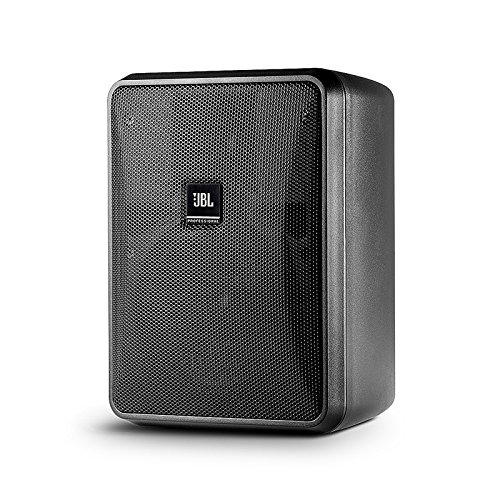
JBL Professional Control 25-1 Compact Indoor/Outdoor Background/Foreground Speaker, Black, Sold as Pair
$457.98 Specs and sizingThe default surface-mount install speaker: 8 ohm or 70V, indoor or outdoor rated, with a bracket that aims it properly. Sold as a pair.
Best for: Under-balcony fills, foyers, cry rooms and side aisles
Check price on AmazonWhat does doubling the distance actually cost?
The rule is constant, and it is cumulative. That cumulative part is what catches people out in a deep room.
Every doubling of distance costs 6 dB, so a listener four times further from a loudspeaker hears it 12 dB quieter, which is roughly half the perceived loudness.
| Distance doubles from | Level change | What it means |
|---|---|---|
| 1 to 2 | -6.0 dB | Halves the perceived loudness roughly every 10 dB, so this is noticeable |
| 2 to 4 | -6.0 dB | Cumulative: 12 dB down from the first position |
| 4 to 8 | -6.0 dB | 18 dB down, which is a quarter of the perceived loudness |
| 8 to 16 | -6.0 dB | 24 dB down. This is why deep rooms need delay speakers |
Perceived loudness roughly halves for every 10 dB, so 6 dB is clearly audible but not dramatic. It is the accumulation across a deep room that becomes a problem.
Level at each seat from a typical church loudspeaker
Worked for a 96 dB sensitivity cabinet at two power levels. Find your distance to see what arrives there.
A 96 dB sensitivity loudspeaker driven with 500 watts produces about 90 dB at 60 feet and about 84 dB at 120 feet, a 6 dB spread across the back half of a large room.
| Distance | Loss from 1 metre | At 100 W | At 500 W |
|---|---|---|---|
| 10 ft | -9.7 dB | 106.3 dB | 113.3 dB |
| 20 ft | -15.7 dB | 100.3 dB | 107.3 dB |
| 30 ft | -19.2 dB | 96.8 dB | 103.8 dB |
| 40 ft | -21.7 dB | 94.3 dB | 101.3 dB |
| 60 ft | -25.2 dB | 90.8 dB | 97.7 dB |
| 80 ft | -27.7 dB | 88.3 dB | 95.2 dB |
| 100 ft | -29.7 dB | 86.3 dB | 93.3 dB |
| 120 ft | -31.3 dB | 84.7 dB | 91.7 dB |
These are free-field figures. A real room adds reflected energy, so a reverberant sanctuary loses less level with distance than this shows and loses intelligibility instead, which is the worse trade.
What levels should a church actually run at?
What rooms measure in practice, with the exposure guidance that goes with them. These are observations, not targets to reach.
Contemporary worship commonly runs 92 to 98 dBA, at which NIOSH allows roughly one hour of exposure before the daily limit is reached.
| Setting | Typical level | Exposure guidance |
|---|---|---|
| Spoken word only | 70 to 78 dBA | No exposure concern |
| Traditional service, hymns and organ | 78 to 85 dBA | No exposure concern |
| Blended service, piano and small band | 85 to 90 dBA | NIOSH: 8 hours at 85 dBA |
| Contemporary worship | 92 to 98 dBA | NIOSH: about 1 hour at 94 dBA |
| Modern, full band | 98 to 102 dBA | NIOSH: about 15 minutes at 100 dBA |
| Youth or student service | 95 to 100 dBA | Offer ear protection at the door |
Offer hearing protection at the door above about 95 dBA, and take a complaint about volume seriously. Hearing damage is cumulative and permanent.
Why a deep room needs more than a bigger amplifier
Consider a room where the front row sits 20 feet from the loudspeakers and the back row sits 80 feet away. That is two doublings plus a bit, so the back row hears roughly 12 dB less than the front. To make the back row comfortable at 85 dBA, the front row has to sit at about 97 dBA. Turning the system up makes both louder and does not change the 12 dB gap at all.
This is the argument for fills rather than power, and it is also the argument for a line array in a genuinely large room. A point source radiates spherically and loses 6 dB per doubling. A line array behaves as a line source in its near field and loses about 3 dB per doubling, which over the same room halves the spread. That is the actual reason large venues use them, rather than raw output. See line array against point source.
For most churches the practical answer is a properly aimed point-source system with front fills such as the QSC K8.2 Active 8" Powered 2000 Watt Loudspeaker and, where there is a balcony, delayed under-balcony fills like the JBL Professional Control 25-1 Compact Indoor/Outdoor Background/Foreground Speaker, Black, Sold as Pair.
Frequently asked questions
How much does sound level drop with distance?
In free field, 6 dB for every doubling of distance, following the inverse square law. A loudspeaker producing 100 dB at 10 feet produces 94 dB at 20 feet and 88 dB at 40 feet. In a real room reflected energy fills in some of that loss, so the level falls more slowly but intelligibility falls instead, which is a worse outcome.
Why is the front row too loud when the back row cannot hear?
Geometry rather than mixing. If the front row is 20 feet from the speakers and the back row is 80 feet, that is two doublings and roughly 12 dB of difference. Turning the system up raises both and leaves the gap unchanged. The fixes are aiming the speakers at the back rows, adding front fills, adding delayed fills, or changing to a line array.
What is loudspeaker sensitivity and why does it matter here?
Sensitivity is the level a loudspeaker produces from one watt measured at one metre, typically 88 to 99 dB for a church cabinet. It sets the starting point for every distance calculation, and every 3 dB of sensitivity halves the amplifier power needed. It is the most overlooked number on a specification sheet and it swamps almost everything else.
How loud should a church service be?
Speech-only services sit comfortably at 70 to 78 dBA, traditional services at 78 to 85, blended at 85 to 90 and contemporary worship at 92 to 98. Above about 92 dBA hearing exposure becomes a real obligation: NIOSH allows about an hour at 94 dBA and about fifteen minutes at 100. Offer ear protection at the door above about 95.
Does a line array really lose less level with distance?
In its near field, yes. A point source radiates spherically and loses about 6 dB per doubling, while a line source loses about 3 dB per doubling until the array transitions to far-field behaviour. Over a deep room that halves the front-to-back spread, and it is the real reason large venues use arrays rather than simply more boxes.
Do reflections make the back of the room louder?
They add level, which sounds helpful and usually is not. Reflected energy arrives from every direction and at varying delays, so it adds loudness without adding clarity and often reduces intelligibility. A reverberant room measures higher at the back than the inverse square law predicts while being harder to understand, which is why treating the room matters more than the level does.
Researched, not professional advice. This page is compiled from published manufacturer specifications, operator manuals, FCC rules, published standards and owner-review consensus, not hands-on testing. Sound system design, rigging loudspeakers overhead, and any electrical work are jobs for a qualified professional: have flown loudspeakers and their attachment points signed off by a structural engineer or a certified rigger, and have all wiring done by a licensed electrician to your local code. Wireless microphone rules change, so confirm the current FCC position before buying. As an Amazon Associate we earn from qualifying purchases.